

A quick note before the list: every name here made the cut because it's describable in plain terms and reasonably well established, not purely because it's a popular search term.
Some names that get searched a lot don't actually have one consistent, real technique behind them — we address those honestly near the end rather than inventing a definition to fill space.
Use the filters to narrow the list by family or difficulty, or jump straight to a section from the index below. Difficulty runs easiest-first inside each family, so browsing by family is the fastest way in.
- Lying face to face (20)
- On top (26)
- Rear entry (17)
- Standing (15)
- Side-lying and scissors (7)
- Oral and mutual (2)
- Inversions and advanced (26)
Lying face to face
Missionary and everything built on it — legs up, folded back, wrapped, twisted, and lifted onto furniture. Face-to-face contact is the common thread; depth and flexibility demands vary widely. Read the face-to-face family guide.
Missionary
The most common named position by far, and the one most other lists skip explaining because it's assumed to be obvious: one partner lies on their back, the other on top facing them, kneeling or lying between their legs. It allows for close eye contact, kissing, and full-body contact throughout.
It's also more variable than it gets credit for — the receiving partner's legs can stay flat, bend up, wrap around the top partner, or rest on their shoulders, and each of those changes the angle and depth noticeably. Low on required flexibility or strength for either partner, which is a lot of why it's stayed the default. For a full breakdown of those leg-position variations, see our missionary position guide.
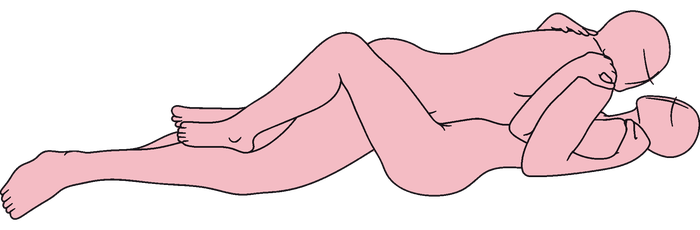
Face to face, one partner on top — the most common default, and more variable than it looks.
Wrapped Missionary
The receiving partner lies flat on their back while the other partner lies on top between their legs, propped on the forearms with legs extended behind and faces close together.
The receiving partner's legs wrap up around the top partner's waist and lower back, one foot hooked high near the buttocks and hands gripping the upper back. A straightforward, close-contact variant on standard missionary.
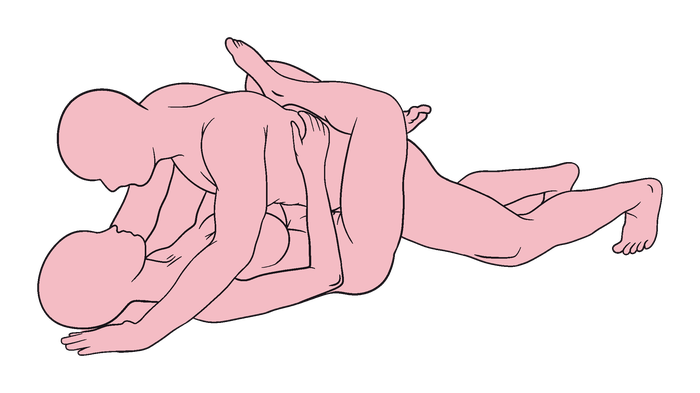
Missionary with the receiving partner's legs wrapped high around the top partner's waist and lower back.
Guard
The receiving partner lies on their back with shoulders and head on the floor and hips lifted onto the lap of the other partner, who kneels upright between their legs.
The receiving partner's knees bend with legs wrapped around either side of the kneeling partner's torso; the kneeling partner grips a thigh and buttock with both hands while the receiving partner reaches around to hold their leg. With the hips resting on the lap, the lift is supported rather than held, so it costs less than it looks.
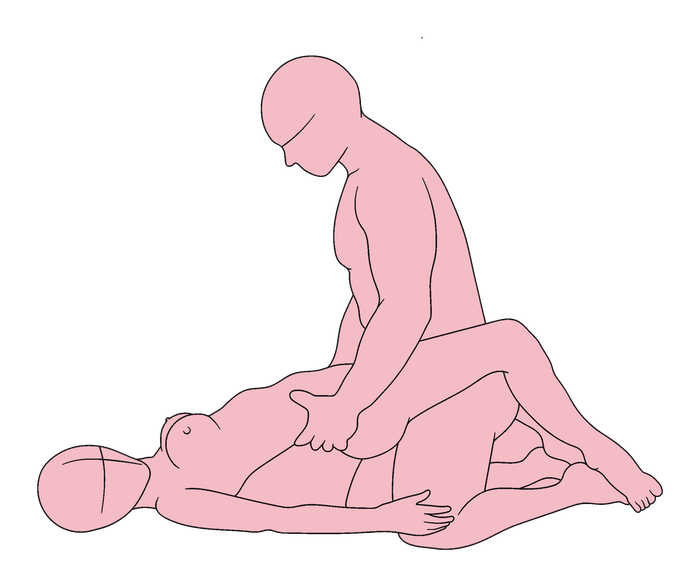
The receiving partner's hips rest on the kneeling partner's lap, legs wrapped around their torso, shoulders on the floor.
Lazy Butterfly
The receiving partner lies back in front of the other partner, who kneels upright, with head and shoulders low, back arched and hips lifted onto the kneeling partner's lap.
One leg hooks around the kneeling partner's side while the other extends toward the floor, and the kneeling partner grips the receiving partner's arm to keep the suspended arch steady. A supported arch rather than a strenuous one — the handhold is what makes the lifted-hip angle sustainable.
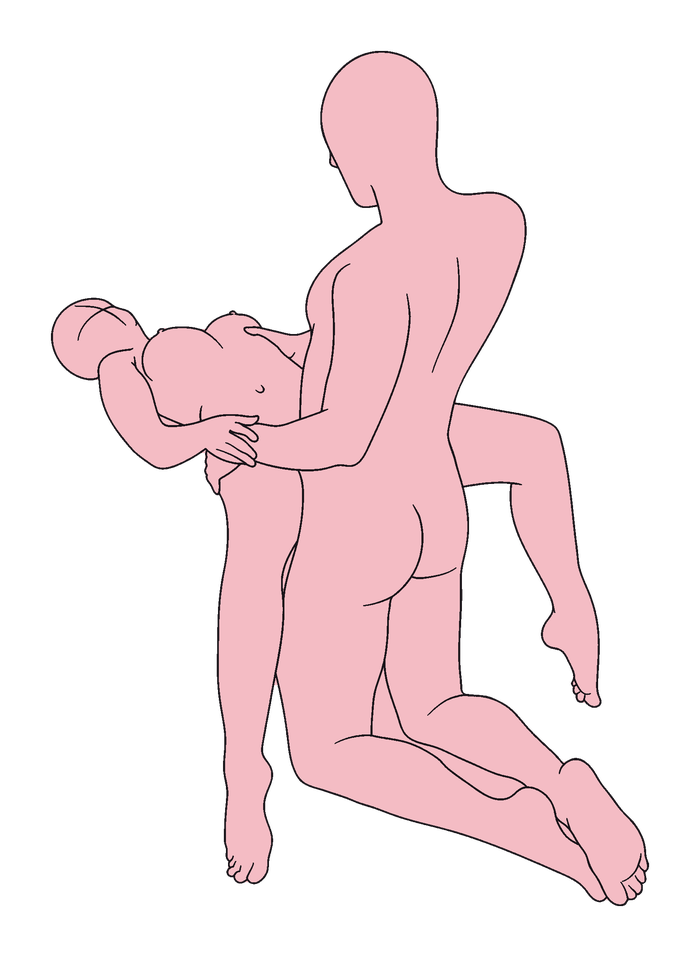
The receiving partner arches back with hips on a kneeling partner's lap, one leg hooked around their side, steadied by a firm handhold.
Legs on Shoulder
The receiving partner lies flat on their back with legs raised straight up together, calves and feet resting against the kneeling partner's chest and shoulder.
The kneeling partner sits back over their heels between the receiving partner's thighs, gripping the raised legs at the ankle and calf, while one of the receiving partner's arms reaches out to rest on the kneeling partner's thigh. Keeping the legs straight and vertical depends on hamstring flexibility, so allow a soft bend at the knees if needed.
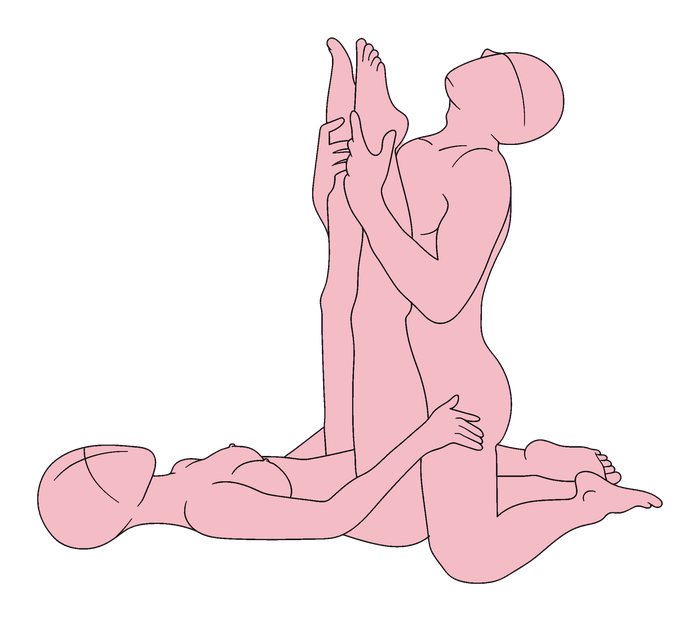
Legs raised straight and held together against the kneeling partner's chest and shoulder.
Single Leg On Shoulder
The receiving partner lies on their back with one leg raised straight up alongside the kneeling partner's shoulder, while the other leg stays bent out to the side with the foot on the floor.
The other partner kneels upright between their legs, head bowed toward them, gripping the raised thigh with one hand as the receiving partner reaches up to their hip. Raising only one leg keeps the hamstring demand modest, making this an easier entry point than putting both legs up.
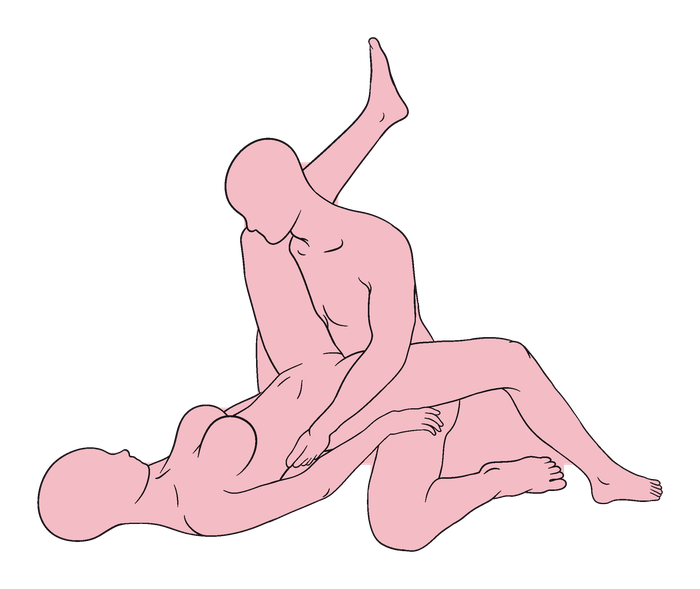
One leg straight up beside the kneeling partner's shoulder, the other bent to the side, foot on the floor.
Twisted Missionary
The receiving partner lies on their back with knees drawn up and both feet in the air, while the other partner lies on top of the receiving partner's pelvis rotated roughly diagonal to their body line.
The top partner keeps the chest low, with torso, outstretched arms, and head extending away to the opposite side, so the two bodies cross in an X at the hips. A hand resting on the top partner's lower back helps keep the position steady.
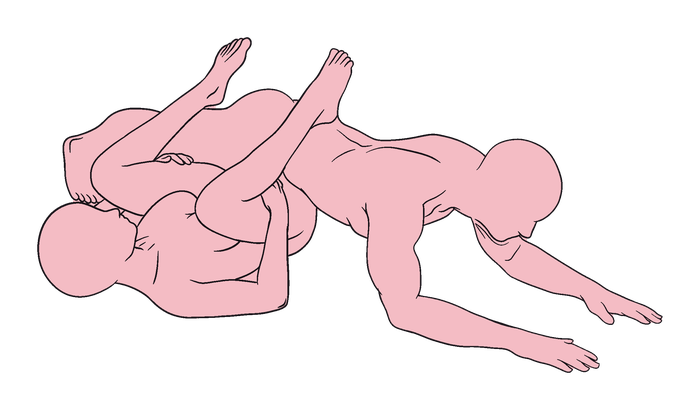
Missionary rotated onto the diagonal so the two bodies cross in an X at the hips.
Kneeling Butterfly
The receiving partner lies on their upper back with hips lifted high onto the lap of the kneeling partner, legs pointing up so the ankles sit beside the kneeling partner's head.
The kneeling partner stays upright but leans over them, gripping a thigh for control, while the receiving partner can reach an arm up toward theirs. Holding the hips elevated puts weight on the shoulders and upper back, so ease in and let the kneeling partner's lap carry most of the load.
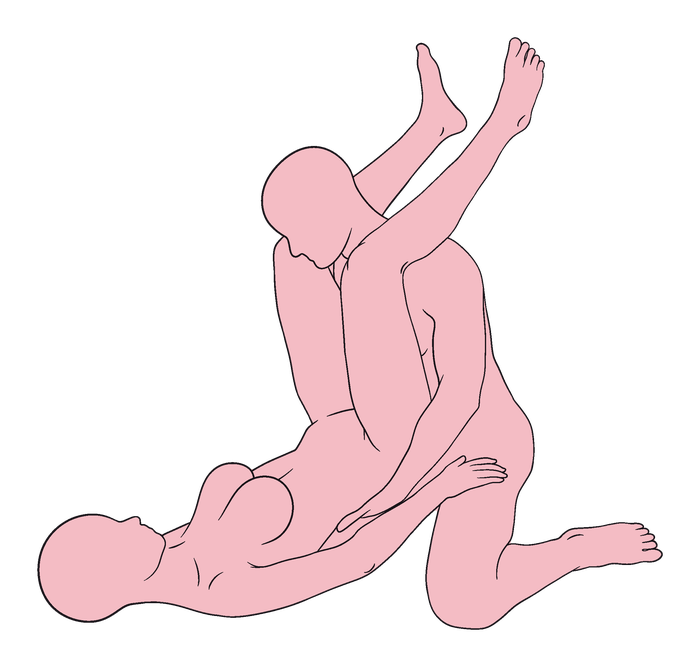
Hips lifted onto a kneeling partner's lap, legs up with ankles beside their head.
Kneeling Splitter
The other partner kneels upright with the receiving partner lying on their back, hips drawn up onto the kneeling partner's thighs.
One of the receiving partner's legs points straight up in front of the kneeling partner's chest, steadied at the ankle, while the other lies bent alongside with the kneeling partner's free hand resting on that thigh. The split between the raised and grounded legs asks for hamstring and inner-thigh flexibility, so bring the vertical leg up gradually.
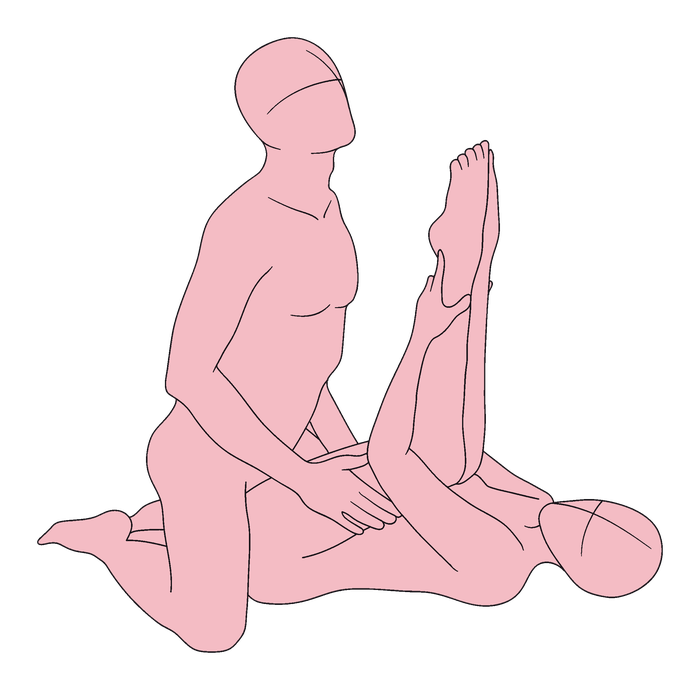
Hips on a kneeling partner's thighs, one leg held straight up at the ankle, the other bent flat beside them.
Folded Missionary
The receiving partner lies flat on their back with both legs together and raised straight up, ankles resting over one of the other partner's shoulders.
The other partner lies extended on top with legs stretched out behind them, propped low over the receiving partner's chest and holding a thigh. Keeping both legs straight and stacked takes real hamstring flexibility, so start with a soft bend in the knees.
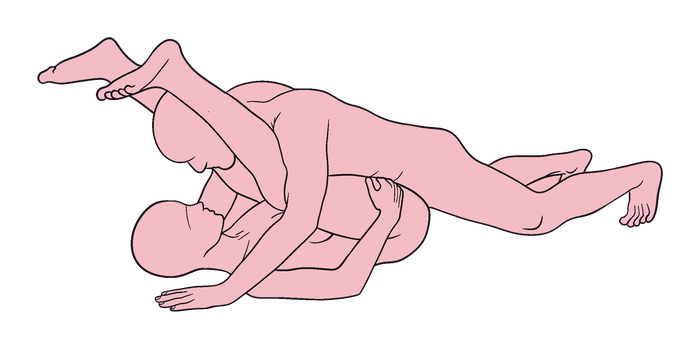
Both legs raised straight up together, ankles over one shoulder, the other partner lying extended on top.
Squatting Twisted Missionary
The receiving partner lies on their back with one leg extended out to the side and the torso twisted slightly toward the other partner, while the other partner squats low over them rather than lying flat, knees bent and weight carried forward on their legs.
One hand braces against the floor for balance and the other rests near the receiving partner's hip, keeping the twist steady. The squat asks real quad endurance from the top partner, so drop to kneeling missionary when the legs tire rather than pushing through it.
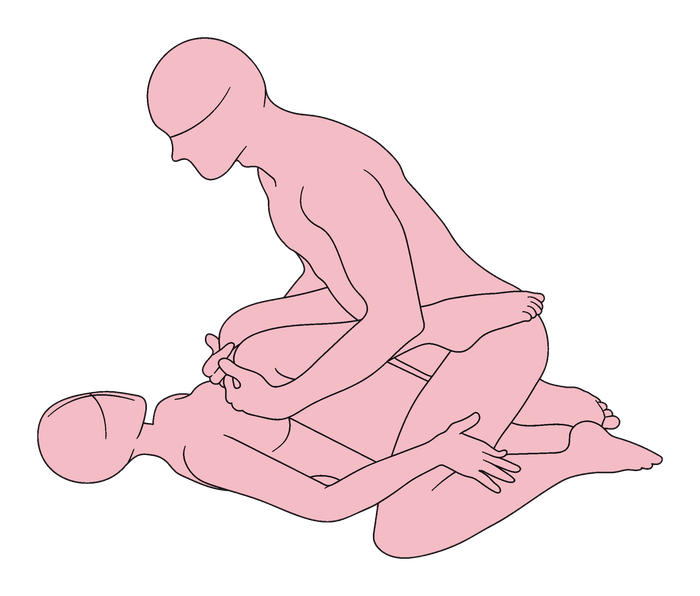
A low squat over a twisted, one-leg-out missionary base — more active than the lying version, with the top partner's legs doing the work.
Mating press
The receiving partner lies on their back with legs pushed up and back toward their own chest and shoulders — further than missionary — typically with the receiving partner's own body weight or the top partner leaning forward doing the work, rather than the top partner holding the legs up with their arms specifically.
It creates a deep, face-to-face angle and reads as more intense and more intimate at once. The deeper the legs push back, the more this asks of the receiving partner's hip and hamstring flexibility — ease in gradually and stop at the first sign of hip or back discomfort.
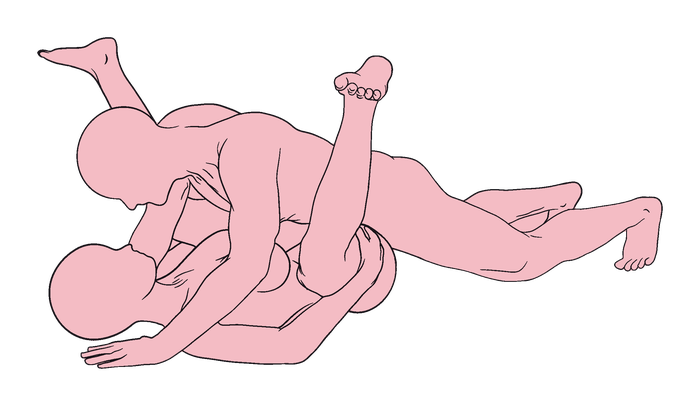
Legs drawn up toward the chest with the top partner pressed forward over them — deep and face to face.
The Erotic V
The receiving partner sits on the edge of a table or counter at roughly hip height, leans back, and lifts both legs up and together over the standing partner's shoulders, bracing on their arms against the tabletop behind them.
The standing partner controls the thrusting angle and pace, usually with hands on the hips or lower back. It asks more flexibility and core strength than most of the easier entries here, and needs a sturdy surface at the right height to work at all.
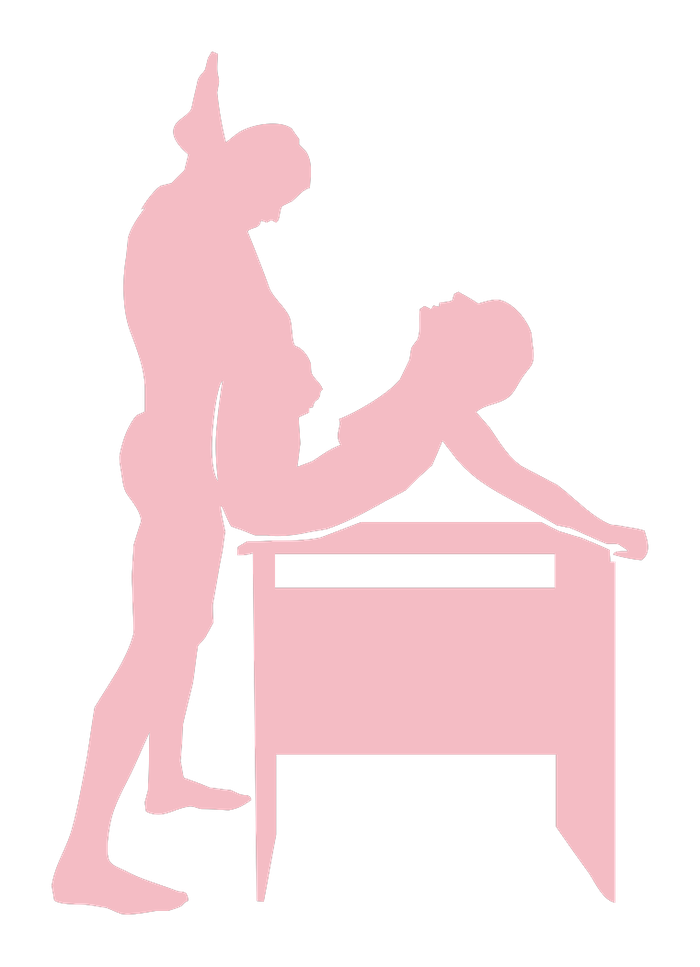
Seated on a table edge, legs braced up over the standing partner's shoulders.
The G-Force
The receiving partner lies on their back and pulls both knees in toward their chest; the other partner kneels in close, holding the feet or ankles, and thrusts forward from that kneeling position while using the grip on the feet for control and balance.
Bringing the feet up against the other partner's chest, rather than just holding the ankles, gives even more leverage and depth — worth trying once the base position feels comfortable.
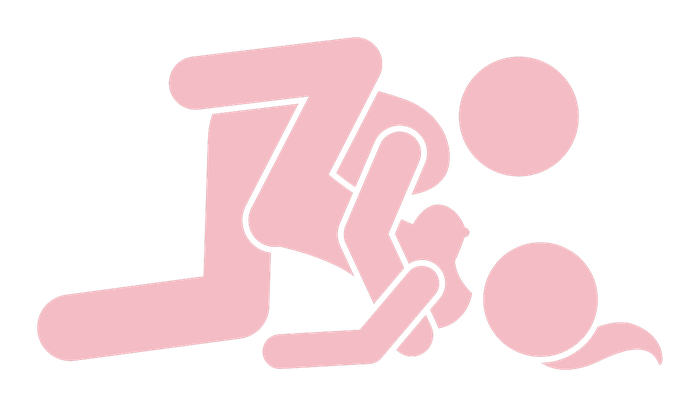
On their back with knees to chest, the kneeling partner holding their feet for control.
Twisted Guard
The receiving partner lies on their back with legs raised around the other partner's body, one foot reaching up near shoulder height and the knees angled off to one side in a twist.
The other partner crouches over the receiving partner's pelvis in a low kneeling lunge — one knee planted alongside, the other leg trailing back — with torso curled forward and head bent down. The twist through the hips asks for some flexibility, so ease into the angle rather than forcing it.
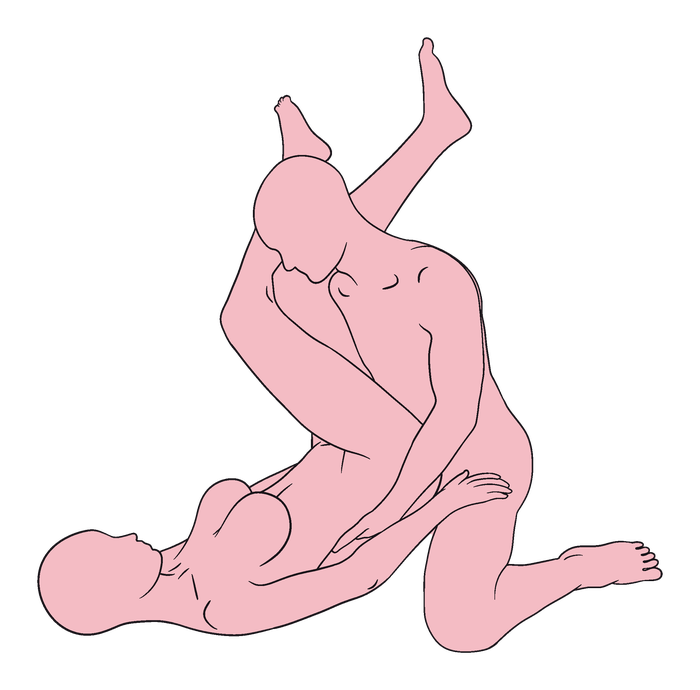
A low kneeling-lunge position with the receiving partner's raised legs twisted off to one side.
Wrapped Guard
The receiving partner lies with head and shoulders on the floor and back arched, hips lifted onto the lap of the other partner, who kneels in a low lunge with the trailing leg stretched back.
The receiving partner's legs wrap around the kneeling partner's waist with an ankle crossed behind them, hands reaching up to rest on the kneeling partner's hip and thigh. Holding the arch through the back takes sustained effort, so settle into it gradually.
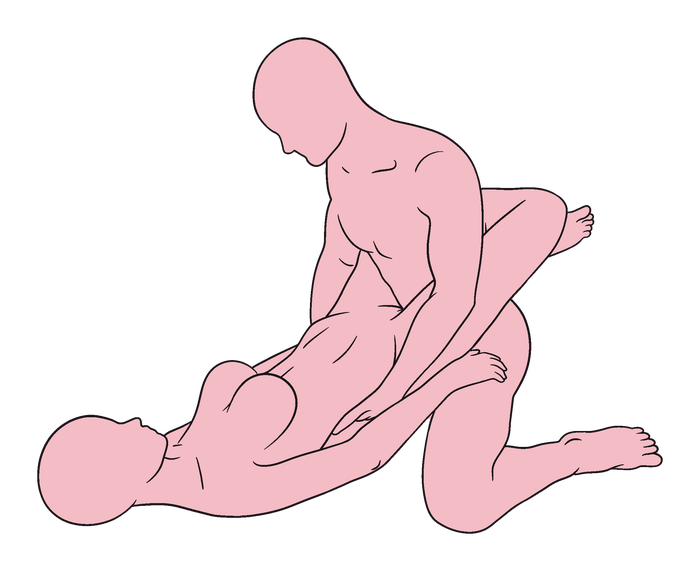
Hips lifted onto a kneeling partner's lap, legs wrapped around the waist with an ankle locked behind.
Folded Saint
The receiving partner lies on their back with legs raised together up the front of the other partner, who kneels upright over them with the raised feet beside their head.
A deep, flexibility-dependent variant in the same family as mating press and anvil, distinguished by how far the legs rise rather than any change in the kneeling partner's position.
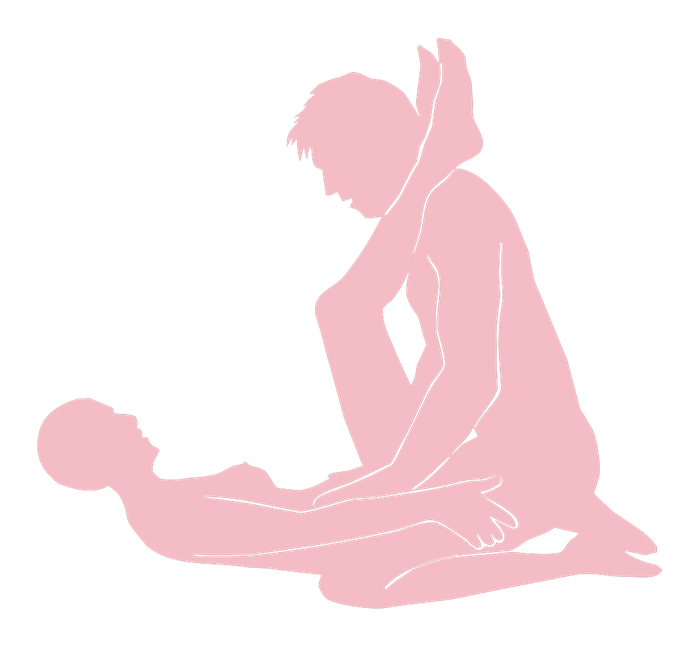
Legs raised together up the kneeling partner's front, feet beside their head — a deep, flexibility-dependent variant.
Saint
The receiving partner arches up into a bridge — weight on hands and feet, chest lifted — while the other partner kneels in close over them, bent down with hands supporting at the hips and faces near each other.
It's a close, demanding variant of Bridge, with the kneeling partner's support doing a lot of the work of holding the arch steady.
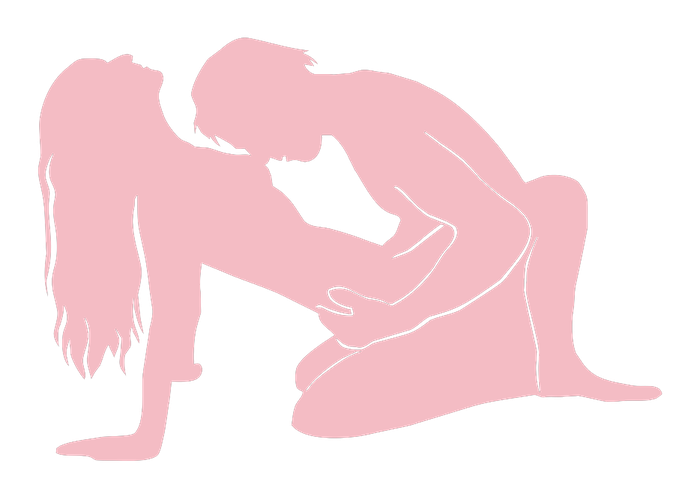
A supported backbend — the receiving partner arched up on hands and feet, held at the hips.
The Butterfly
The receiving partner sits back on a suitable piece of furniture — a bed edge, ottoman, or table — bracing behind themselves while the standing partner steps in close and lifts one leg up against their body.
Getting the angle right matters more than anything else here: the standing partner supports the raised leg and some of the receiving partner's weight, which is also what allows for a deeper thrust. It's a more demanding hold than the Erotic V, since weight is being carried rather than fully braced against the surface.
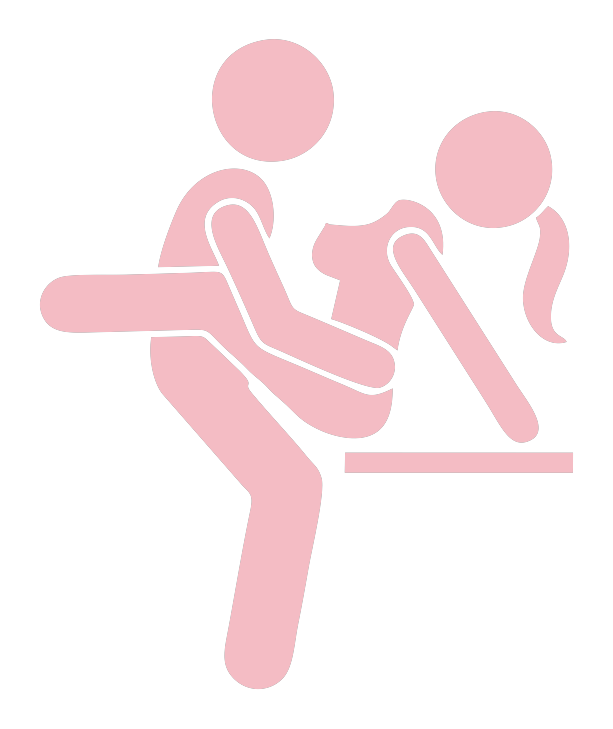
Braced on furniture with one leg lifted against the standing partner — support the leg, then find the angle.
Twisted Anvil
The receiving partner rests on the upper back and shoulders with hips raised into the lap of the other partner, who kneels on one knee and leans over them.
Both of the receiving partner's legs extend up past one side of the kneeling partner's torso, swung together toward the shoulder in a sideways twist, steadied by one hand at the hip and the other gripping the raised thigh. Some weight sits on the neck and shoulders here, so ease in slowly and come out of it at any sign of strain.
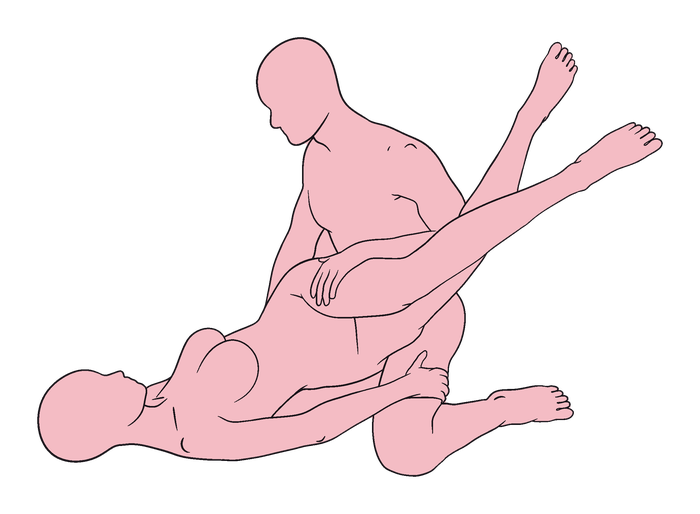
An anvil variant with both legs swung together past one side of the kneeling partner's torso.
On top
The receiving partner is on top and sets depth and pace — cowgirl and its many variants, plus the rodeo, amazon, lap dance, and cradle families. Read the woman-on-top family guide.
Cradle
The seated partner sits upright on the floor with legs spread wide while the receiving partner straddles their lap facing them, one knee raised with the foot planted and the other leg tucked alongside the seated partner's thigh.
Both lean in toward each other face to face, one hand resting on a thigh and the other on a hip. A relaxed, low-effort seated position built for closeness rather than range of motion.
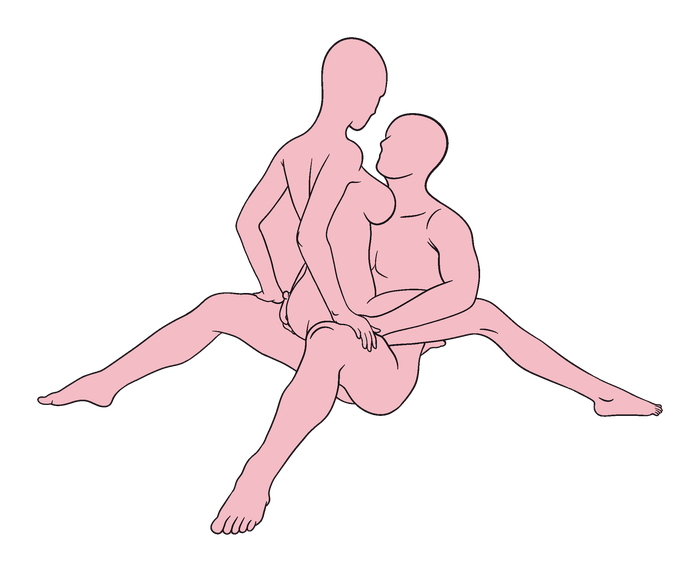
A face-to-face lap straddle on the floor — one foot planted, the other leg tucked alongside the seated partner.
Cowgirl
The receiving partner sits or squats astride the other partner, who's lying on their back, facing them.
It's one of the most commonly named positions for a reason: the partner on top controls depth, angle, and pace directly, rather than that control sitting with the partner underneath. Leaning forward changes the angle noticeably; staying upright leaves the top partner's hands free for additional touch.
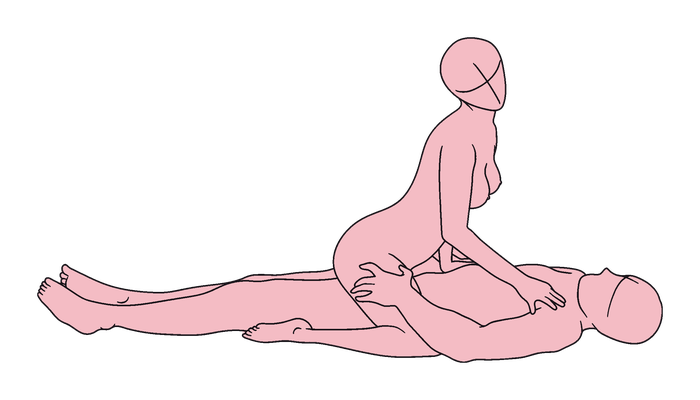
Receiving partner astride, facing the partner underneath — top partner controls depth and pace.
Lap Dance
The kneeling partner sits back on their heels while the receiving partner sits on their lap, both facing the same direction. The receiving partner's legs open wide in front — one extended, one bent — with a hand resting on the kneeling partner's knee, while the kneeling partner wraps both hands around the receiving partner's lower belly from behind.
The receiving partner sets the pace by rocking from the lap; the kneeling partner's knees and heels take sustained load, so a cushion underneath helps.
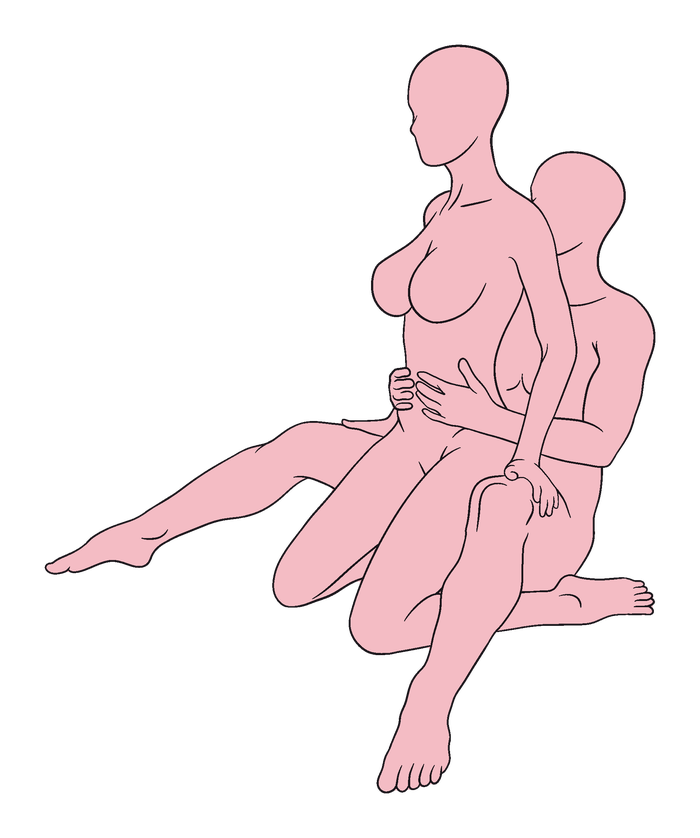
The receiving partner sits on the kneeling partner's lap, both facing forward, legs spread wide, held around the lower belly from behind.
Lotus
Both partners sit facing each other — one cross-legged, the other in their lap with legs wrapped around the seated partner's waist. There's little room for deep thrusting; the motion is closer to rocking or grinding than a full stroke.
It also takes a leaned-back form — the version shown here — with the receiving partner arching away and bracing a hand on the floor behind them, trading eye contact for a deeper angle. Either way it's borrowed from tantra and yoga naming conventions rather than internet slang, needs no equipment, and suits slow, unhurried sessions rather than anything fast-paced.
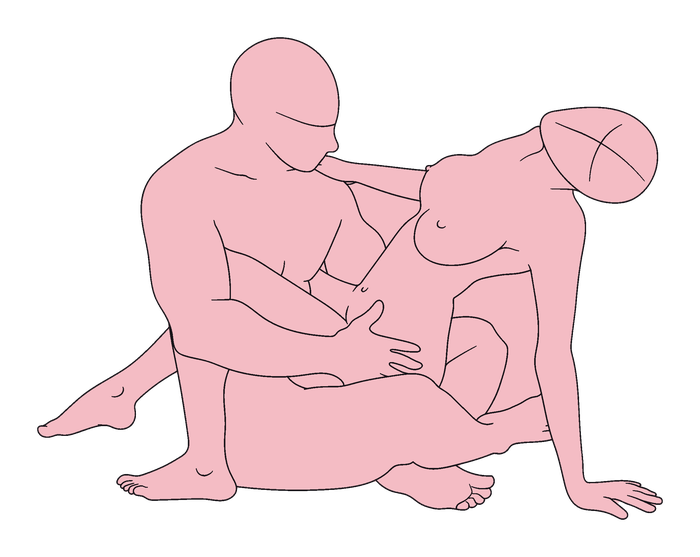
Seated straddle shown leaned back — the same in-the-lap rocking mechanic, arched into a backbend.
Lounging Lap Dance
The reclining partner leans back with hands clasped behind their head and knees bent, while the receiving partner sits upright on their lap facing away, back resting against the reclining partner's chest.
The receiving partner's legs extend down alongside the reclining partner's, hands resting at their sides. With the reclining partner's hands out of play, the receiving partner sets the rhythm entirely.
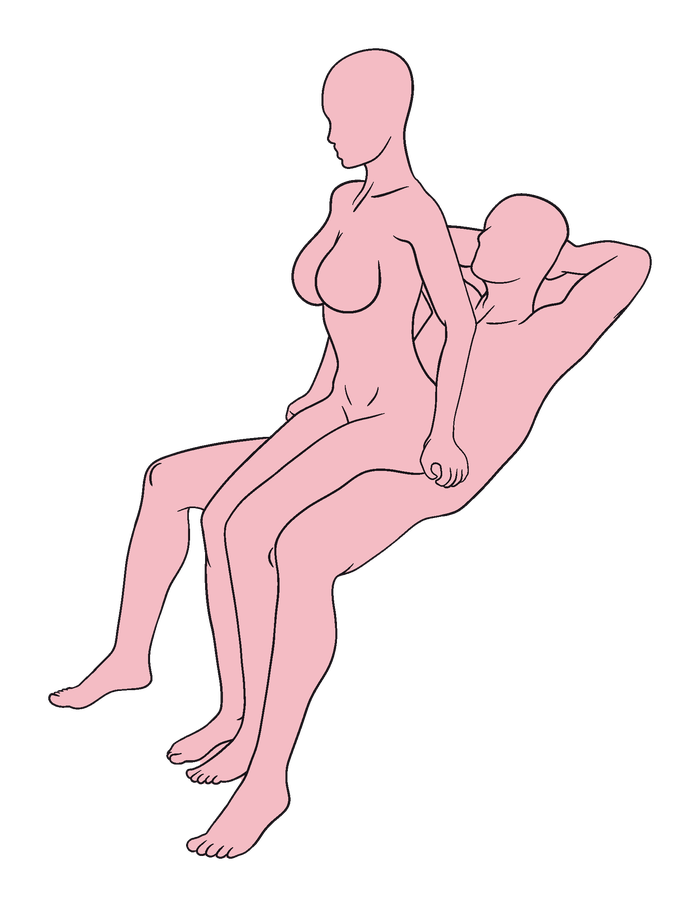
Facing away, the receiving partner sits back against the reclining partner's chest, legs extended, hands resting at their sides.
Lying Reverse Cowgirl
The reclining partner lies flat on their back with legs extended, and the receiving partner reclines on top of them face-up, back resting against the other partner's chest.
The receiving partner's feet plant outside the reclining partner's legs with one knee bent, one hand gripping the other partner's arm near their head for stability.
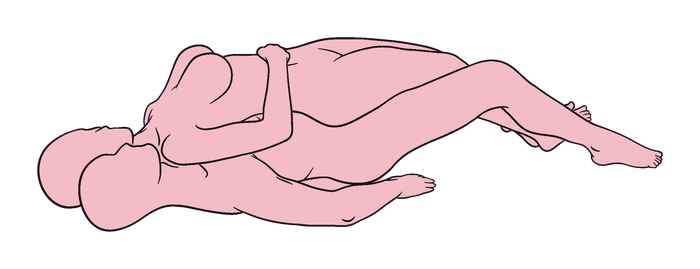
The receiving partner lies back face-up on the reclining partner's chest, feet planted outside their legs.
Prowling Cowgirl
The reclining partner lies on their back with one knee bent while the receiving partner crouches over them on hands and knees, facing them with hips positioned directly above theirs.
One knee plants beside the reclining partner's hip and the other leg stretches back along their legs, keeping the pose low, close, and ready to rock rather than bounce.
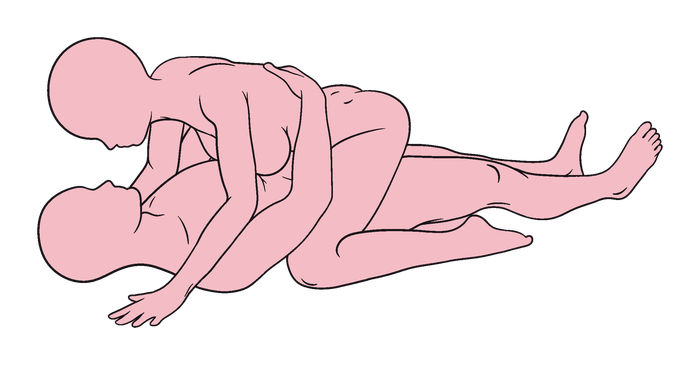
The receiving partner crouches on all fours over the reclining partner, one knee beside their hip, the other leg stretched back.
Reclined Reverse Rodeo
The reclined partner leans back with arms outstretched wide and legs extended forward while the receiving partner kneels astride their lap facing away, lower legs folded back.
The receiving partner rests their hands near their own hips on the reclined partner's thighs, using them as a brace for movement.
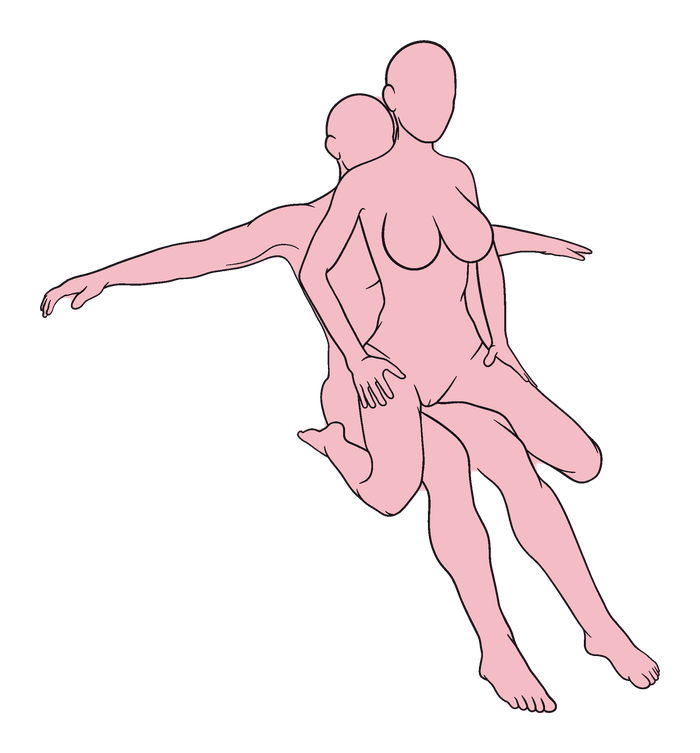
A kneeling reverse straddle over a reclined lap, hands braced on the partner's thighs.
Restrained Cowgirl
The reclining partner lies on their back with one knee raised and the other leg extended wide, while the receiving partner rides upright astride their hips, facing them.
One of the receiving partner's hands rests near the raised thigh; the reclining partner reaches up and holds their other arm behind their back, adding a light restraint element to an otherwise standard upright ride.
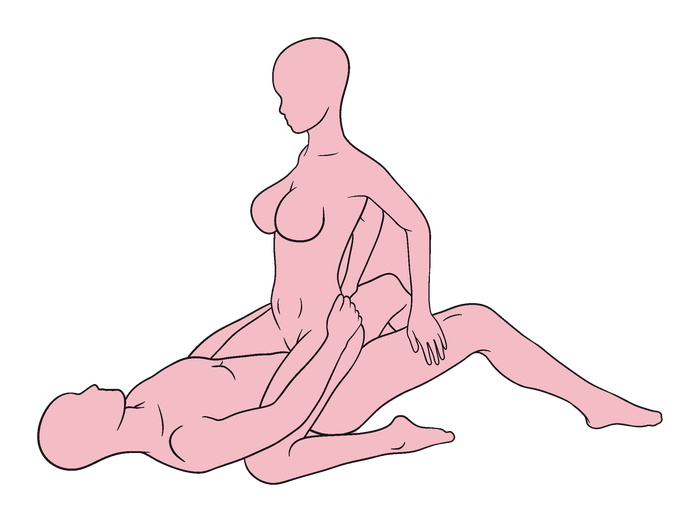
An upright face-to-face ride with one of the receiving partner's arms held gently behind their back.
Reverse cowgirl
The same base position as cowgirl, but the top partner faces away rather than toward the partner underneath. The angle shifts meaningfully because of that change — some people find it hits differently for exactly that reason — and depth and pace still sit with the top partner.
Eye contact and kissing aren't part of this version the way they are with regular cowgirl, which is the main tradeoff.
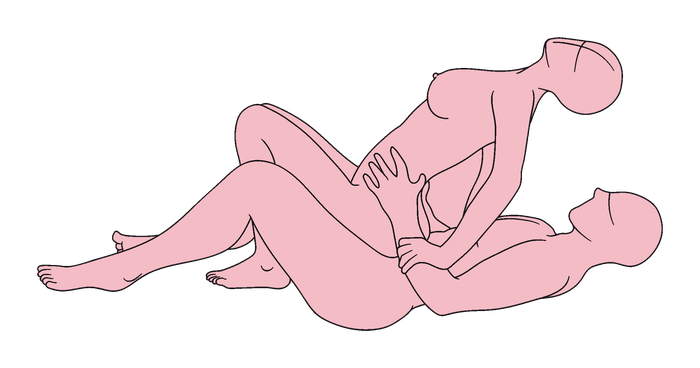
The same base as cowgirl with the top partner facing away — shown leaning back toward the other partner's chest.
Reverse Rodeo
The reclining partner lies flat on their back with legs extended while the receiving partner kneels upright astride their hips, facing the reclining partner's feet with torso vertical.
One of the receiving partner's hands reaches back to rest on the reclining partner's abdomen for support. A straightforward kneeling, facing-away ride in the reverse-cowgirl family, easier on the legs than the crouched versions.
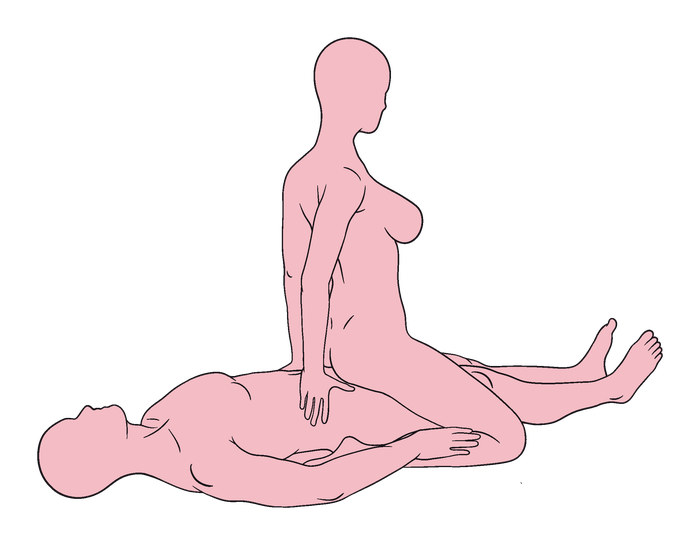
A kneeling, facing-away ride with one hand braced back on the reclining partner's abdomen.
Wrapped Cradle
Both partners sit upright on the floor facing each other with torsos pressed together and faces meeting, arms wrapped around neck and lower back.
The receiving partner's legs drape over the seated partner's thighs while the seated partner keeps one knee drawn up and braces an arm on the floor behind them for stability. Movement stays small and rocking — more a held embrace than an athletic position.
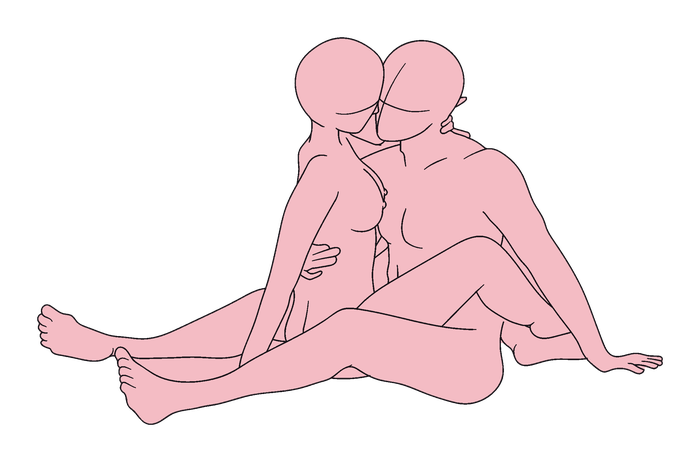
Seated face to face, torsos pressed together, legs draped across the seated partner's lap.
Amazon
The other partner lies on their back with knees folded tightly to the chest, one foot raised against the receiving partner's side, while the receiving partner squat-kneels over the raised pelvis facing them, torso upright.
The receiving partner's hands rest on the backs of the folded thighs, and the reclining partner grips their hip for stability. The classic Amazon on-top arrangement — the sustained squat-kneel works the receiving partner's thighs fast, so shift position before they burn out.
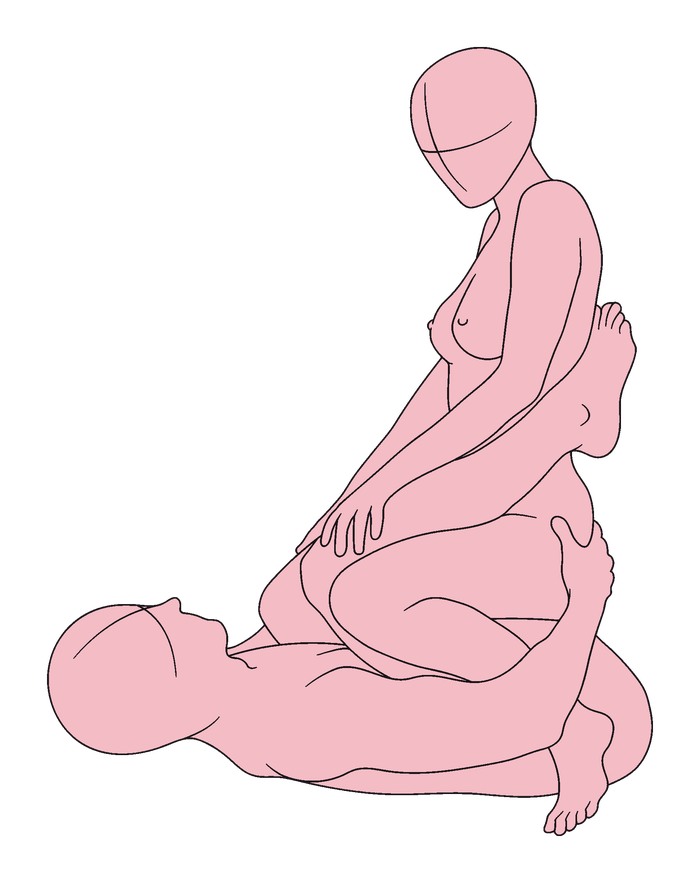
The receiving partner squat-kneels upright over the reclining partner, whose knees fold to the chest with one foot braced at their side.
Reverse Amazon
The lying partner raises both legs bent, feet in the air on either side of the receiving partner, who sits on their hips facing away toward the feet.
Framed between the raised legs — one foot near their chest — the receiving partner keeps one leg folded beneath them and reaches one arm back to brace on the lying partner's torso.
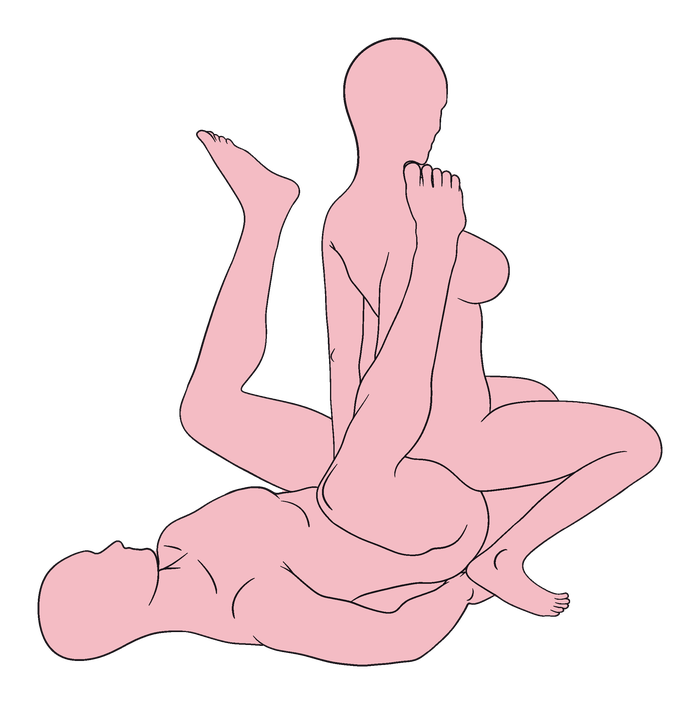
Reverse cowgirl boxed in by the lying partner's raised legs, one arm reaching back to brace on the torso.
Facing Rodeo
The reclining partner lies flat on their back with legs extended while the receiving partner crouches astride their hips, facing them, one knee drawn up high with that foot planted beside the reclining partner's torso.
The receiving partner leans back slightly, bracing one arm on the thigh behind them while the reclining partner's hand supports their seat. The half-crouch loads one leg heavily, so expect the supporting thigh to tire first.
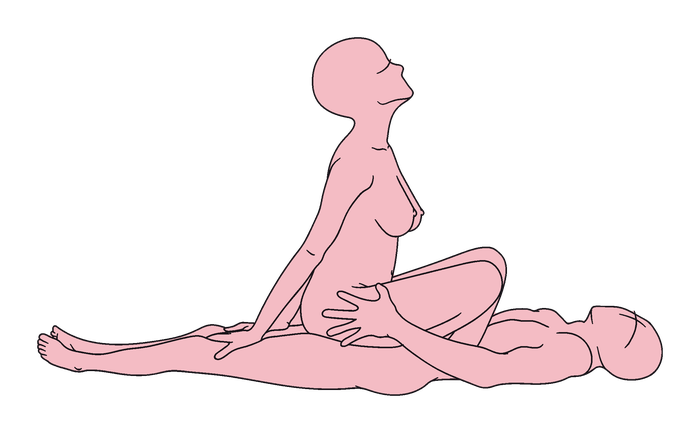
A face-to-face half-crouch ride, one foot planted, leaning back onto the reclining partner's thigh.
Reclined Cowgirl
The reclining partner lies flat with legs extended while the receiving partner sits astride their hips, facing their head.
Rather than riding upright, the receiving partner leans well back with head tilted up, bracing both arms behind them on the reclining partner's thighs with one knee drawn up in front, while the reclining partner rests a hand on that raised thigh. The lean-back shifts the angle and asks steady work from the arms and core, so settle into it gradually.
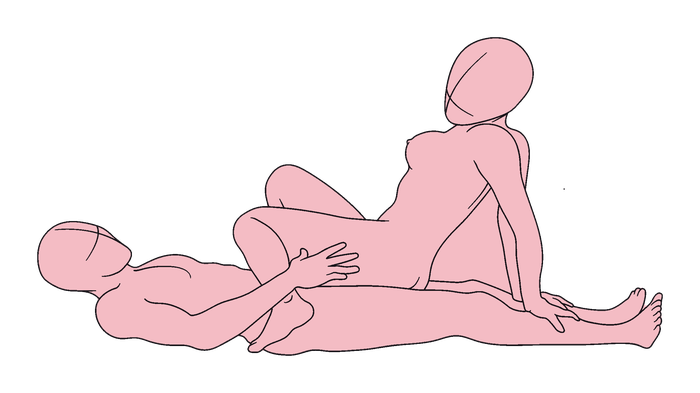
Astride and facing forward, the receiving partner leans well back onto arms braced against the reclining partner's thighs.
Reclined Facing Rodeo
One partner sits reclined, leaning back on straightened arms with knees bent, while the receiving partner sits astride their lap facing them, legs extended past the reclined partner's sides.
The receiving partner wraps both arms around the other's shoulders, keeping their faces close; the reclined partner's arms carry much of the load, so shift positions when they tire.
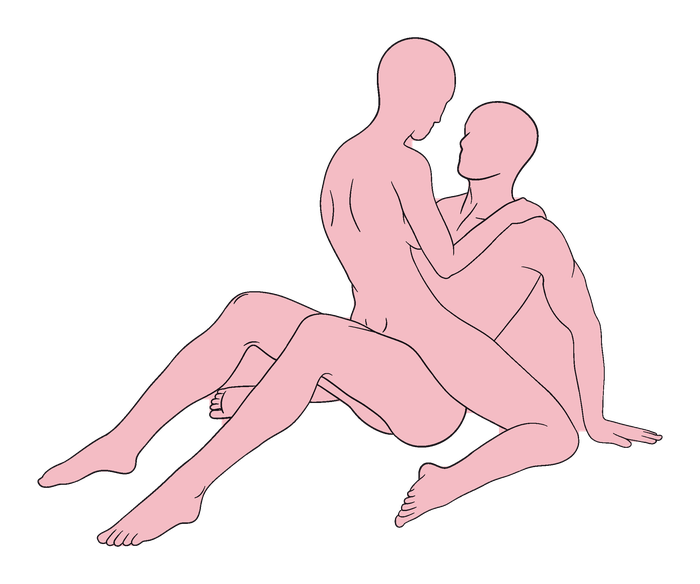
Receiving partner straddles a reclined lap face-to-face, legs stretched past the sides, arms around the shoulders.
Rocking Cradle
The seated partner sits on the floor with legs extended and spread while the receiving partner sits on their lap facing them, leaning back into the seated partner's encircling arms.
One of the receiving partner's legs lifts high, foot in the air, while the seated partner supports their back and raised thigh. The lean-back depends entirely on that arm support, so settle into the recline gradually rather than dropping into it.
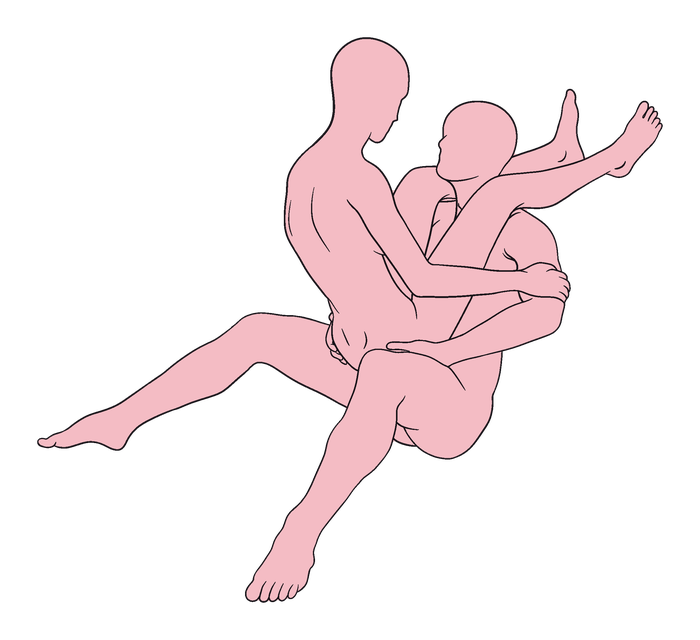
The receiving partner leans back into the seated partner's encircling arms, one leg raised high, back and thigh supported.
Facing Lap Dance
The seated partner sits with knees bent wide, as if in a chair, while the receiving partner sits sideways across their lap with one arm hooked around the seated partner's neck.
Both of the seated partner's hands cup the receiving partner's buttocks, supporting from below, while the receiving partner's legs drape down together in front to the floor. The sideways orientation keeps most of the work in the seated partner's hands, which can lift and rock the receiving partner through the motion.
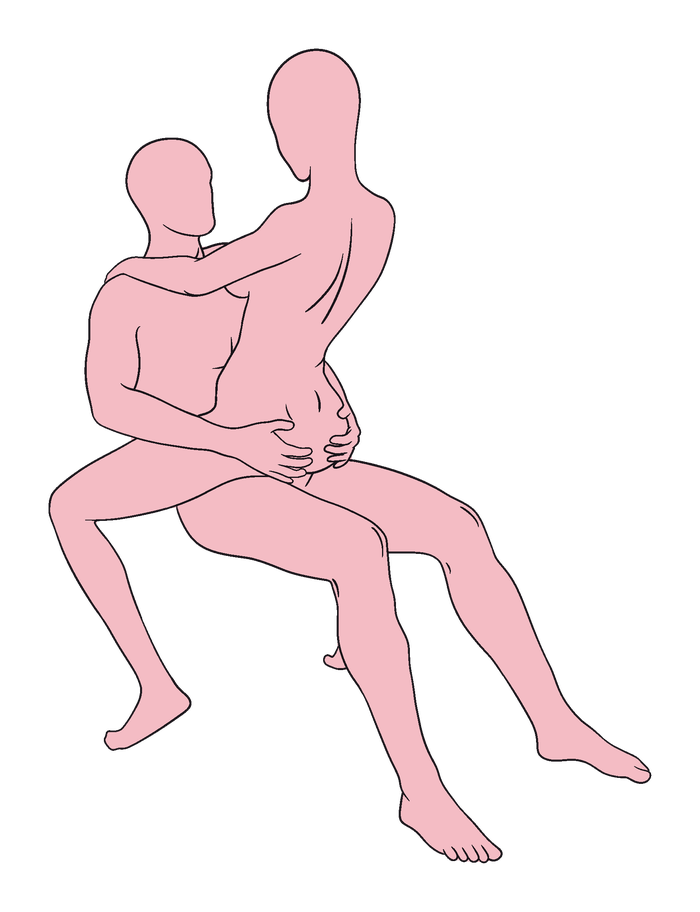
The receiving partner sits sideways across the seated partner's lap, arm hooked around their neck, legs draped together to the floor.
Kneeling Cradle
The seated partner leans back on their hands with legs stretched out in front and one knee raised, while the receiving partner sits sideways across their lap, both legs together and extended along the floor to one side.
The receiving partner twists their upper body to face the seated partner, faces nearly touching; the twist asks something of the spine, so ease into it rather than forcing the turn.
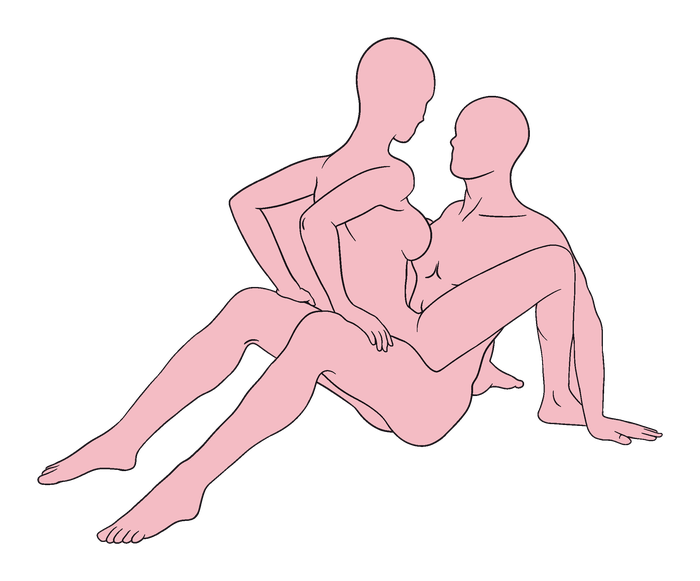
Receiving partner sits side-on across a leaned-back lap, legs together to one side, twisting to meet the other's face.
Squatted Cowgirl
The reclining partner lies flat on the floor with one leg extended and one knee bent while the receiving partner straddles their pelvis facing them, torso upright in a low squat with one leg folded beneath them.
The receiving partner braces one hand back on the reclining partner's bent leg while the reclining partner steadies their hip and thigh. The asymmetric half-squat gives the rider good control but works the supporting leg hard.
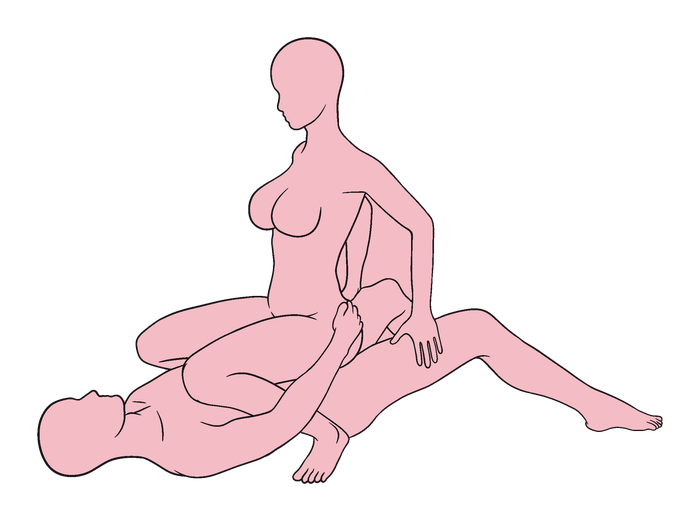
A face-to-face low-squat ride on the floor, one hand braced back on the reclining partner's bent knee.
Upright Reverse Cowgirl
One partner lies flat on their back with legs extended while the receiving partner sits upright astride their hips facing the feet, one hand braced on the lower belly in front of them.
The receiving partner extends one leg forward over the lying partner's body with the knee bent, and the lying partner reaches out to hold that calf for support.
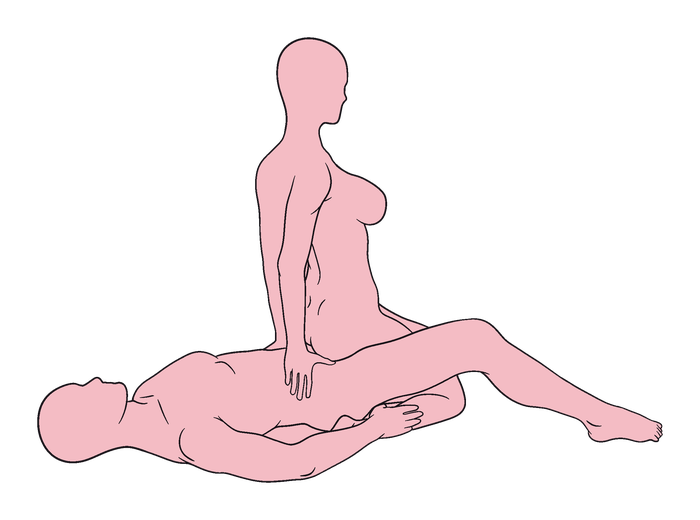
Receiving partner sits tall astride facing the feet, one leg extended forward with the calf held by the partner below.
Folded Cowgirl
The reclining partner lies on their back with one knee bent and foot planted while the receiving partner sits astride their pelvis facing them, torso upright, both legs folded up and extended into the air in front of them.
The reclining partner holds the raised legs at the ankles with one hand and steadies the receiving partner's hip with the other. With neither foot on the floor, balance depends entirely on the receiving partner's core and the reclining partner's grip, so ease into it.
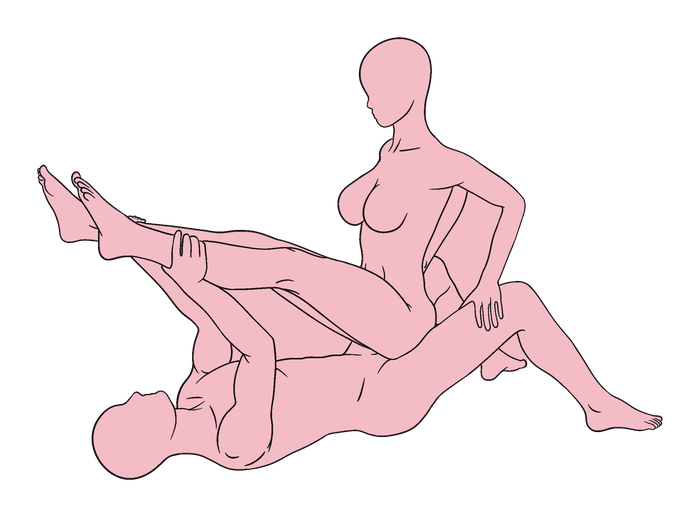
A seated face-to-face ride with both of the receiving partner's legs raised, ankles held by the reclining partner.
Reclined Reverse Cowgirl
The reclining partner lies flat with legs extended while the receiving partner lies back on top of them face-up, head beside theirs and back arched, arms stretched back to the floor above both heads.
The receiving partner's knees bend with feet planted on the floor outside the reclining partner's hips, giving the arch its base. A deeper-arched sibling of lying reverse cowgirl, distinguished by the planted feet and overhead reach, it takes some back flexibility, so ease into the bridge.
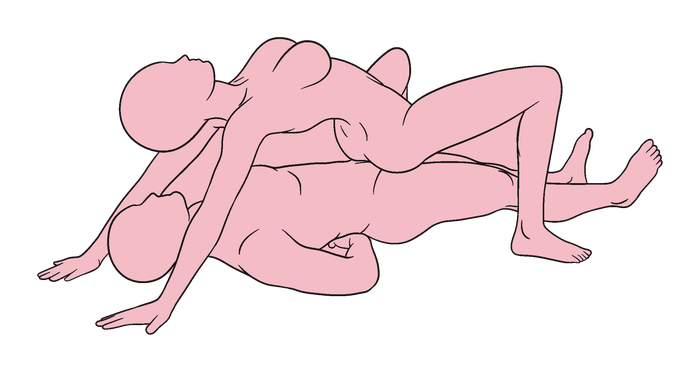
Face-up on top with back arched, feet planted on the floor outside the reclining partner's hips, arms stretched overhead.
Squatted Facing Rodeo
The kneeling partner sits upright back toward their heels while the receiving partner straddles their lap facing them, knees bent and both feet planted flat in a squat.
The receiving partner wraps their arms around the kneeling partner's shoulders with head tipped back, and the kneeling partner steadies them with a hand under the buttock. The sustained squat demands leg strength and balance, so start slow and rest when needed.
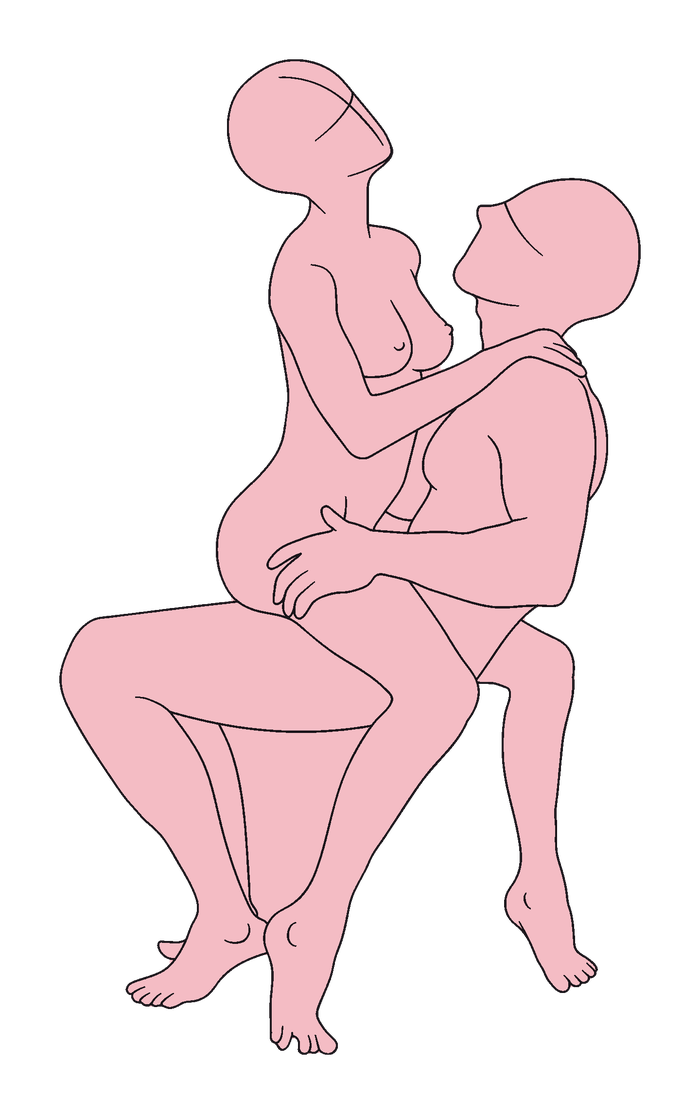
A face-to-face squat over a kneeling lap, arms wrapped around the shoulders, one steadying hand beneath.
Planted Bull
The seated partner leans back with knees bent while the receiving partner's hips rest in their lap, one leg hooked over the seated partner's forearm and the other extended along the floor.
The receiving partner's body twists until the chest faces the floor, head and shoulders resting on the ground away from the seated partner. The twist through the spine is considerable, so rotate into it slowly and come out the moment it strains.
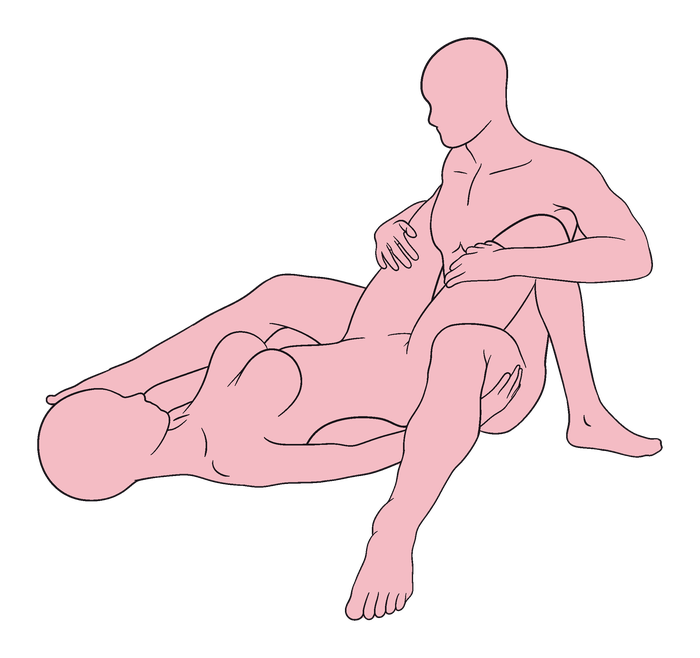
Hips in the seated partner's lap, the receiving partner twists chest-down, shoulders resting on the floor, one leg hooked over a forearm.
Rear entry
Kneeling and lying rear-entry positions — the doggy style, prone bone, and groundhog families, from upright on hands and knees to completely flat. Read the rear-entry family guide.
Kneeling Doggy
The receiving partner is on all fours with arms extended, palms flat on the floor, torso sloping slightly downward.
The other partner kneels upright directly behind their hips with both knees down, hands resting on the lower back and hip. A stable, low-demand rear-entry staple with no real flexibility or strength requirements.
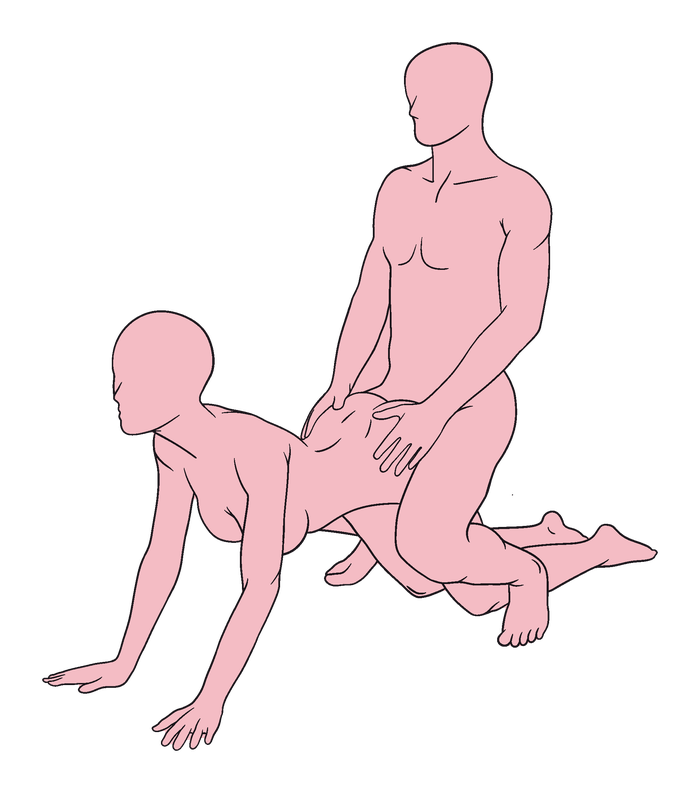
A stable rear-entry staple: one partner on all fours, the other kneeling upright behind their hips.
Lazy Doggy Style
A flatter, lower-effort rear-entry variant — the receiving partner lies chest-down and low to the surface instead of up on hands and knees, while the other partner kneels close behind at a shallower angle.
Less strain on the arms and shoulders than standard doggy style, at the cost of a bit of depth and control.
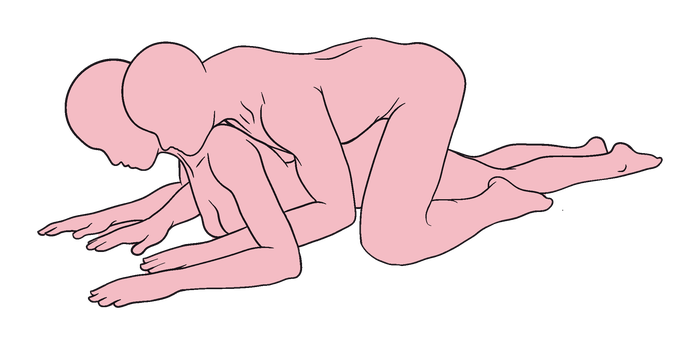
Chest-down and low to the bed — an easier-on-the-arms rear-entry variant.
Leapfrog
A relative of the standard all-fours position: the receiving partner folds forward and drops their chest low while the hips stay high for the partner behind — the same shape as the playground game the name comes from.
That fold changes the angle of entry, and letting the upper body hang rather than holding a tall all-fours takes the strain off the arms.
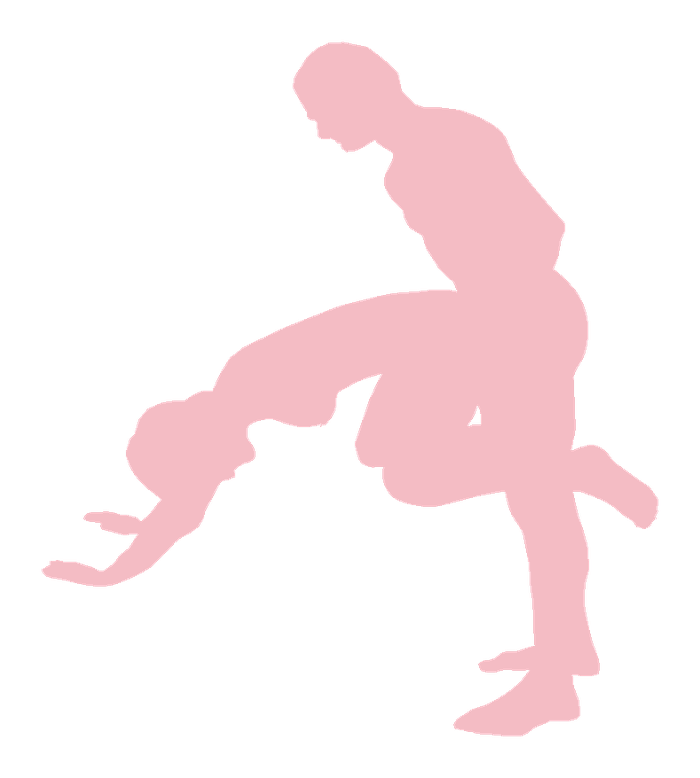
Folded low with hips high for the partner behind — easier on the arms than tall all-fours.
Upright Kneeling Doggy
The receiving partner is on all fours with arms fully extended and back arched, while the other partner kneels directly behind them, torso upright and vertical, both hands gripping the receiving partner's hips and lower back.
Classic doggy style with the kneeling partner sitting tall rather than leaning forward, which keeps both hands free for grip and control.
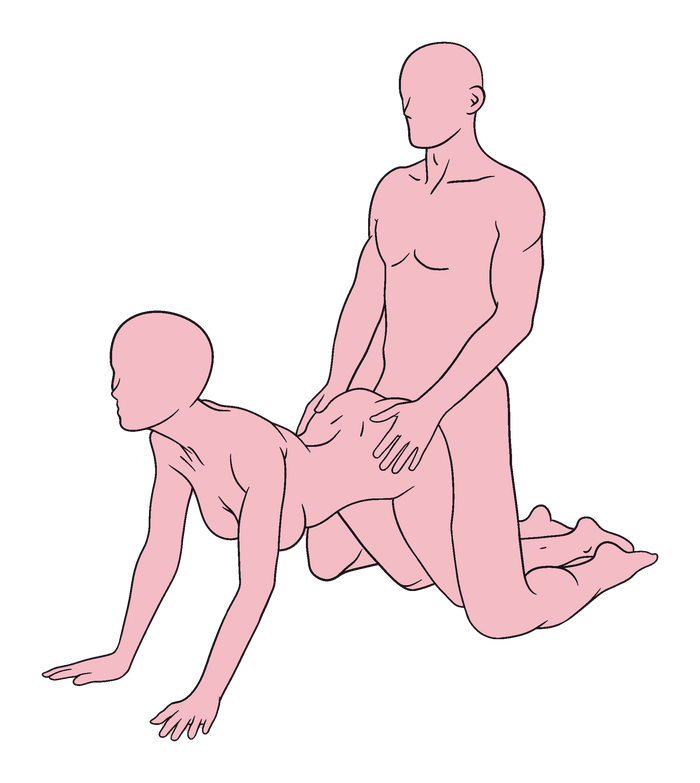
Classic all-fours doggy with the kneeling partner upright and tall, hands on the receiving partner's hips.
Arched Prone Bone
The receiving partner lies flat on their stomach propped on their forearms, while the other partner lies across their lower body facing the opposite way — chest low over the receiving partner's hips, weight propped on a forearm beside their legs.
An unusual reversed take on prone bone: the overlap keeps heavy body contact while the opposite facing changes the angle entirely.
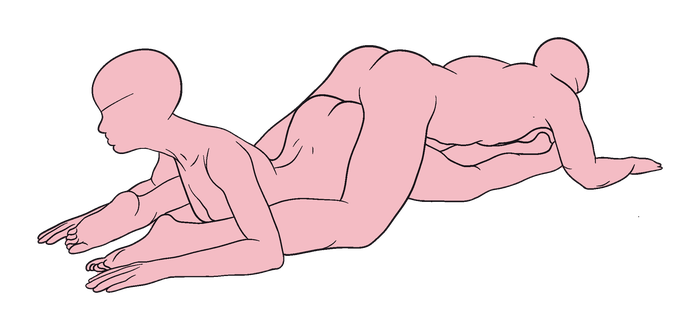
A reversed prone stack — the top partner lies across the receiving partner's hips facing the other way.
Doggy style
The receiving partner is on hands and knees, the other partner kneeling or standing behind. Depth and angle adjust easily depending on how far the receiving partner lowers their chest or arches their back — our leapfrog entry and the bulldog and lazy dog notes in the quick reference below are variations built around that same adjustment.
It's a genuinely versatile default: it doesn't demand much flexibility, adapts to a wide height difference between partners, and leaves the partner behind with their hands free.
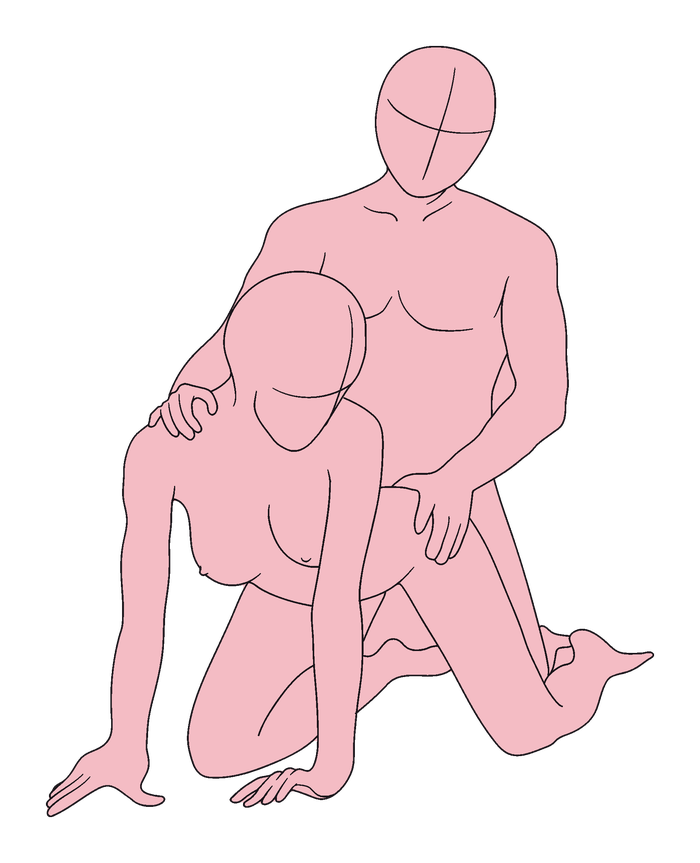
On hands and knees, other partner behind — chest and back angle adjust depth easily.
Kneeling Bodyguard
Both partners kneel upright on the floor facing the same direction, the other partner close behind with chest pressed to the receiving partner's back.
Their arms wrap around the front, one hand resting low on the receiving partner's belly with the receiving partner's hand laid over it, head tilted back against the partner's head and shoulder. The same close rear-entry setup as Bodyguard, brought down to the knees for a lower, more grounded version.
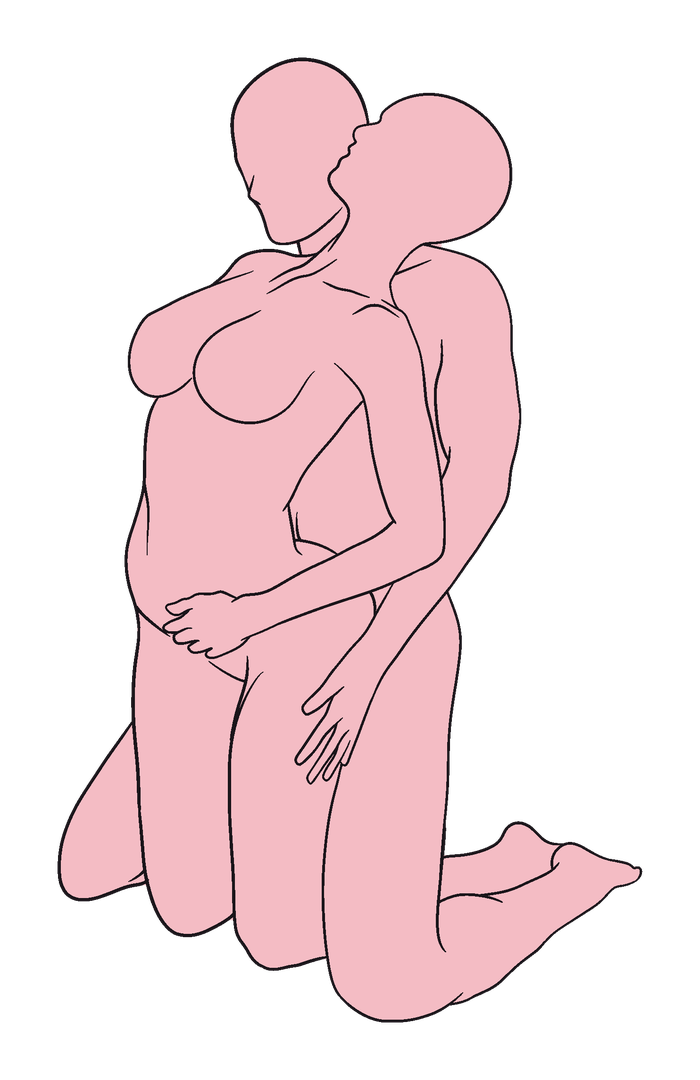
Bodyguard taken to the floor: both partners kneel facing the same direction, chest to back, arms wrapped around the front.
Prone Bone
The receiving partner lies face down propped on their forearms with legs together and extended, while the other partner lies directly on top from behind, legs stretched out over theirs, one knee slightly bent, pelvis pressed to the buttocks.
The top partner carries their weight forward on their arms beside the receiving partner's shoulders — keeping that weight on the arms rather than on the body underneath is the main job here.
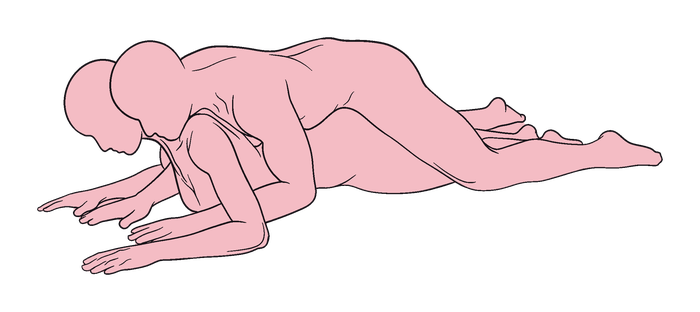
Full-contact prone rear entry: the receiving partner lies flat with legs together, the other partner stretched out on top.
Seated Doggy
The receiving partner is on hands and knees, leaning forward onto their palms, while the other partner sits close behind their hips with one leg folded beneath them and the other knee raised with the foot planted.
A relaxed spin on doggy style — the seated partner rests a hand on the receiving partner's hip and thigh to guide the pace.
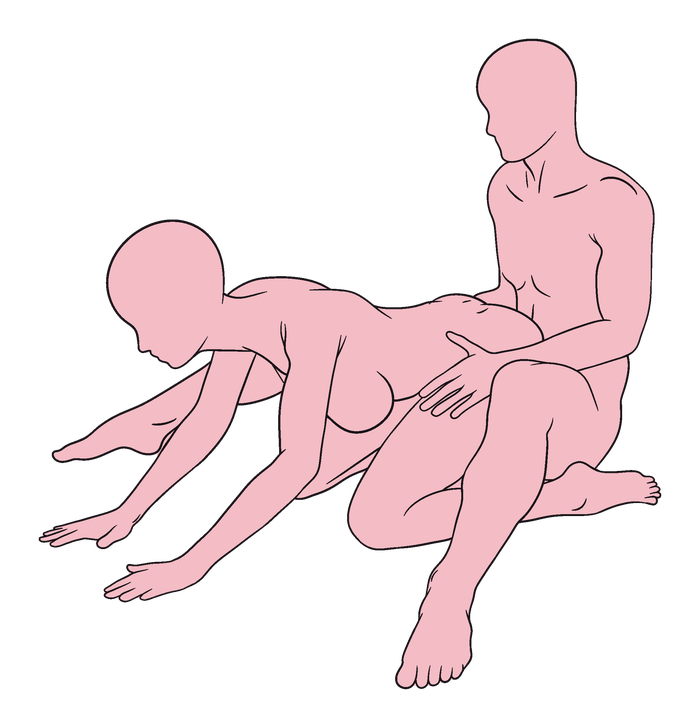
Doggy style with the entering partner seated close behind — one leg folded under, one knee raised.
Upright Prone Bone
The receiving partner lies flat on their stomach propped on their forearms, legs extended behind them, while the other partner kneels upright astride their thighs, sitting slightly back with hands on the receiving partner's buttocks and lower back.
A low-effort take on prone rear entry — the kneeling partner stays tall instead of lying down, keeping hands free and weight off the partner underneath.
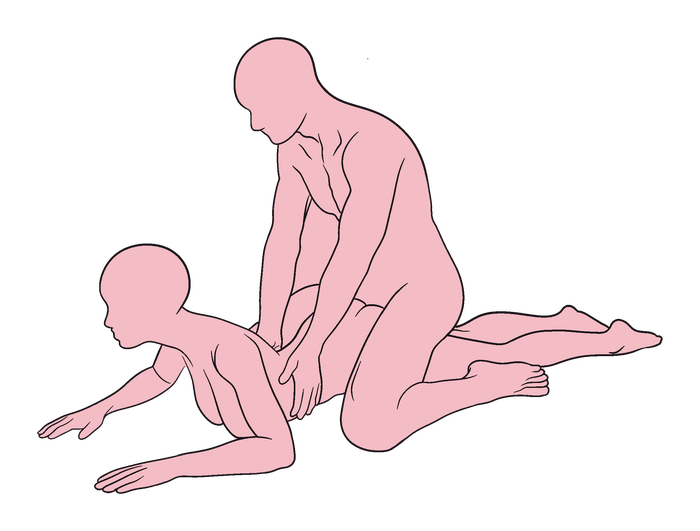
Prone bone with the entering partner kneeling tall astride the receiving partner's thighs.
Kneeling Groundhog
The receiving partner rests their head, chest, and forearms on the floor with hips raised high, while the other partner kneels tall behind them, hands on their lower back, drawing the raised hips against their lap with the receiving partner's legs running alongside the kneeling partner's thighs.
The chest-down, hips-high posture puts a deep arch through the receiving partner's spine and hips, so ease into it gradually.
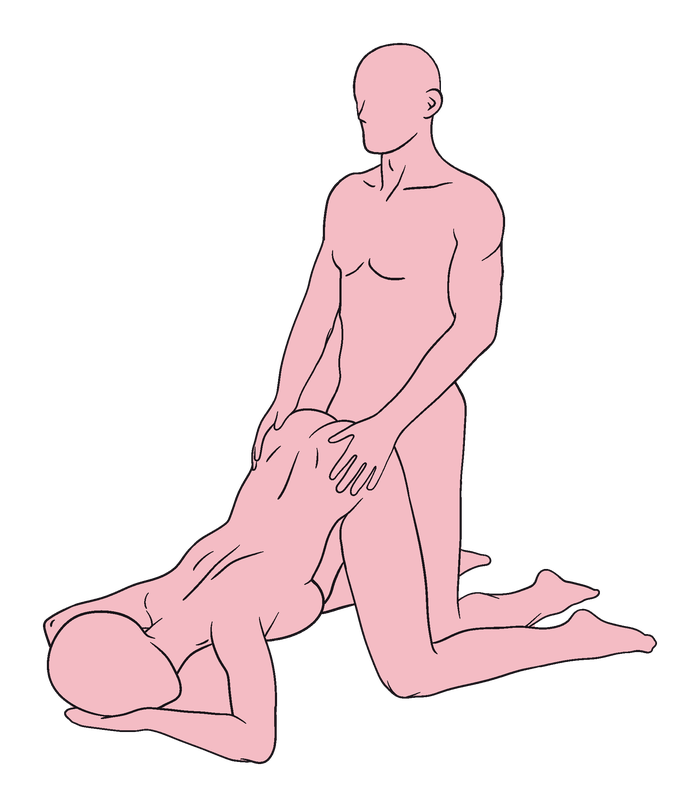
Chest and forearms on the floor, hips raised high and drawn against the tall-kneeling partner's lap.
Kneeling Sideways Doggy Style
The other partner kneels upright with both knees down while the receiving partner lies perpendicular to them, twisted sideways: shoulders, head, and upper back on the floor with hips rolled toward the kneeling partner and raised onto their lap.
The receiving partner's legs extend together across the kneeling partner's front, one arm cradling the lower thigh and the other hand resting on the hip, giving entry from the side and rear. The twist through the receiving partner's spine is real, so settle into the rotation gradually rather than forcing it.
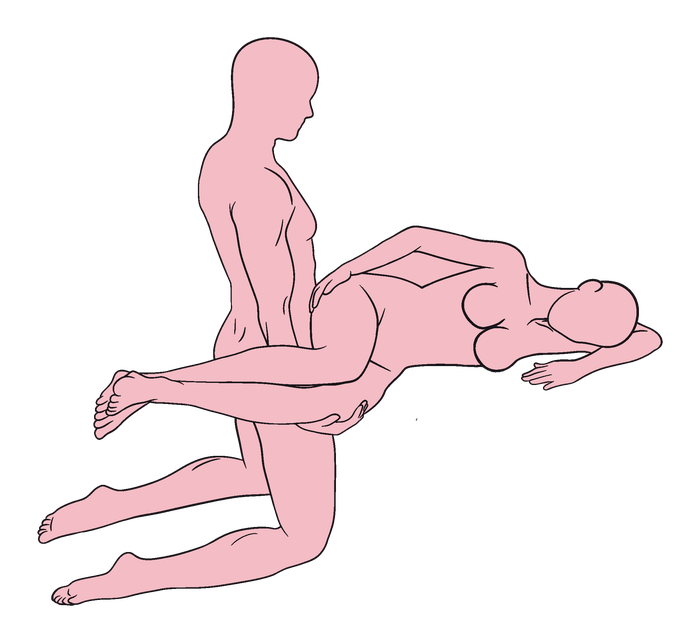
The receiving partner lies twisted sideways, hips raised to the kneeling partner's lap, legs extended together across their front.
Push Up Prone Bone
The receiving partner lies flat on their stomach, legs extended and head resting on folded arms, while the other partner covers them from behind, legs over theirs, torso arched high on straightened arms like the top of a push-up.
The raised hold keeps weight off the receiving partner's back but asks for steady arm and core strength — drop to forearms when it fatigues.
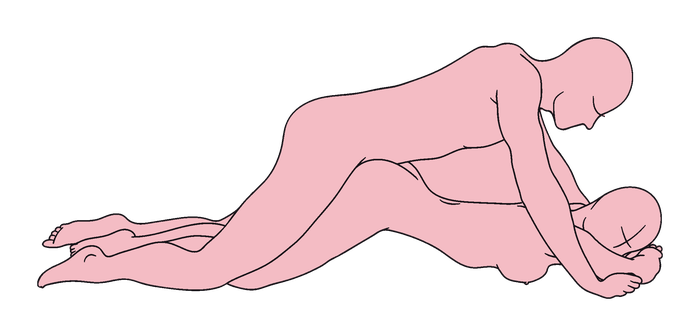
Prone rear entry with the top partner arched high on straight arms in a push-up hold.
Snared Groundhog
The receiving partner lies in a low prone sprawl, chest and forearms on the floor with hips raised, while the other partner kneels upright astride their thighs from behind, one hand gripping the receiving partner's raised foot.
The receiving partner's other foot presses against the kneeling partner's torso, hooking them in place — the detail that separates this from a standard Groundhog. The full knee bend takes some flexibility, so build up to it gradually.
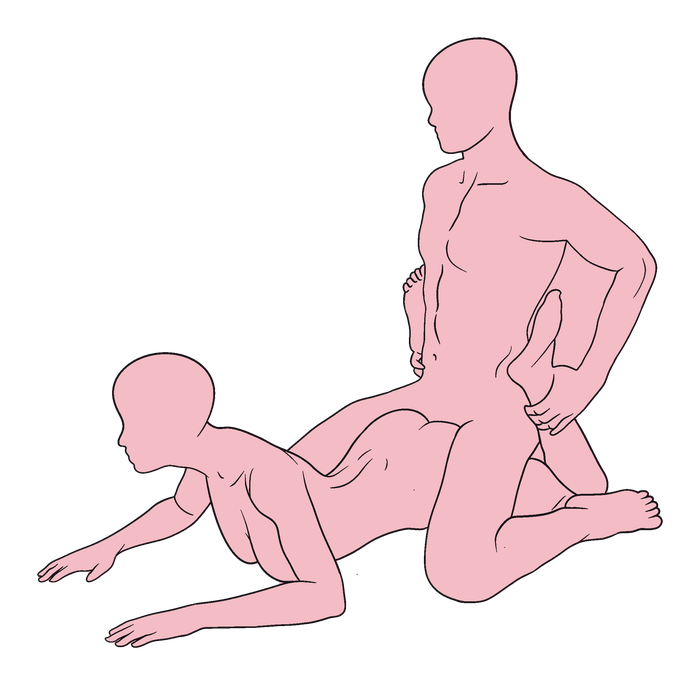
A Groundhog variant where the receiving partner's feet press against the kneeling partner's torso, hooking them in place.
Groundhog
The receiving partner lies flat on their stomach with legs extended straight and upper body propped on their forearms. The other partner squats over the back of their thighs facing the same direction, feet planted flat and knees deeply bent, reaching down to grip the hips and buttocks.
That deep squat asks a lot of the squatting partner's legs and balance, so ease in and swap to a kneel when they tire.
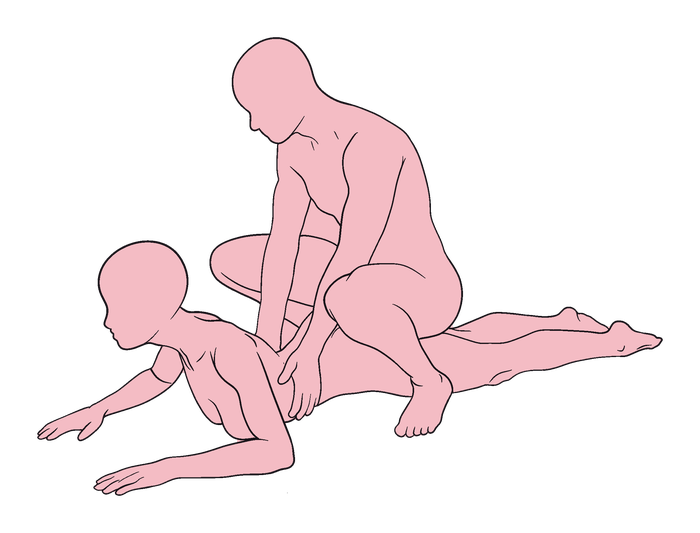
A prone position with the other partner in a deep squat over the receiving partner's thighs, gripping their hips.
Reclined Groundhog
The receiving partner crouches in a low doggy position on forearms and knees, chest near the floor, while the other partner enters from behind leaning far backward — back arched, head back, weight propped on arms stretched behind them, one foot planted beside the receiving partner and one leg angled over their back.
The deep backward lean demands real back flexibility and arm strength from the reclining partner, so ease into the arch rather than dropping straight into it.
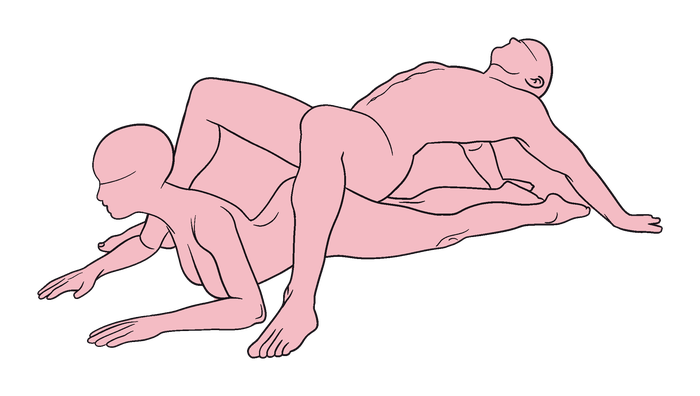
Low doggy underneath; the entering partner arches far back on propped arms, one leg angled over the receiving partner's back.
Standing Groundhog
The receiving partner crouches low and folds forward, head down with hands and forearms near the floor, one knee bent deeply underneath while the other leg extends straight back at hip height.
The other partner stands astride from behind in a forward lean, knees bent into a shallow lunge, gripping the receiving partner's hips and raised thigh for rear entry. Holding one leg extended at hip height from a deep crouch takes hamstring flexibility and hip strength — lower the leg whenever it starts to shake.
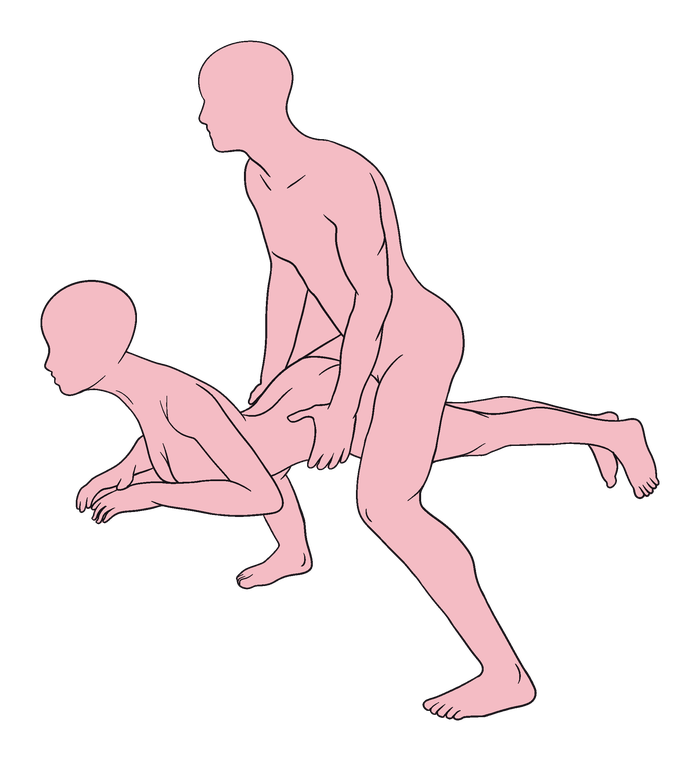
A low crouch with one leg extended straight back at hip height, the standing partner lunging astride from behind.
Standing
No bed required. Standing embraces, standing rear entry, and the dancer family — most benefit from a wall, and all of them ask something of your balance. Read the standing family guide.
Bodyguard
Both partners stand facing the same direction, pressed close together — the receiving partner leans back against the other's chest with head tilted back onto their shoulder, while the standing partner wraps an arm around and enters from behind.
Works well against a wall for extra stability. One of Clove's favorite positions — it pairs well with a toy against the front, and a mirror facing the pair adds a visual element neither partner gets to see in most other positions.
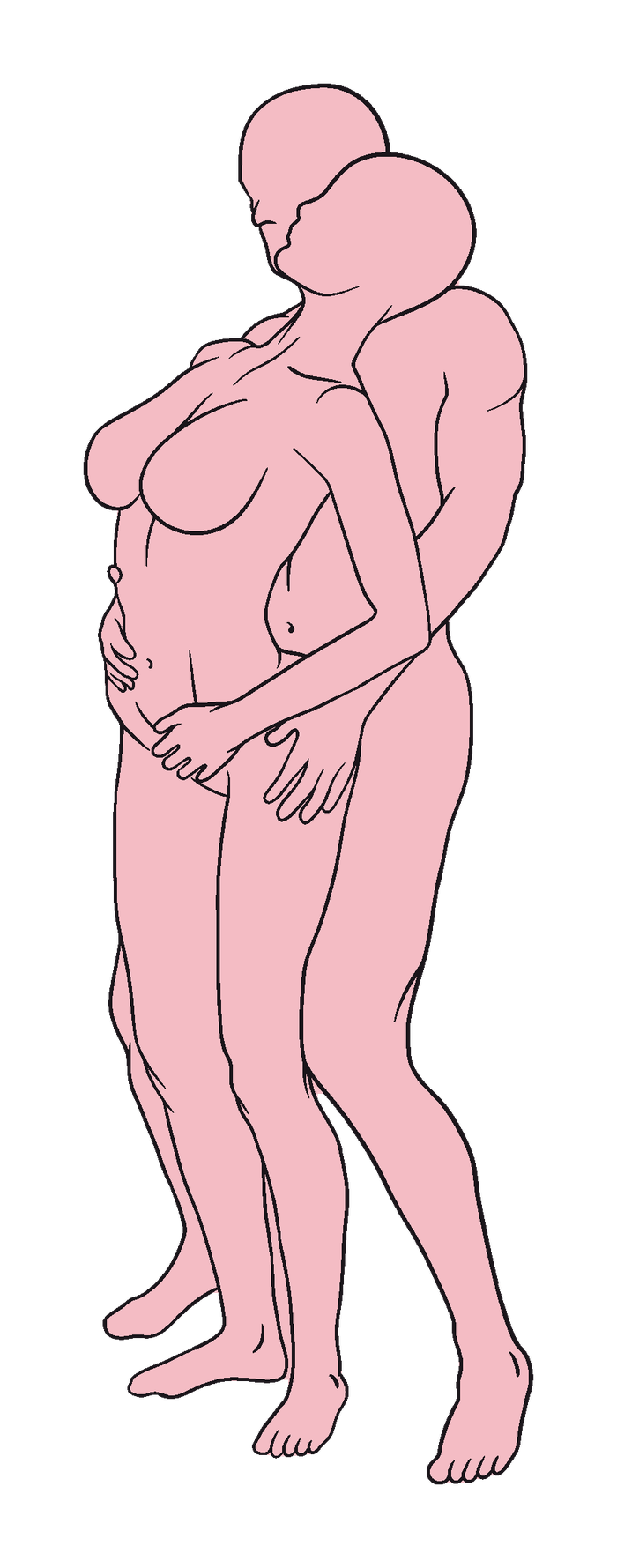
Standing chest-to-back embrace — the other partner wraps around from behind, a wall adds stability.
Supported Dancer
Both partners stand face to face in a close embrace, faces together. The receiving partner lifts one leg with the knee bent and hooks it around the standing partner's hip, and the standing partner supports them with a hand cupped under the buttock.
With both of the standing partner's feet and the receiving partner's standing leg sharing the load, this is a comparatively steady entry point to the standing Dancer family.
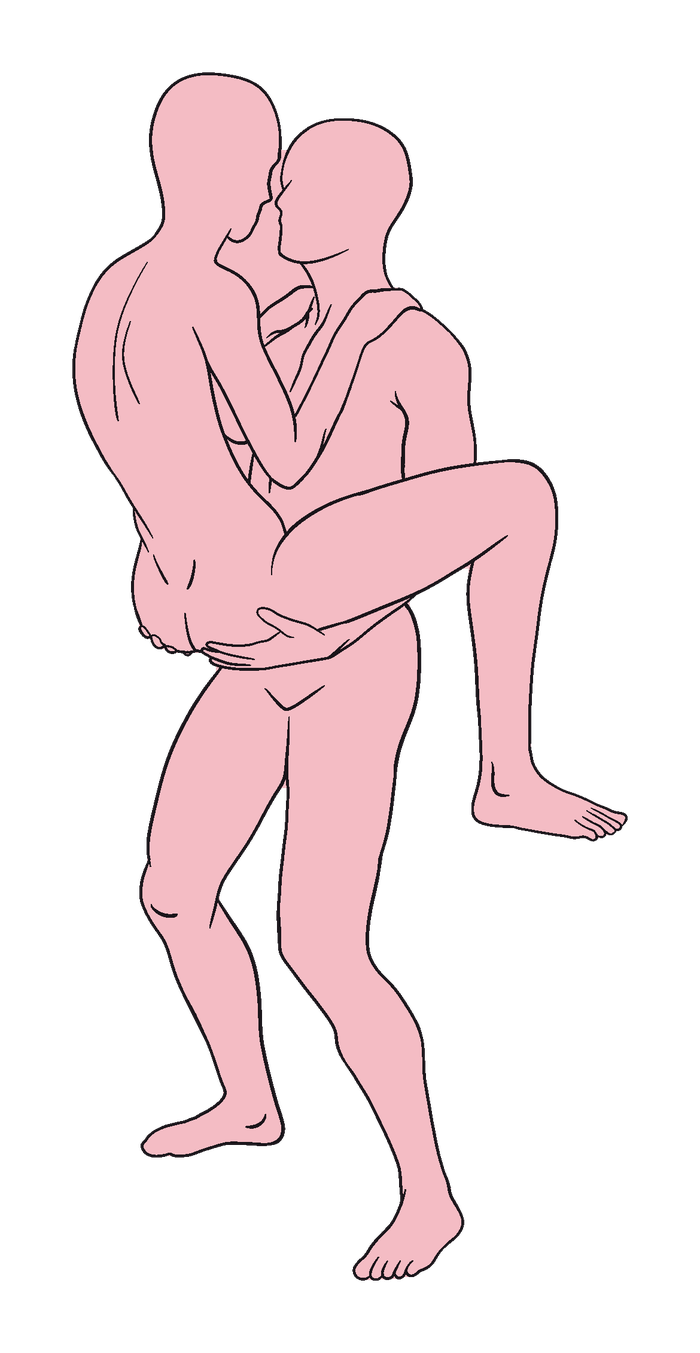
Close face-to-face embrace with one knee hooked around the partner's hip and a hand cupped underneath for support.
Supported Standing Doggy
A standing rear-entry variant where the receiving partner bends forward and braces their upper body — on a wall, counter, or the other partner's guiding hands — rather than going all the way down to a full fold like Downward Doggy.
The support takes weight off the legs and back, making it more sustainable to hold for longer than an unsupported standing bend.
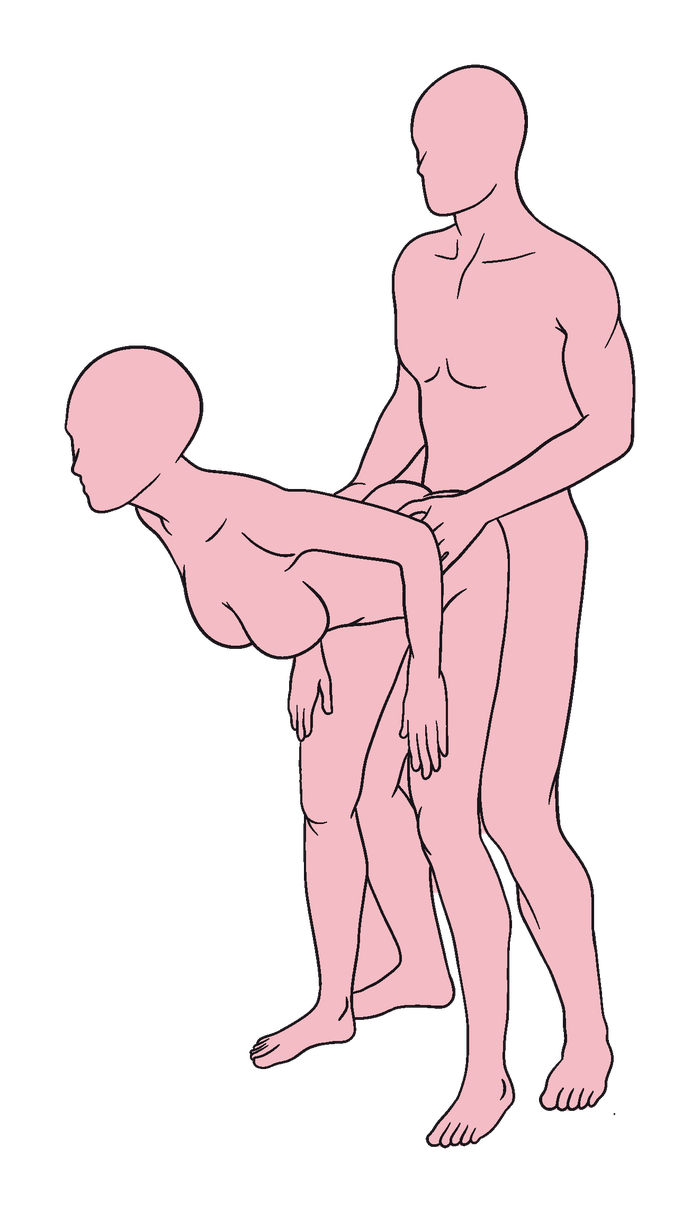
Bent toward horizontal with the other partner's hands at the hips doing the steadying.
Folded Standing Doggy
The receiving partner stands folded fully forward at the hips, legs straight and hands reaching down toward the floor, while the other partner stands upright behind and enters from behind, steadying them with a hand on the lower back.
In the same family as Toe Touch Standing Doggy, but with the hands free toward the floor rather than gripping anything. The full fold still depends on loose hamstrings, so ease into it.
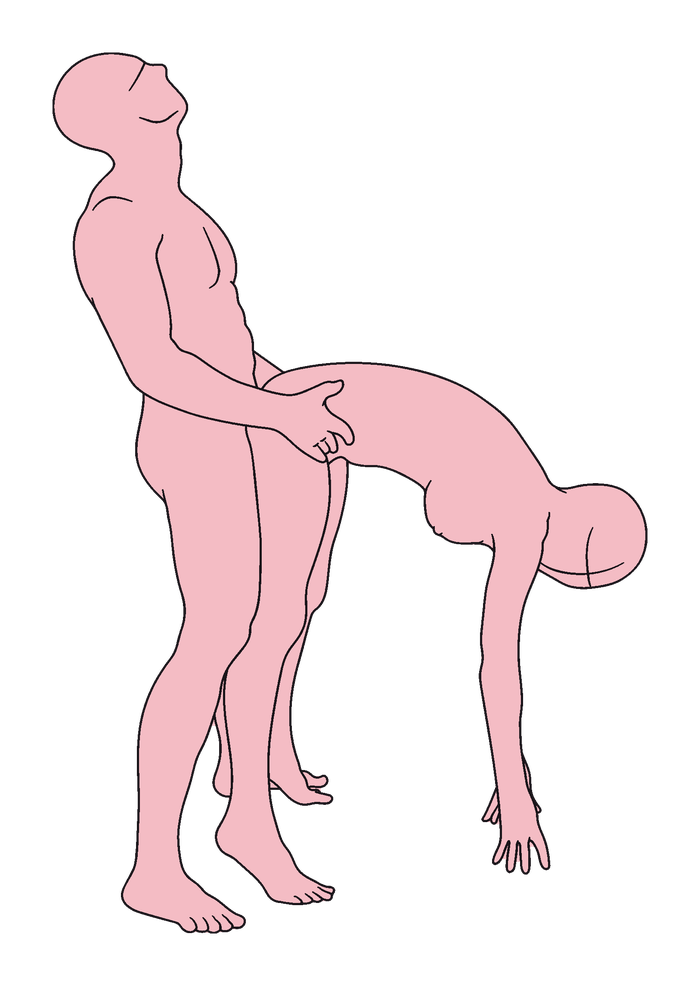
The receiving partner folds flat forward, hands toward the floor, while the standing partner enters from behind.
Leg Up Dancer
Both partners stand upright face to face, the receiving partner with arms wrapped over the other partner's shoulders and around their neck.
One leg lifts and wraps around the standing partner's hip so the foot extends behind them at waist height, while the standing partner keeps both feet planted, grips the receiving partner's waist, and supports the raised thigh. The receiving partner balances on a single leg, so settle the footing before anything else.
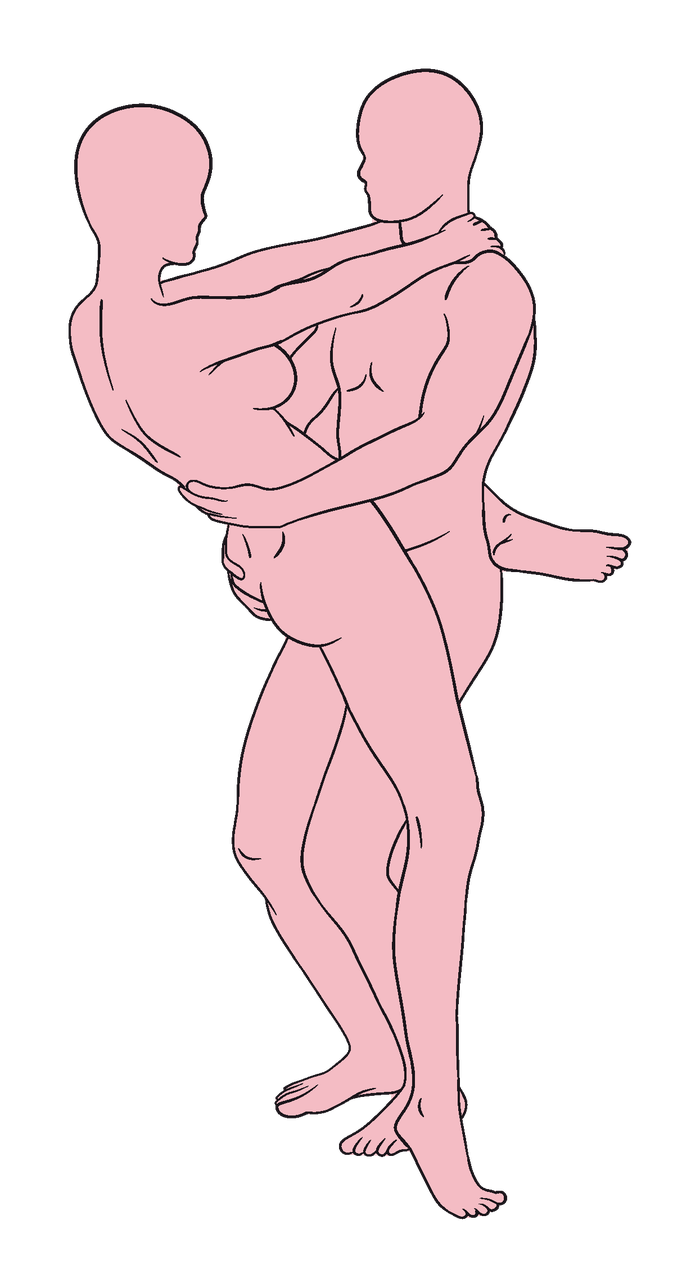
Upright and face to face, one leg wrapped around the partner's hip — the standing partner stays double-planted.
Raised Bodyguard
Both partners face the same direction as in bodyguard, but here the receiving partner stands elevated on a padded ottoman in a half-squat, knees bent, leaning back against the standing partner behind them.
The standing partner reaches around the hips from behind, hands at the lower belly and thigh, with the ottoman supplying the height difference that lines the hips up for standing rear entry. The half-squat asks for some thigh endurance from the receiving partner, and the platform needs to be genuinely stable — the furniture is doing the alignment work here.
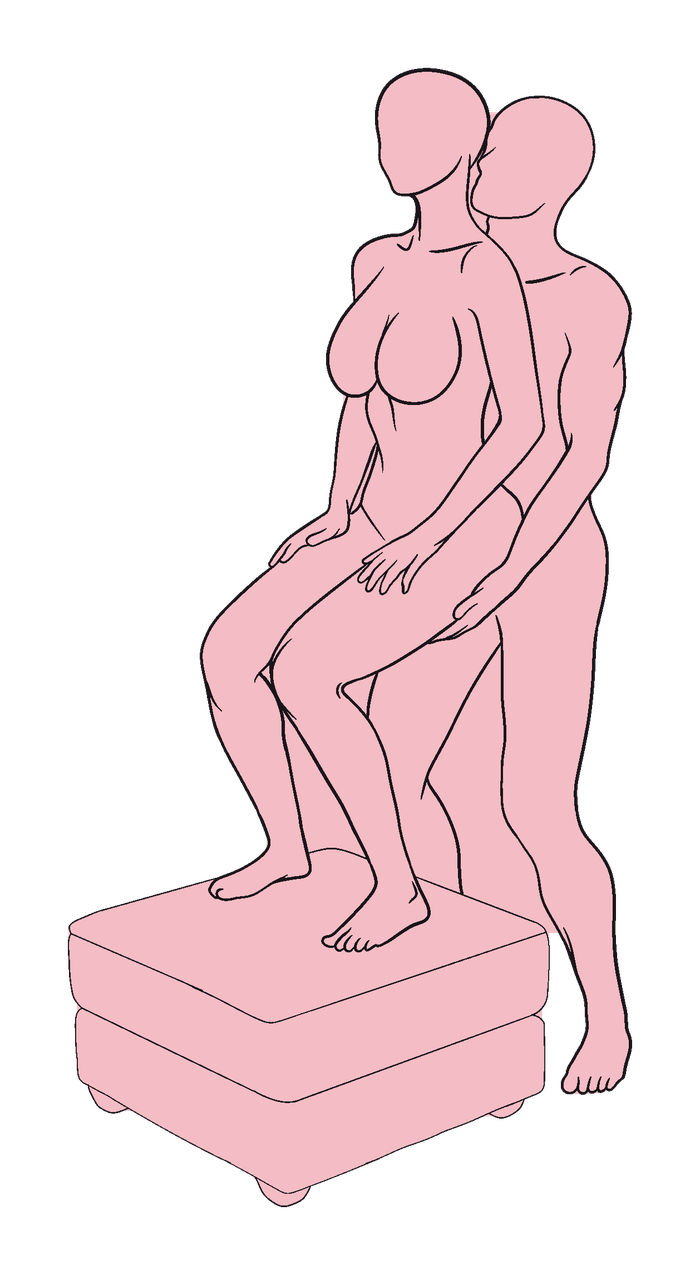
Bodyguard with a height assist — the receiving partner half-squats on a padded ottoman to align hips for standing rear entry.
Standing
Both partners standing, facing each other or with one partner behind the other. It works well for spontaneous moments and doesn't require a bed, but it takes real core and leg strength to hold for long, and it's easier with a height difference that isn't too extreme.
A wall or doorframe to lean against takes a lot of the strain off and makes it far more sustainable than standing unsupported.
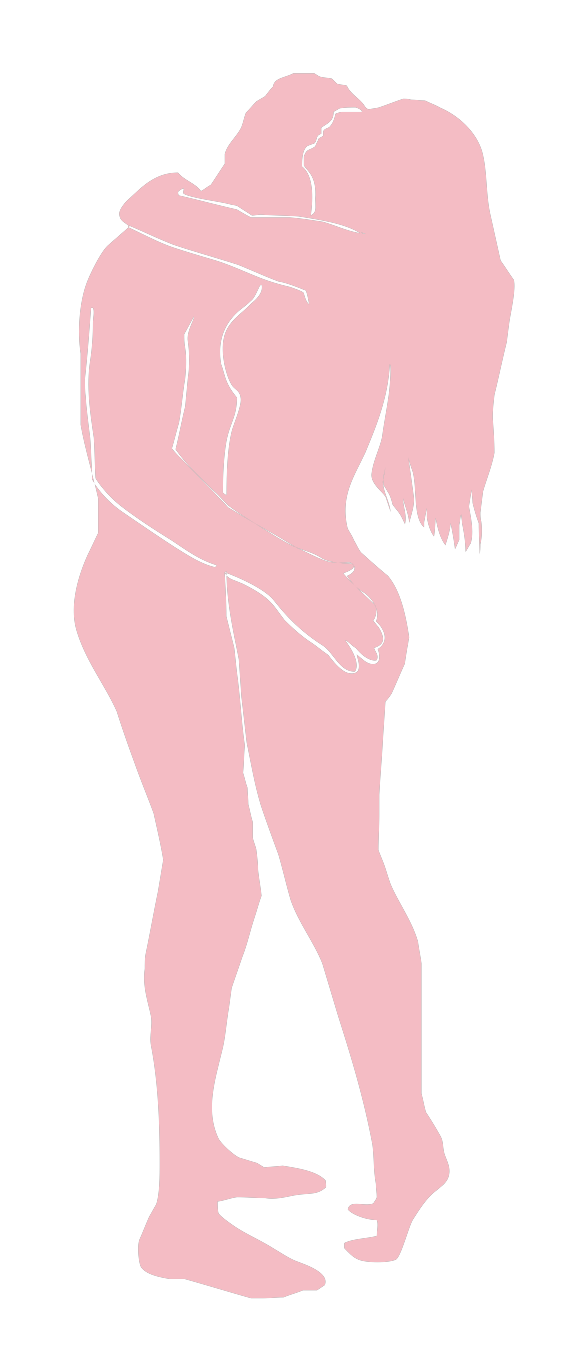
Both partners standing, facing the same direction or facing each other — a wall or doorframe takes the strain off.
Standing Doggy
Both partners stand: the receiving partner bends forward at the waist to roughly horizontal, arms held bent out in front rather than braced on anything, while the other partner stands close behind with knees slightly flexed, gripping the hips and buttocks with both hands.
With no wall or furniture in play, the receiving partner's hamstrings and lower back do all the supporting work — keep the fold shallow at first if that stretch is a reach.
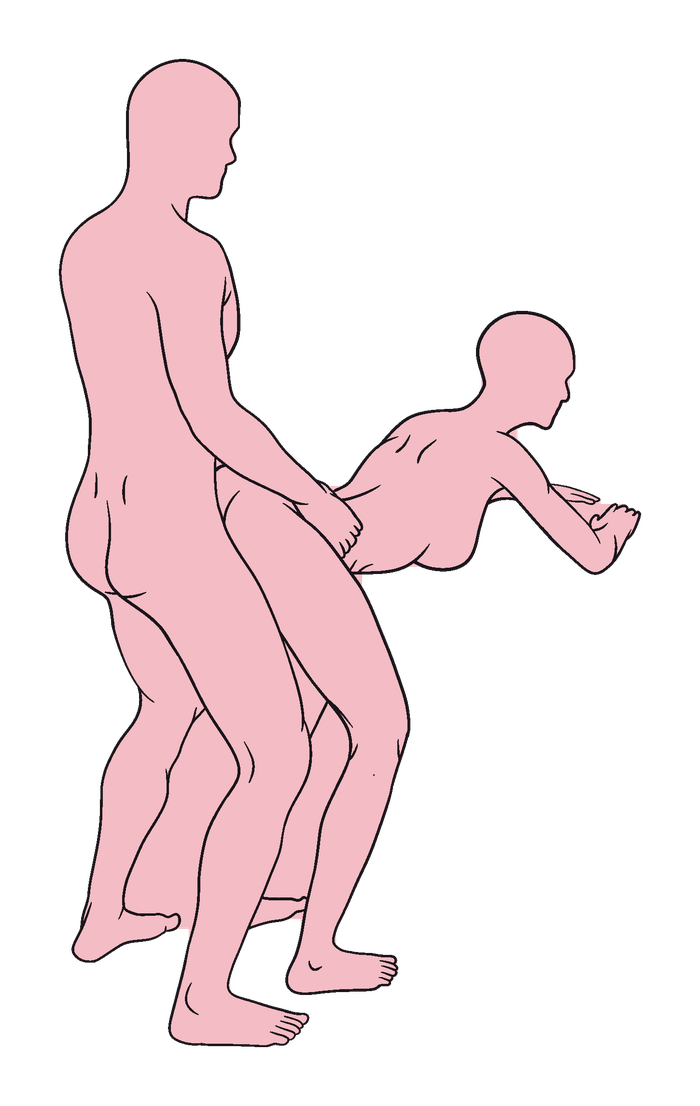
A freestanding rear-entry bend: the receiving partner folds to horizontal with nothing but their own back holding the position.
Toe Touch Standing Doggy
Both partners stand, with the receiving partner bent fully forward at the waist, legs straight, one hand gripping their own ankle and the other holding the standing partner's leg for stability.
The standing partner stays upright behind them with a hand on their back, entering from behind. The straight-legged fold asks a lot of the hamstrings, so warm up and ease down in stages.
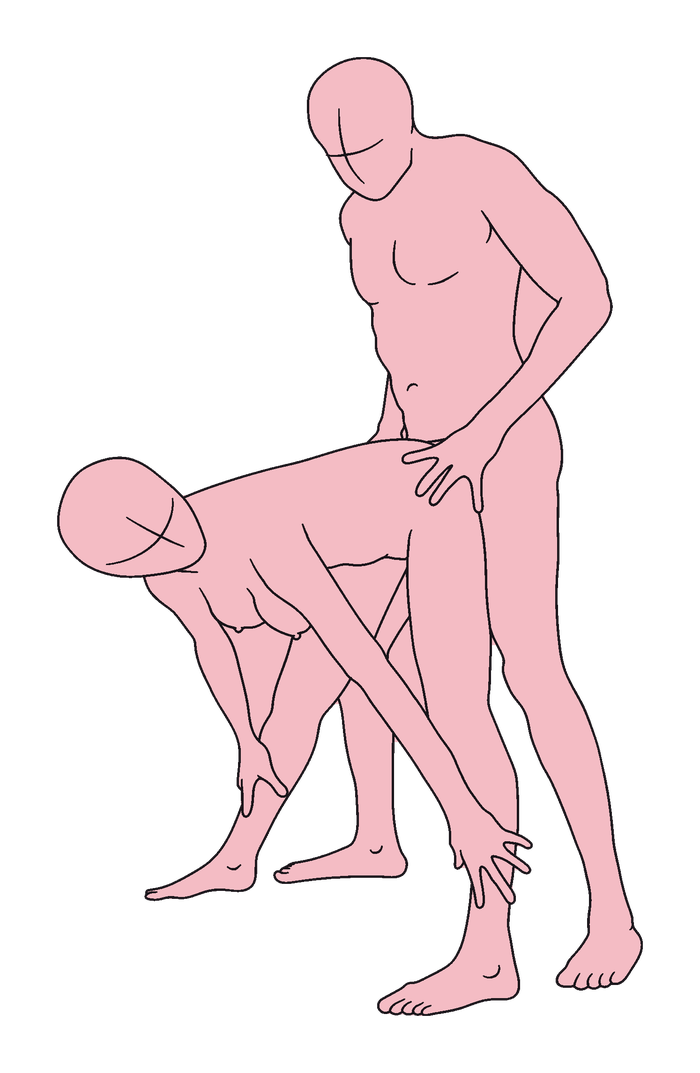
Standing rear entry with the receiving partner folded flat, gripping their own ankle and the partner's leg.
Wrapped Dancer
The partners stand face to face; the receiving partner drapes both arms over the other partner's shoulders and balances on one leg, the other leg lifted and wrapped around the standing partner's waist.
The standing partner supports the raised thigh and buttock with both hands, holding the receiving partner's pelvis snug against their own.
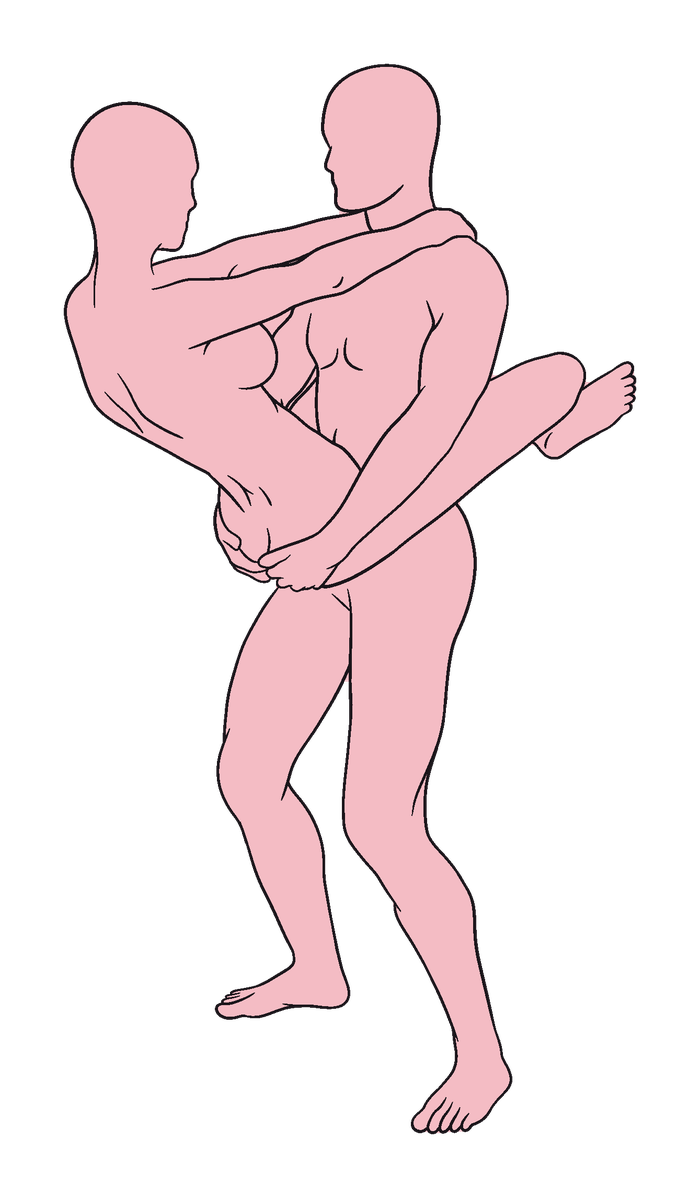
Face-to-face standing hold with one leg wrapped around the waist, both hands supporting the raised thigh and buttock.
Arched Dancer
The receiving partner balances on one leg with the other hooked around the standing partner's hip, arching backward with arms thrown over their head.
The other partner props one knee on a raised surface and supports the arch with a hand at the receiving partner's lower back. Single-leg balance stacked on a deep backbend makes this one to build up to slowly.
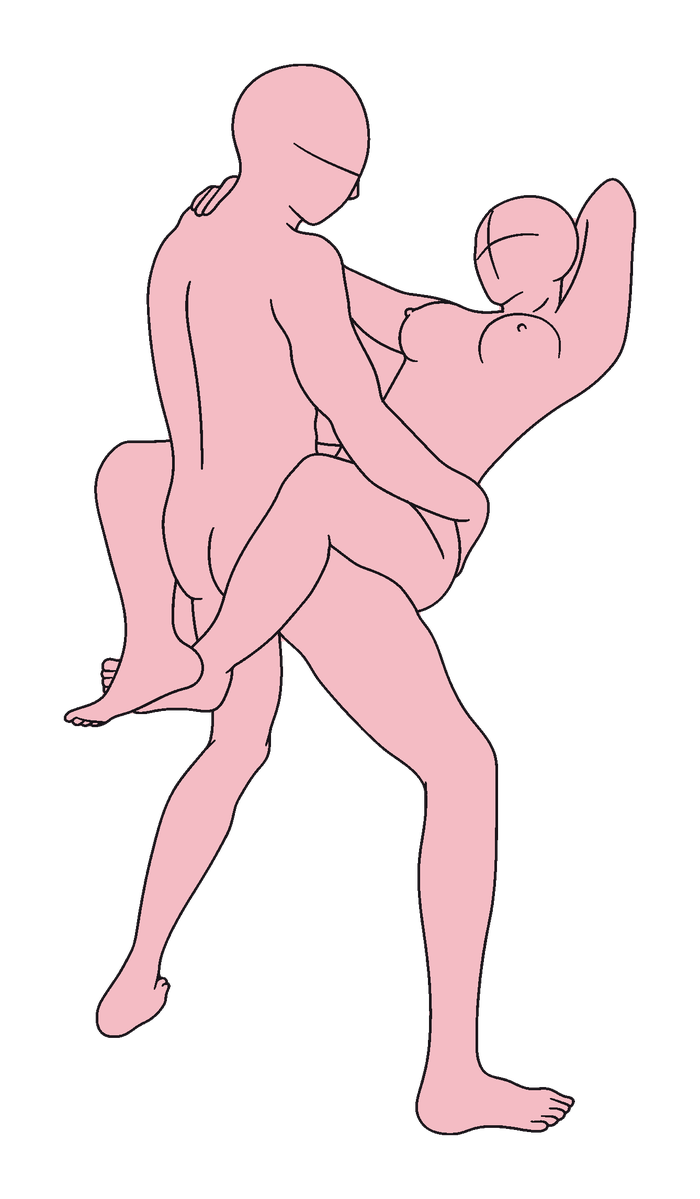
A one-legged standing arch, leg hooked over the partner's hip, supported by a hand at the lower back.
Dancer
Both partners stand face to face; the receiving partner arches backward with head dropped back while the standing partner supports their buttocks with one hand and holds their raised leg with the other, the bent knee lifted alongside the standing partner's hip.
The receiving partner braces a hand against the other partner's chest, and the back of their head rests cradled in the other partner's hand as it tips back. The deep standing back arch asks real balance and spinal flexibility of the receiving partner, so ease into it.
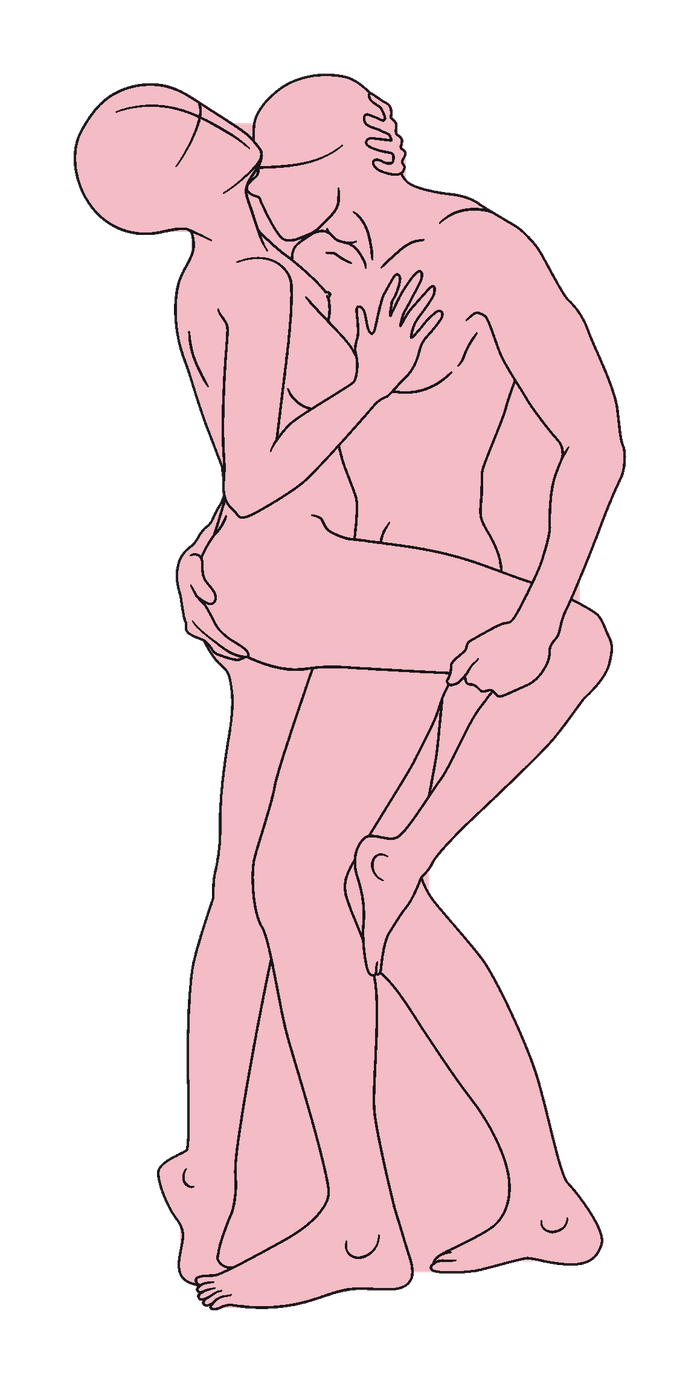
Standing face to face, the receiving partner arches back with one bent knee lifted alongside the standing partner's hip.
Raised Dancer
The partners stand chest to chest in a full embrace with no furniture involved; the receiving partner drapes both arms over the other partner's shoulders while the other partner grips their buttocks with both hands.
One leg lifts high with the knee bent and swung out to the side, leaving the pair balanced on their remaining standing legs. The high, open leg position leans on hip flexibility and shared balance, so raise it gradually.
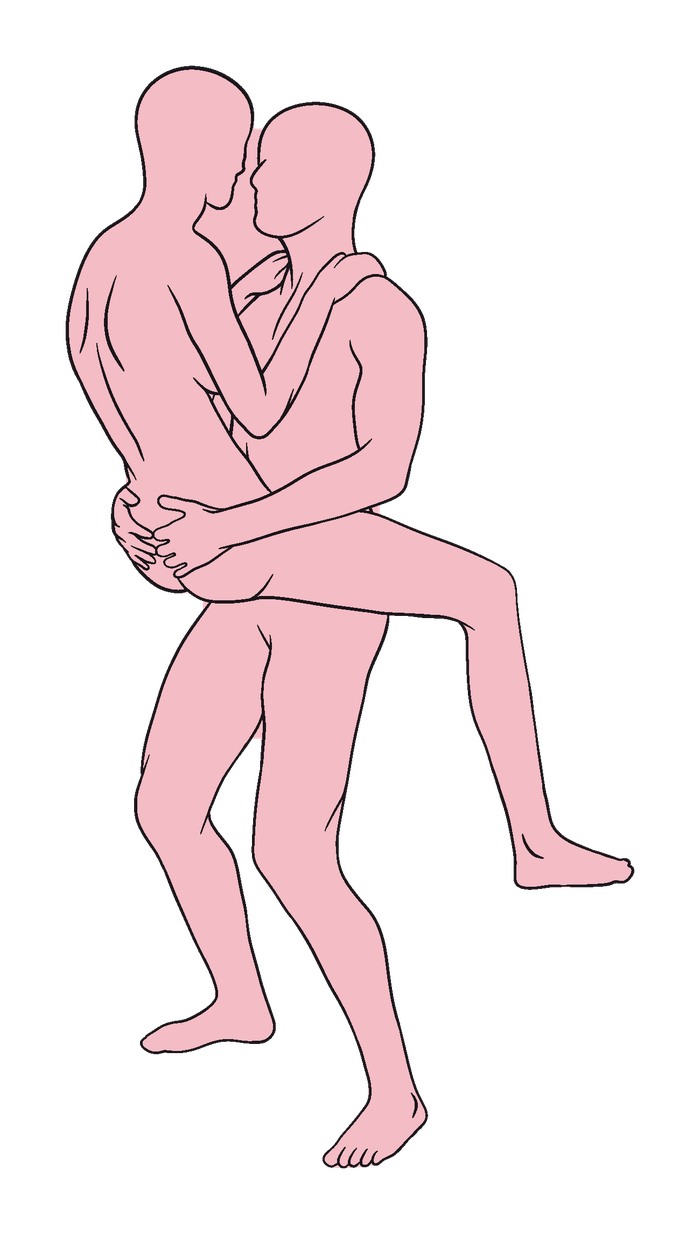
Chest-to-chest standing embrace with one leg lifted high and swung out to the side, no furniture required.
Split Dancer
The receiving partner extends one leg straight up while folding forward over their standing leg, head dropping low, while the other partner stands close against the raised leg and enters from that angle.
It demands real hip and hamstring flexibility from the receiving partner and steady balance from both.
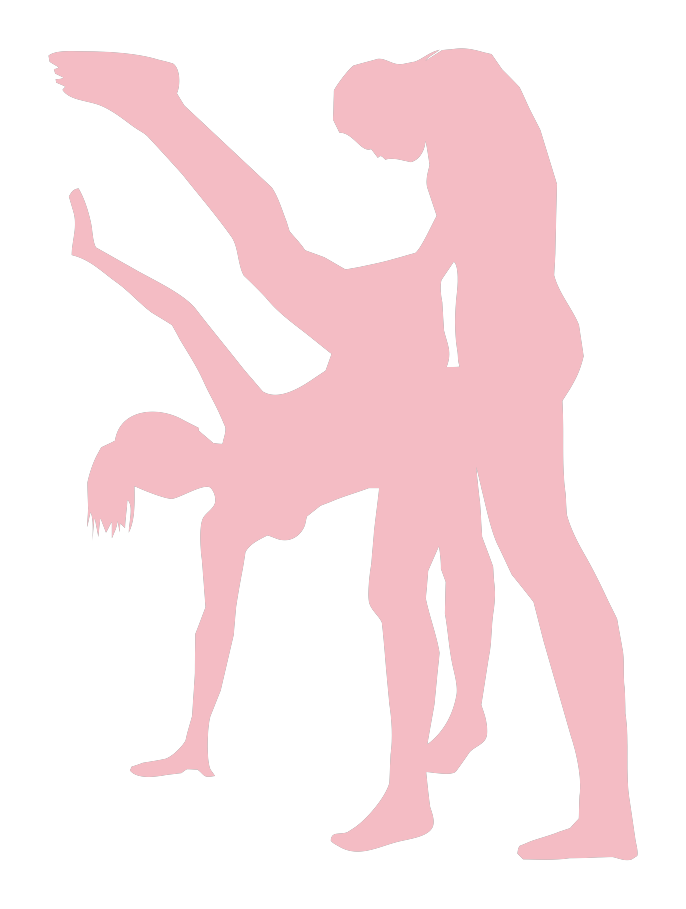
One leg extended high, torso folded toward the standing leg — flexibility and balance both required.
Standing Twisted Doggy
The receiving partner bends forward at the waist until the torso hangs horizontal, one arm dangling toward the floor, while the other partner stands behind. One of the receiving partner's legs lifts and extends straight back at hip height past the standing partner's side, held up by their hand, which rotates the hips into a twist during rear entry; the other leg carries all the weight on the floor.
Balancing a forward fold, a hip-height leg extension, and a twist on one standing leg is demanding — ease into the rotation rather than forcing it.
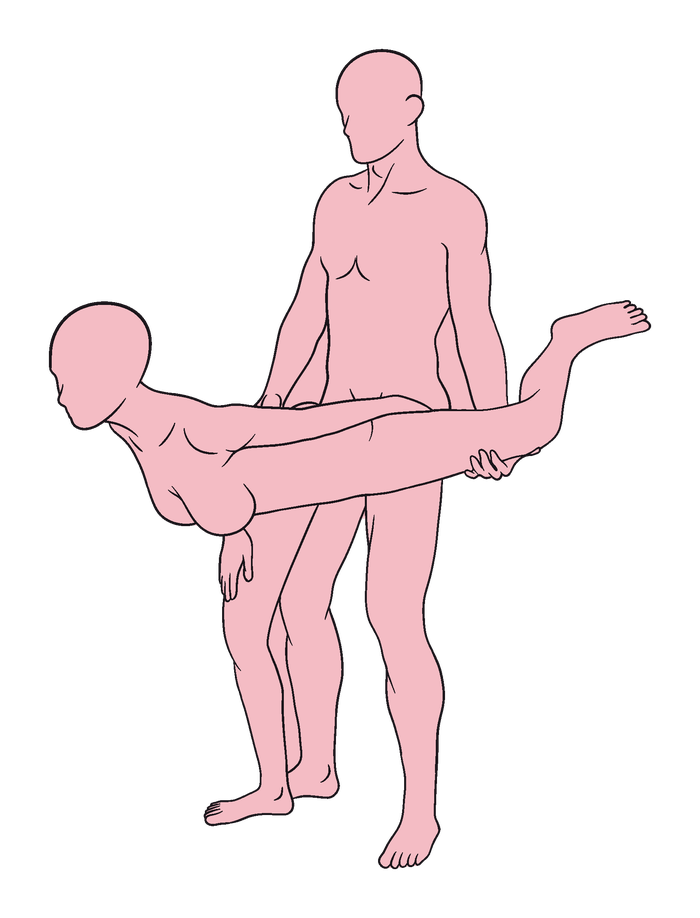
A one-legged forward fold with the raised leg held past the standing partner's side, twisting the hips during rear entry.
Side-lying and scissors
Side-lying, interlocked, and perpendicular shapes — lower effort on average, with angle doing the work instead of elevation. Read the side-lying family guide.
Facing Spooning
Both partners lie on their sides face-to-face, bodies pressed together with legs interleaved.
The receiving partner's upper leg bends and drapes over the other partner's hip, one arm hooking up around their neck and head, while the other partner's hand rests at the receiving partner's hip and waist. An easy, low-effort position with plenty of close contact.
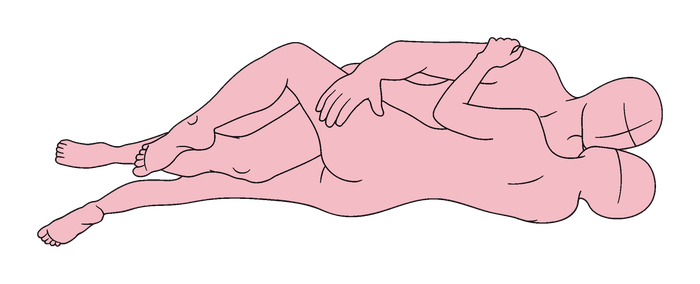
Side-lying and face-to-face, legs interleaved with the upper leg draped over the partner's hip.
Facing Scissors
Both partners sit upright facing each other, chest to chest and close enough to kiss, legs interlacing with one knee bent up and the foot planted.
One partner wraps an arm around the receiving partner's hip to hold them on their lap. A seated, penetrative take on the scissor shape that trades range of motion for full-body contact, so movement stays small and grinding.
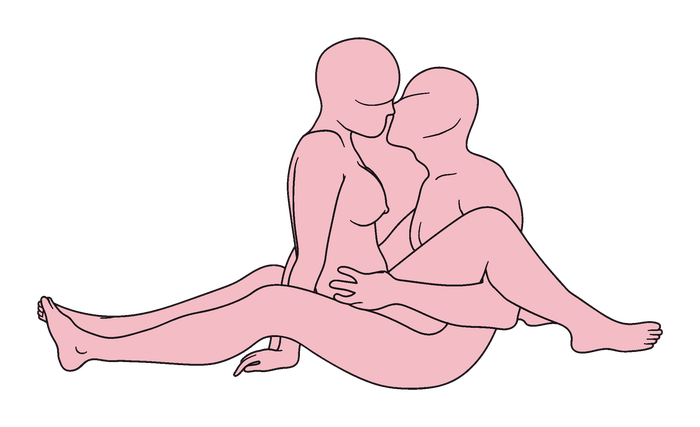
Seated chest to chest, legs interlaced with one knee up — small, grinding movement.
Leg Up Scissors
The receiving partner lies on their back on the floor while the other partner sits upright between their legs, both sets of legs interlocked in the scissor arrangement.
The sitting partner holds one of the receiving partner's legs raised straight up against their own chest and shoulder with both hands. A penetrative take on the scissor shape; the raised leg asks for hamstring flexibility, so lift it only as far as it goes comfortably.
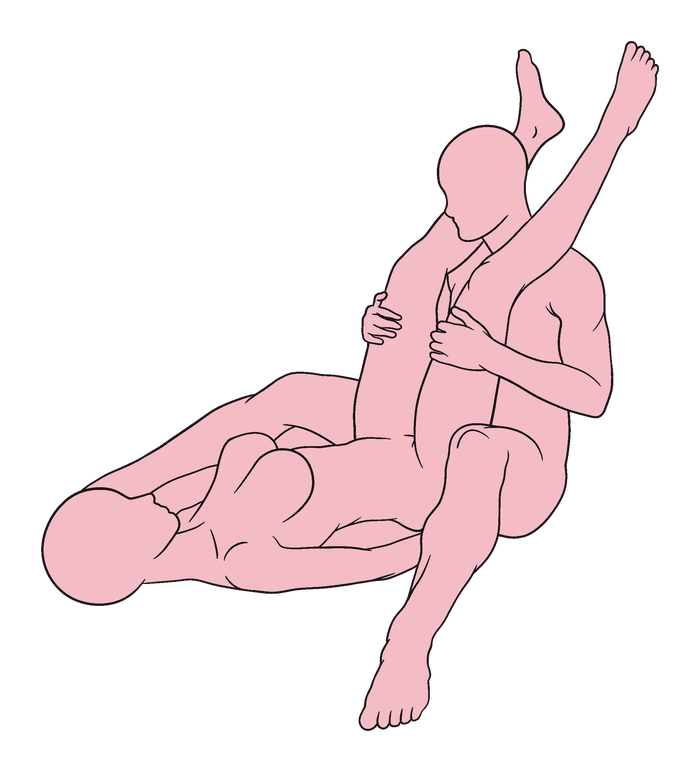
Legs interlocked scissor-style, the sitting partner holds the receiving partner's raised leg against their chest and shoulder.
Sitting Penetration Scissoring
The other partner sits upright on the floor with one knee raised, while the receiving partner lies back at a right angle to them with one arm stretched overhead.
Their legs interleave scissor-fashion at the pelvis: one of the receiving partner's legs rises across the sitting partner's body, held at the thigh, while the other passes beneath the raised knee. A penetrative take on the scissoring shape — legs interlocked at right angles — reached from sitting rather than lying down.
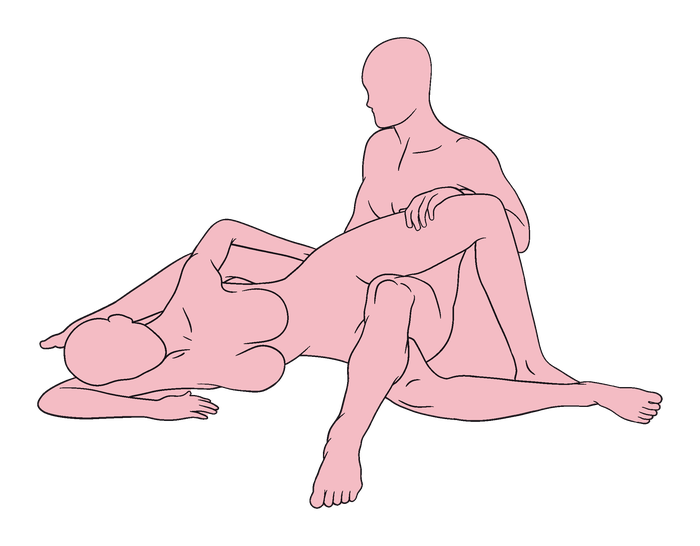
A seated, penetrative scissoring shape — bodies at right angles, legs interleaved at the pelvis.
X Position
Both partners lie flat on their backs pointing in opposite directions with their pelvises joined at the center, each one's legs extending past the other's torso so the two bodies form an X.
Hands clasped over the receiving partner's stomach hold the connection and give both partners something to pull against. Neither partner can thrust much from flat on their backs, so movement comes from slow rocking and the pull of the joined hands.
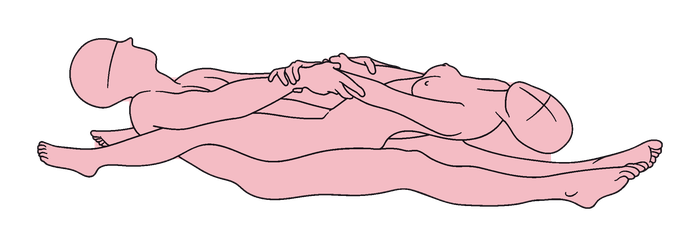
Both partners lie flat in opposite directions, pelvises joined and legs interleaved, hands clasped over the receiving partner's stomach.
Upright Penetration Scissoring
The receiving partner lies on their back and side on the floor, head resting near an outstretched arm, with one leg flat on the ground passing between the knees of the other partner, who kneels upright straddling the lower thigh.
The other leg is raised straight up, held vertically against the kneeling partner's chest and shoulder with both hands. A penetrative take on the scissoring shape, legs interlocked at right angles; the vertical leg asks for hamstring flexibility, so raise it only as far as it goes without strain.
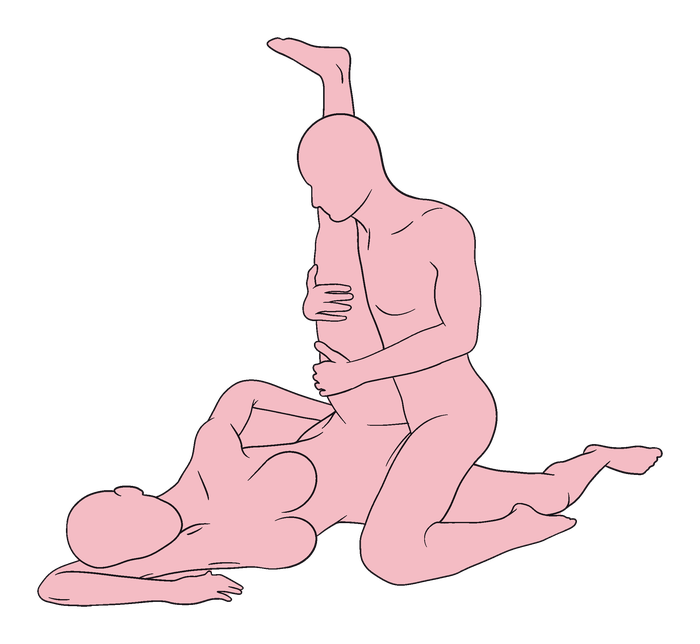
Scissoring with one leg flat and one held straight up the kneeling partner's chest, bodies at right angles.
Lying Penetration Scissoring
The receiving partner lies on their back with legs split wide, one raised straight up and the other extended out along the floor, while the other partner lies curled crosswise at their hips, legs interlocked in the scissor arrangement.
The receiving partner grips the kneeling partner's thigh for leverage and connection. The wide split demands genuine flexibility, so open into it gradually rather than forcing the full spread.
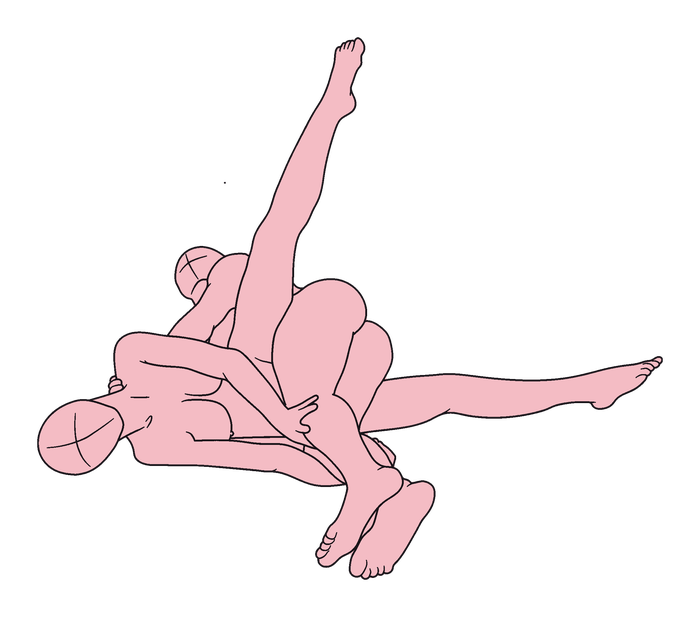
One leg straight up, one along the floor — the other partner lies curled crosswise at the receiving partner's hips.
Oral and mutual
Oral positions, one-way and mutual — the main variable is who is on top, because that decides who controls pace and pressure. Read our full oral sex guide.
Oral
One partner stands while the other kneels in front, head at hip height, hands free to guide pace and pressure.
It's not penetrative in the way the rest of this glossary is, but "oral" gets searched often enough as a named position that it's worth including here rather than assuming it's covered elsewhere — for technique specifically, see our oral sex guide.
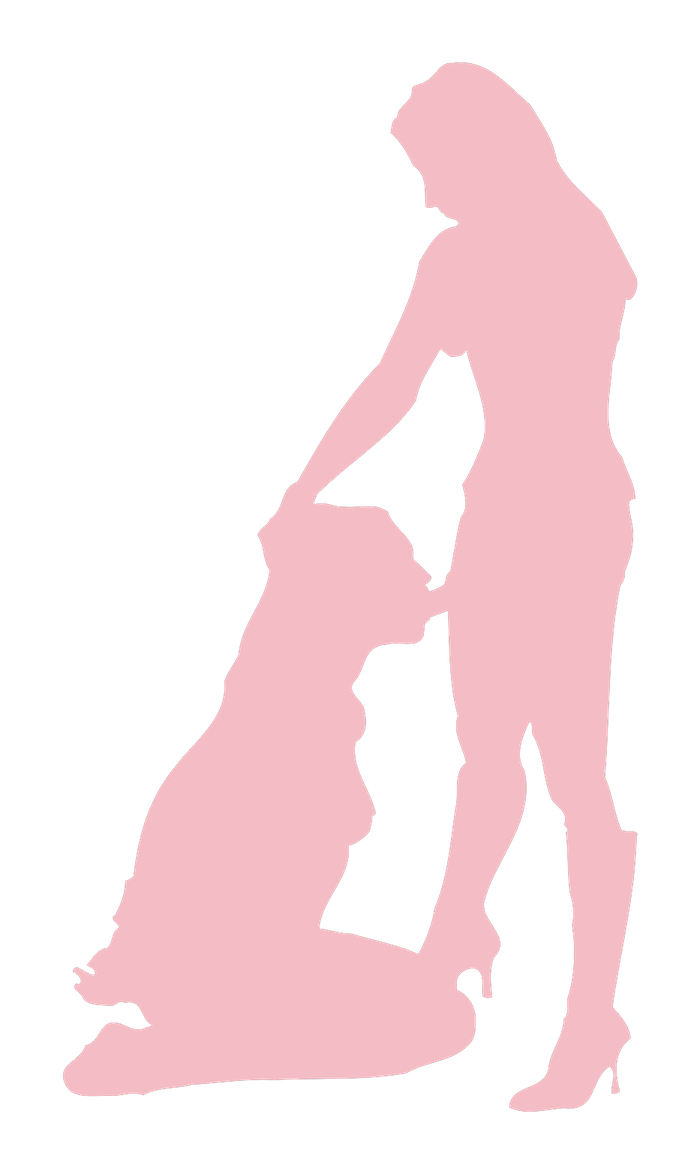
Standing partner, kneeling partner at hip height — the most-searched non-penetrative "position."
69
Both partners give oral sex to each other at the same time, in a mirrored, inverted position — most commonly one partner on top facing the other's hips, though it works lying side by side too.
Simultaneous stimulation appeals to some people and splits focus in a way that's more distracting than additive for others — neither reaction means you're doing it wrong. Side-lying removes the weight-support demand of the on-top version, and it's worth trying if that's the actual obstacle rather than the concept itself.
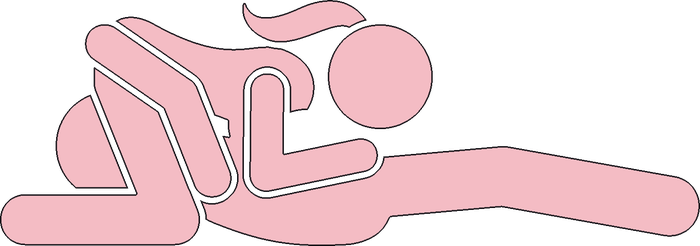
One partner on top facing the other's hips — the most common arrangement; side-lying is the lower-effort variant.
Inversions and advanced
Head-below-hips territory: the piledriver, handstand, and waterfall families, plus the deepest folds and carries. Real strength, flexibility, and neck caution required — ease in and keep sessions short. Read the advanced positions guide.
Arching Guard
The other partner rises into a tall kneel-lunge, one knee down and one foot planted, while the receiving partner lies beneath them on their upper back and shoulders, hips lifted high to meet the pelvis so the body arches like a bridge.
One of the receiving partner's legs hooks over the partner's bent leg, the partner steadies the raised hips with a hand, and the receiving partner reaches up toward their thigh. The bridge loads the receiving partner's neck, shoulders, and lower back, so ease into the arch and come down slowly.
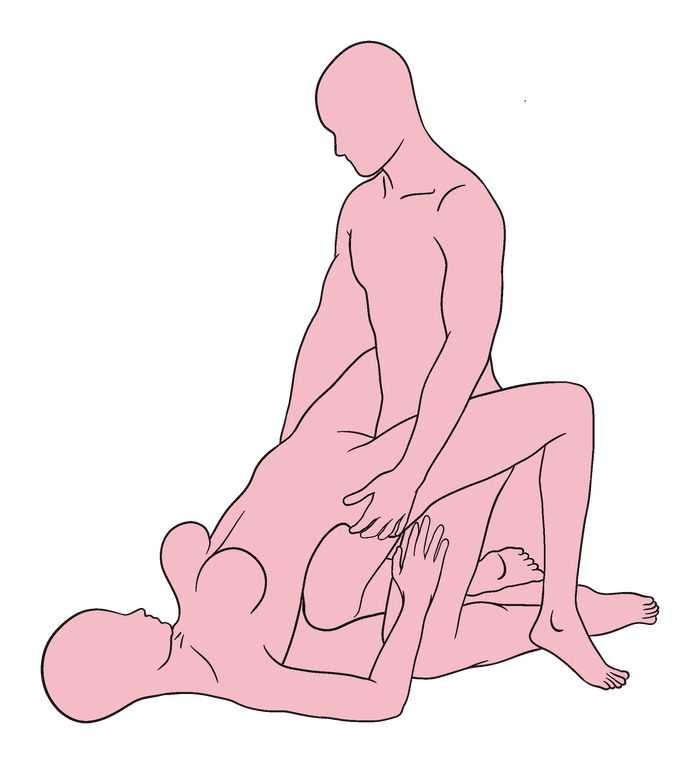
A high-arch Guard: the receiving partner bridges up from their shoulders to a kneel-lunging partner, one leg hooked over theirs.
Downward Doggy
The receiving partner bends fully forward at the hips into something close to a yoga downward-dog fold, hands flat on the ground, while the other partner stands behind and enters from that angle.
The straight-legged forward fold gives a different angle than a standard hands-and-knees doggy style, and it's a real hamstring stretch on top of everything else.
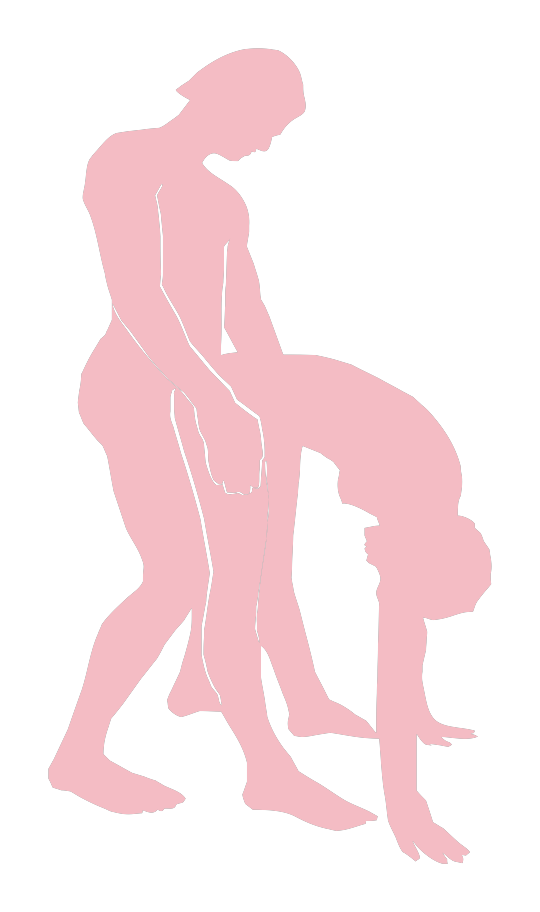
A standing partner entering a full forward fold — flexibility-dependent, named for the yoga pose it resembles.
Guided Sitting Waterfall
The seated partner leans back with knees up and feet planted wide, while the receiving partner arches backward off their lap face-up, head and arms reaching the floor behind them, legs spread wide with one draped over the seated partner's arm.
Their hands overlap between the receiving partner's thighs, which is where the guiding comes in. The full backbend demands real spinal flexibility and puts the head below the hips, so ease in and come up slowly.
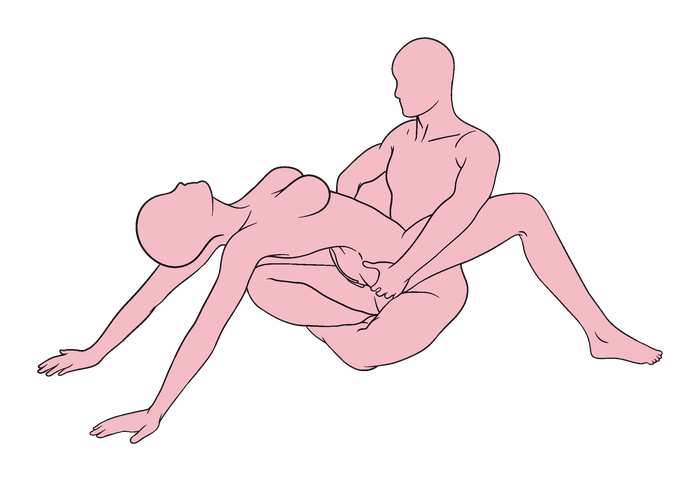
The receiving partner arches back off the seated partner's lap, head reaching the floor, their hands overlapping between the thighs.
Kneeling Waterfall
The other partner kneels upright while the receiving partner drapes face-up across their lap: hips resting on the kneeling partner's thighs, back arching into a full backbend with the head dropping toward the floor and both hands planted flat behind for support.
The receiving partner's legs spread wide with feet on the floor to either side of the kneeling partner, who steadies their hips and waist with both hands. The deep backbend and head-down drop demand real spinal flexibility, so ease in gradually and come up slowly.
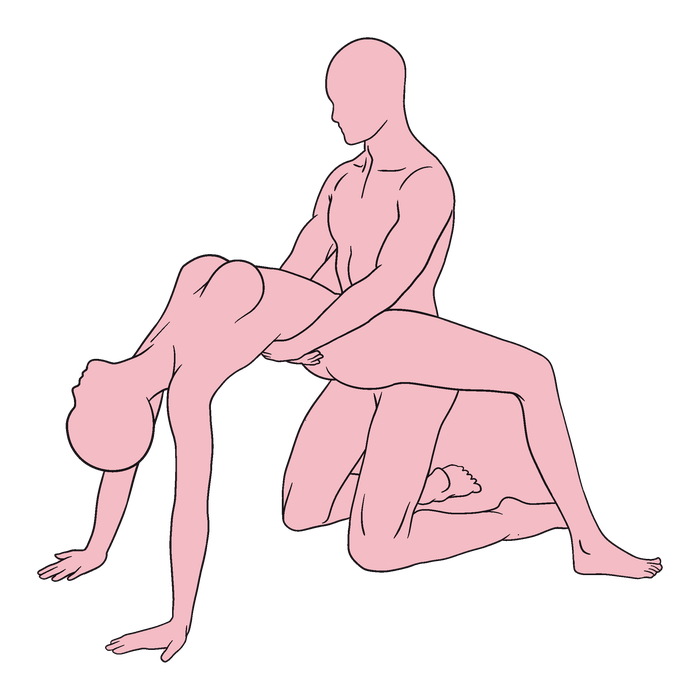
The receiving partner backbends face-up across the kneeling partner's lap, head toward the floor, feet planted wide to either side.
Lap Bridge
The other partner sits leaning back with knees bent and feet planted while the receiving partner arches into a full backbend over their lap — hips raised against them, both hands and both feet touching the floor, head hanging back toward the ground.
The backbend loads the spine and shoulders and drops the head below the heart, so ease into it slowly and hold it only briefly.
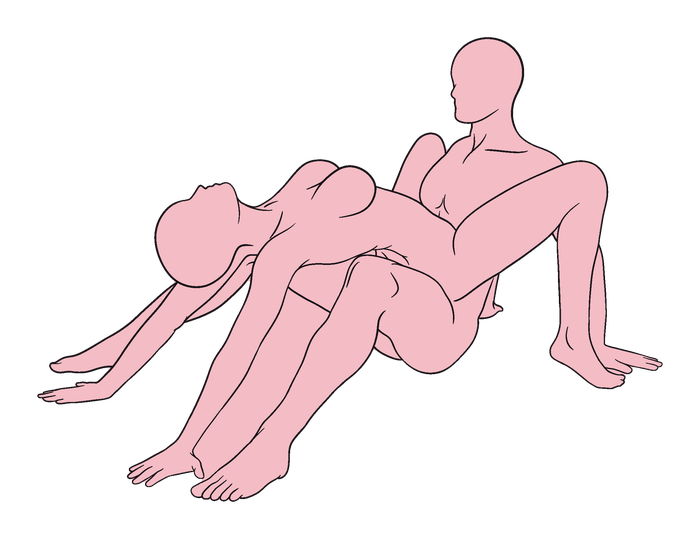
A full backbend over a seated partner's lap, hands and feet on the floor, head hanging back.
Reclined Pile Driver
The receiving partner rests their head and shoulders on the floor with the torso twisted and hips raised into the other partner's lap, one leg extended up against that partner's chest and the other bent at their side.
The other partner sits leaning far back on their arms with knees bent, holding the raised hips to their pelvis. As with any pile driver variant, the receiving partner's neck carries inverted load — keep the weight on the shoulders rather than the neck, and come out of it at any strain.
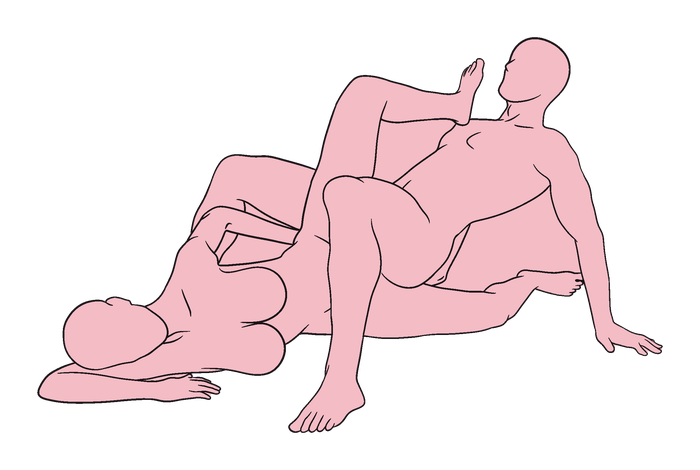
Shoulders on the floor, hips raised into a reclining partner's lap, one leg extended up their chest.
Sitting Waterfall
The seated partner leans back with knees bent and feet planted wide while the receiving partner arches backward off their lap face-up, head and outstretched arms reaching the floor behind them.
One of the receiving partner's legs drapes wide over the seated partner's arm, with the seated partner's hand resting between their thighs. The backward drape puts the head below the hips and asks a lot of the spine, so lower into it in stages and come up slowly.
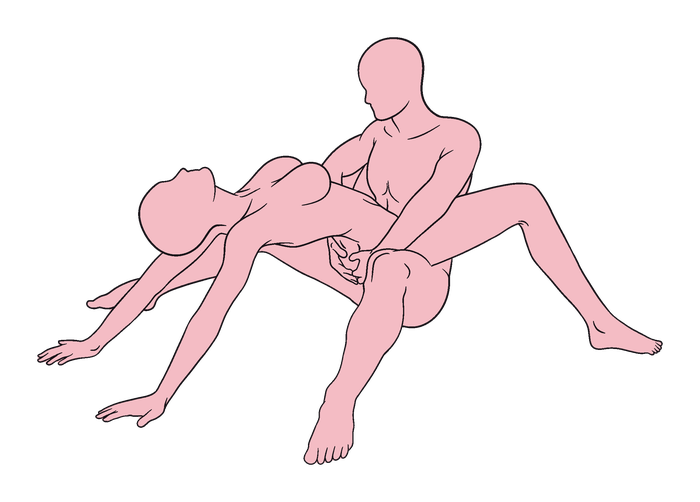
The receiving partner arches face-up off a seated partner's lap, head and arms reaching the floor behind.
Standing Restrained Doggy
The other partner stands upright while the receiving partner, feet on the floor, folds forward at the waist until the head hangs down near the ground. The receiving partner's arms draw back toward the lower back, where the standing partner gathers both wrists in one hand, rests the other hand on their back, and enters from behind.
With the arms held, the receiving partner cannot catch themselves, so the standing partner's grip is doing real balance work — keep it firm, go slowly, and release at the first wobble.
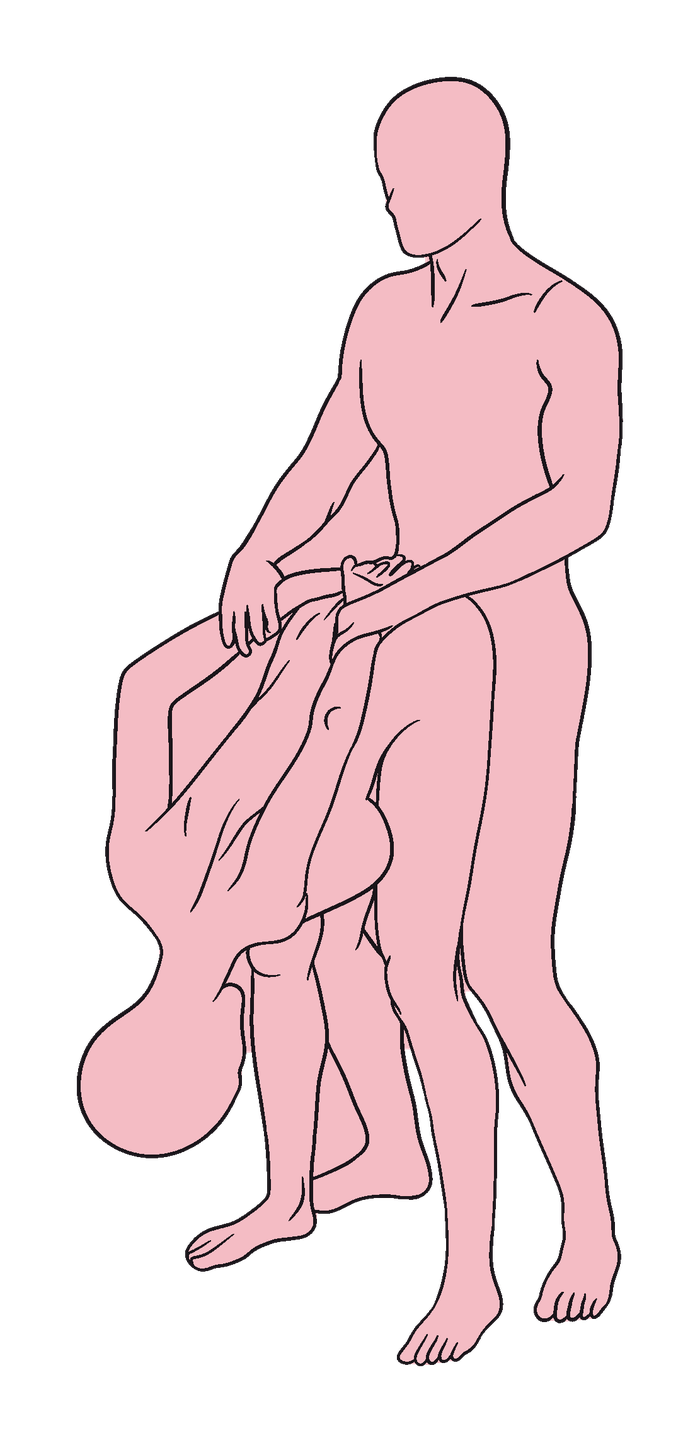
A deep standing fold with wrists gathered behind the back, balance resting entirely on the standing partner's grip.
Standing Waterfall
The standing partner keeps knees flexed while the receiving partner tips steeply forward and down in front of them: hips raised to the standing partner's pelvis, torso plunging toward the floor with both hands planted on the ground and head down.
One of the receiving partner's legs lifts and extends out to the side, gripped at the thigh and hip by the standing partner, while the other leg reaches down to the floor; entry is from behind. The head-down angle and lifted side leg call for flexibility and steady balance from both partners, so build up to it gradually.
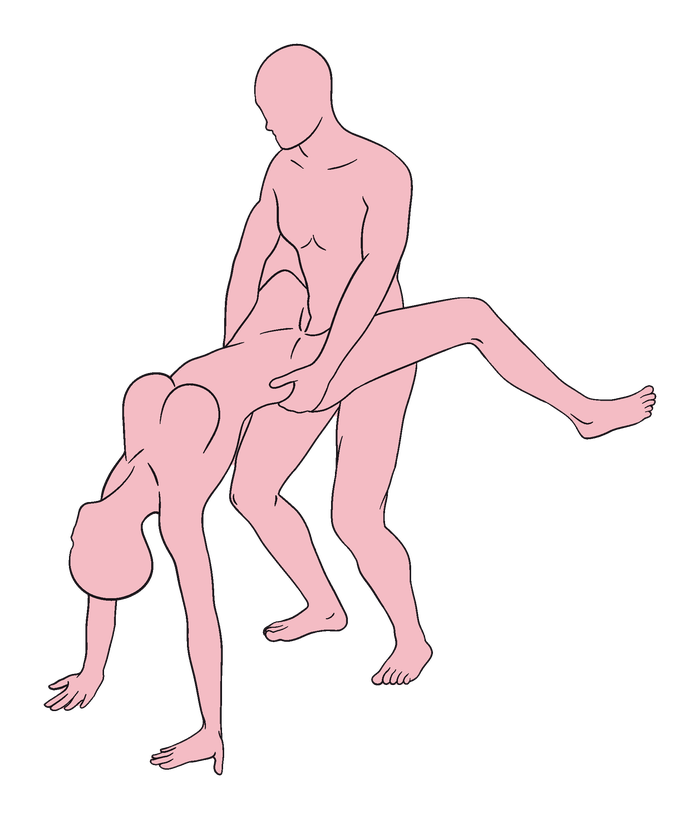
A head-down forward plunge with one leg lifted to the side, hips raised to the standing partner entering from behind.
Waterfall
The standing partner stays upright while the receiving partner, facing away, folds steeply forward at the hips so the torso and head drop toward the floor, both palms planted on the ground.
The receiving partner balances on one leg with the other bent and hooked up over the standing partner's arm, foot near the shoulder, while the standing partner grips the hip and thigh to keep their pelvises pressed together. The head-down fold and one-legged balance are demanding — move into the fold gradually and rise slowly to avoid lightheadedness.
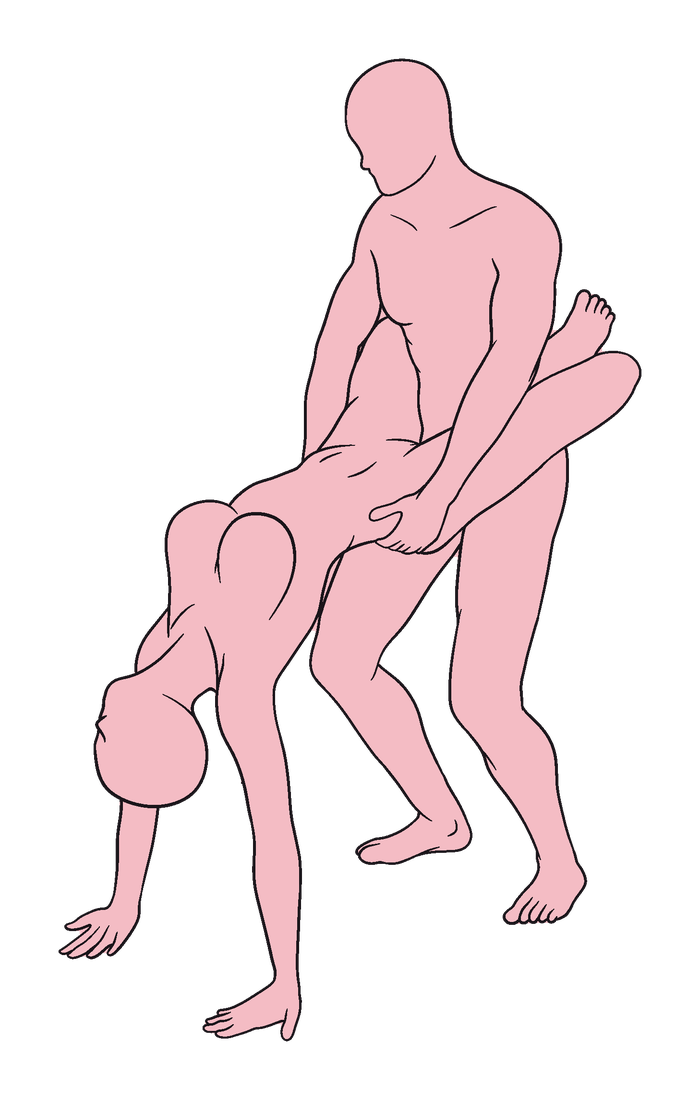
Rear-entry standing fold with the torso dropped toward the floor and one leg hooked up over the partner's arm.
Brute Sex
The receiving partner rests on the shoulders and upper back with hips rolled up and both legs extended straight into the air, while the other partner positions on hands and knees above the raised pelvis, facing away toward the receiving partner's feet.
The top partner's hips lower onto the receiving partner's from above, weight carried on palms and knees as the raised legs pass up along their side. This is an awkward, advanced novelty angle in the pile driver family: the inversion loads the receiving partner's neck and shoulders, so ease in carefully and keep sessions brief.
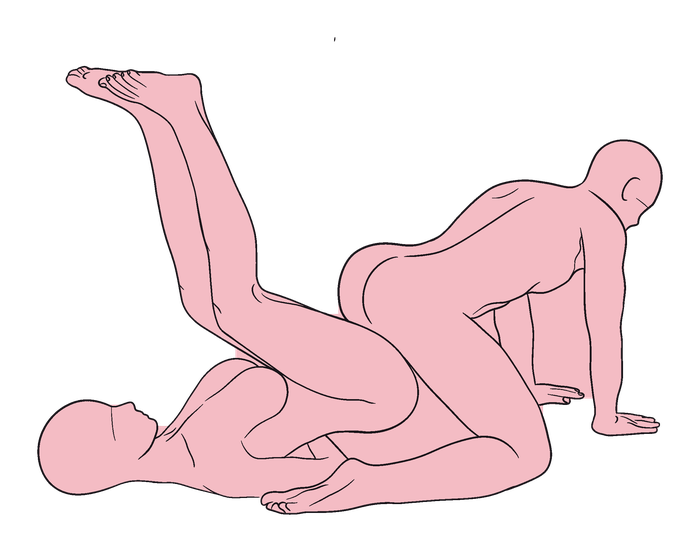
An inverted novelty angle with the top partner on all fours over the raised hips, facing the feet.
Dipped Dancer
Both partners stand facing each other with hips pressed together, and the receiving partner arches deeply backward until their head drops toward the floor.
The standing partner stays upright, clasping the receiving partner's arm in a firm mutual grip that carries the weight of the dip. The deep backbend demands real spinal flexibility and total trust in that grip, so lower into the arch gradually.
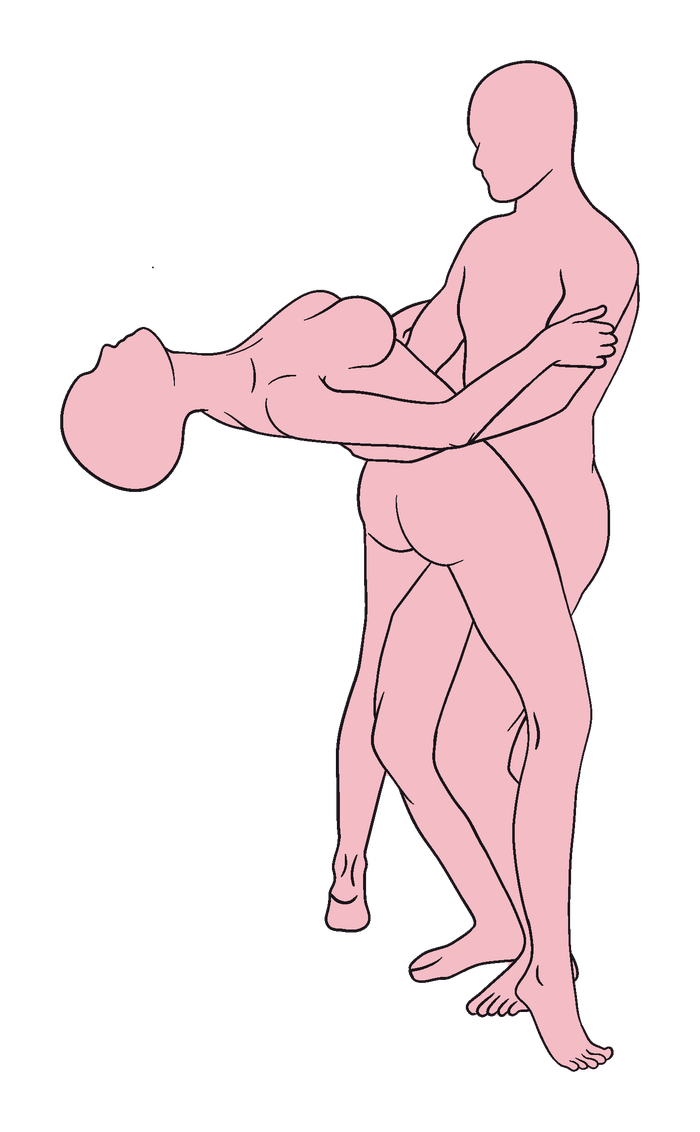
A standing face-to-face dip: the receiving partner in a supported deep backbend, head dropped toward the floor.
Handstand
The receiving partner inverts into a handstand-like position, hands flat on the floor with arms extended and head down, the body angling up so the pelvis meets the standing partner's hips while the legs extend straight up on either side of the standing partner's head.
The standing partner stays upright with knees slightly bent, holding the receiving partner's hips and buttocks from behind. Full inversion puts considerable load on the neck, shoulders, and arms — build up to it and come down slowly.
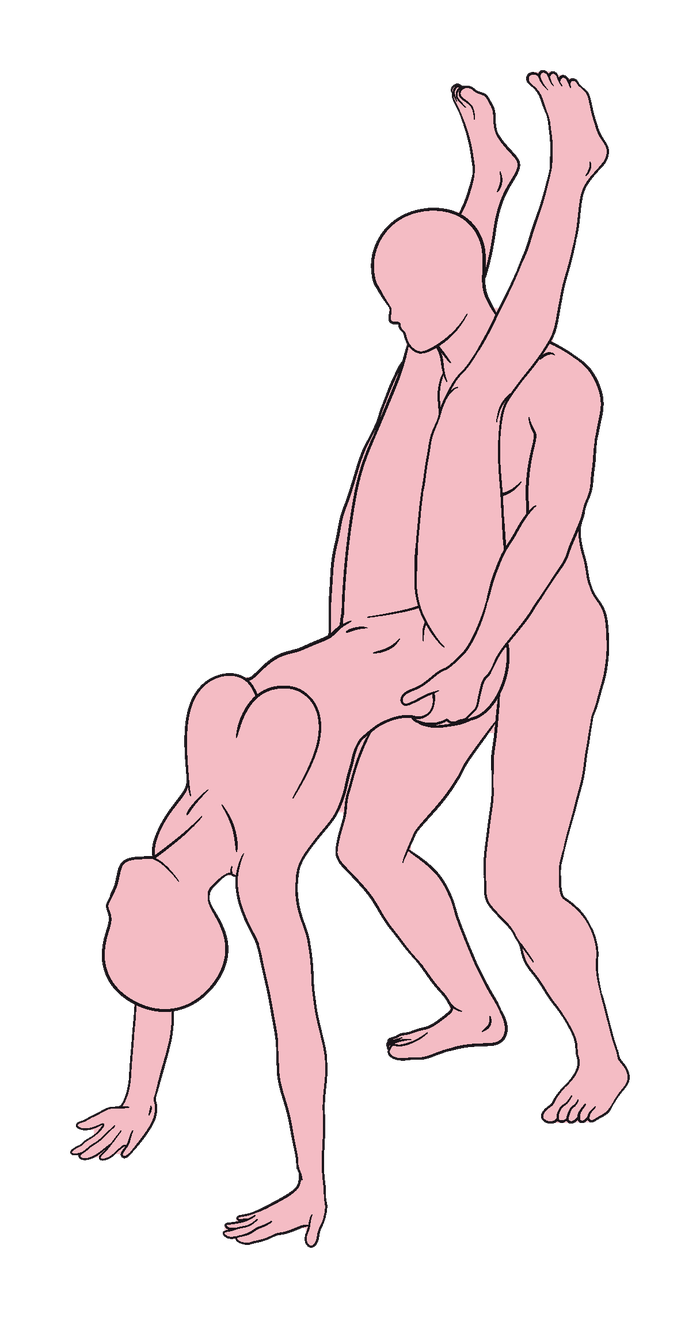
The receiving partner inverts onto their hands, legs straight up past the standing partner's head, hips held from behind.
Italian Chandelier
One partner lies flat on their back while the receiving partner balances over them face-up in a crab bridge — feet planted beside the lying partner's torso, hands reaching the floor near their legs, hips raised over their pelvis and head dropped back toward their feet.
The whole pose hangs on the bridging partner's arms, shoulders and spine, a genuinely strenuous hold that demands strength and back flexibility. Build up to it in short spells and come down at the first sign of fatigue.
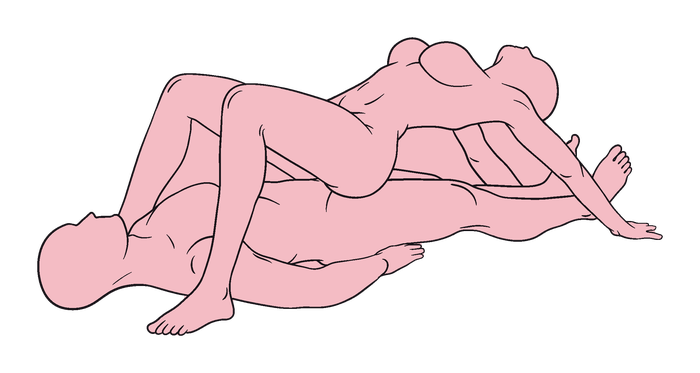
The receiving partner holds a face-up crab bridge over a partner lying flat, hips raised over their pelvis.
Kneeling Split Wheelbarrow
The receiving partner holds a straight-arm plank with hands flat on the floor and torso horizontal, hips resting at the lap of the other partner, who kneels upright behind them.
The receiving partner's legs split wide in the air, one pointing straight up and the other extended out to the side, supported under the thigh by the kneeling partner's hand. A wheelbarrow variant that adds an airborne split, so it calls for solid arm strength and open hips — build toward the full spread gradually.
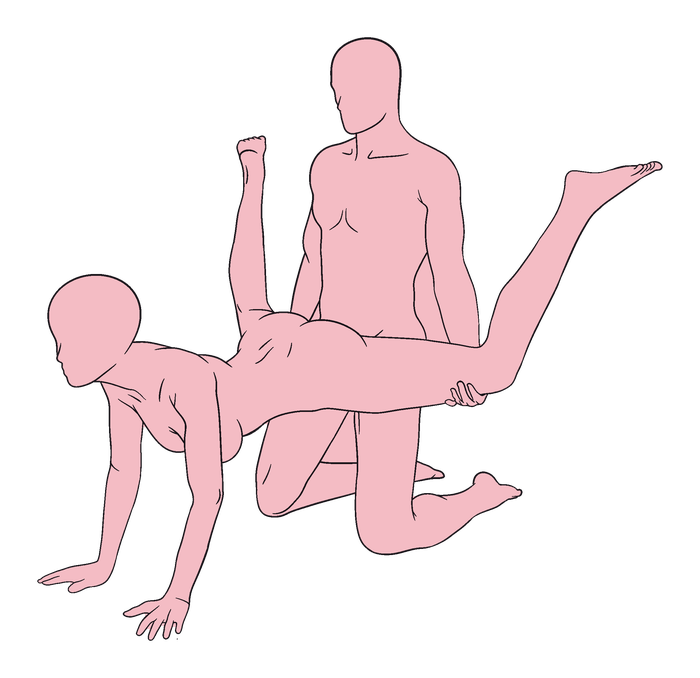
A wheelbarrow held at a kneeling partner's lap, legs split wide in the air with one thigh supported.
Piledriver
The most demanding position in this glossary: the receiving partner's hips are elevated above their head and shoulders, more folded and inverted than mating press, with weight resting on the upper back and shoulders rather than the hips.
It's genuinely advanced, usually done with support from furniture or a wall rather than freestanding, and comes with real considerations around neck loading, blood pressure, and flexibility that the earlier positions in this list don't. Not a first-time or casual-session position.
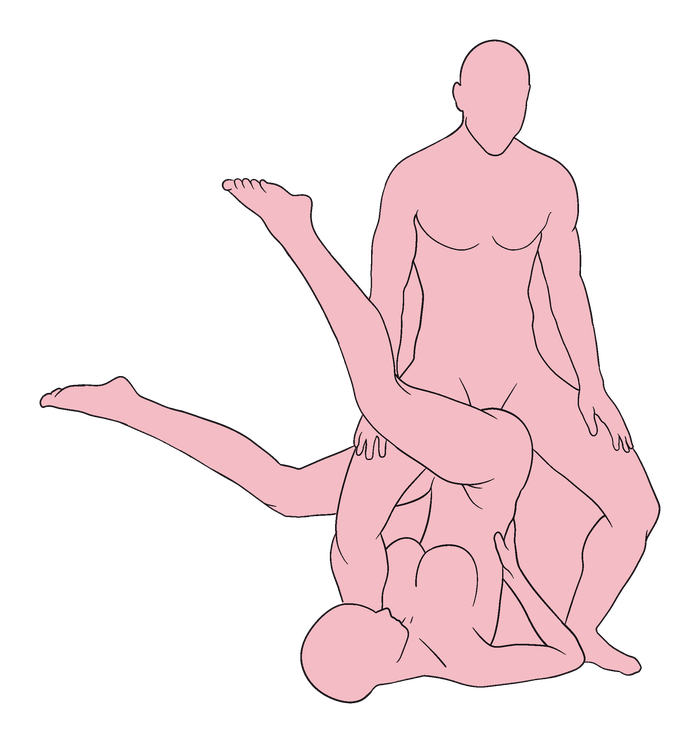
Hips elevated above head and shoulders — the most inverted, advanced position in this glossary.
Reclined Lap Dance
The squatting partner holds a low seated squat with knees wide and feet planted, as if sitting on a chair that isn't there, while the receiving partner reclines back across their lap facing away, spine arched and head dropped fully back.
The receiving partner's legs extend down to the floor in front and their arms reach toward the ground for balance, with the squatting partner's hands supporting the hip and lower belly. Holding an unsupported squat under a partner's weight is a serious strength demand, and the deep backbend loads the receiving partner's neck and spine — a sturdy chair or bench underneath makes it far more workable.
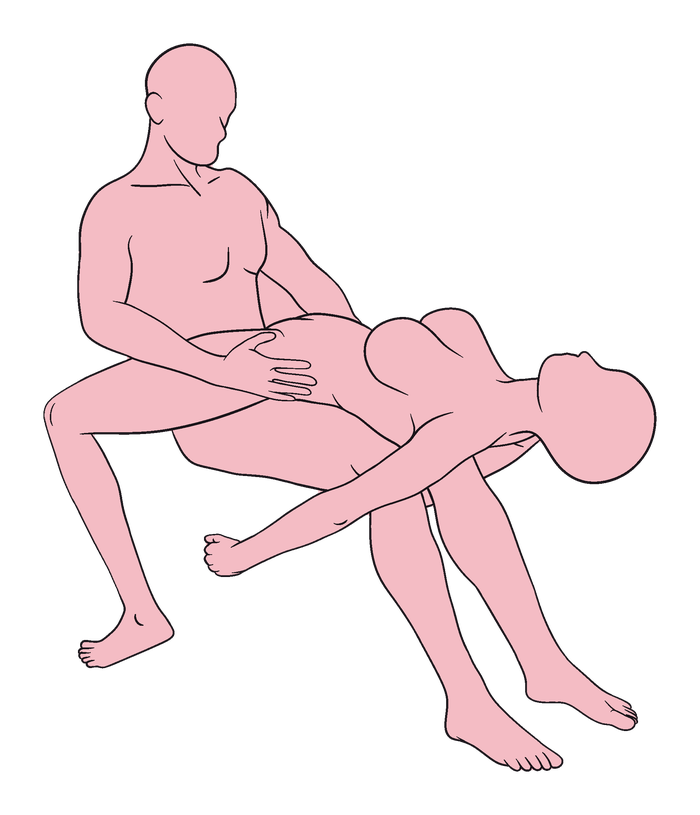
The receiving partner arches back across a squatting partner's lap, head dropped back, limbs reaching to the floor.
Split Handstand
The receiving partner is inverted with both hands on the floor and hips lifted to the standing partner's pelvis, legs split wide — one pointing straight up past the standing partner's shoulder, the other extended out horizontally and supported under the thigh by their hand.
The standing partner stays upright behind, holding the split steady. Stacking a wide split on a full inversion demands serious flexibility and arm strength, so ease in and don't hold it long.
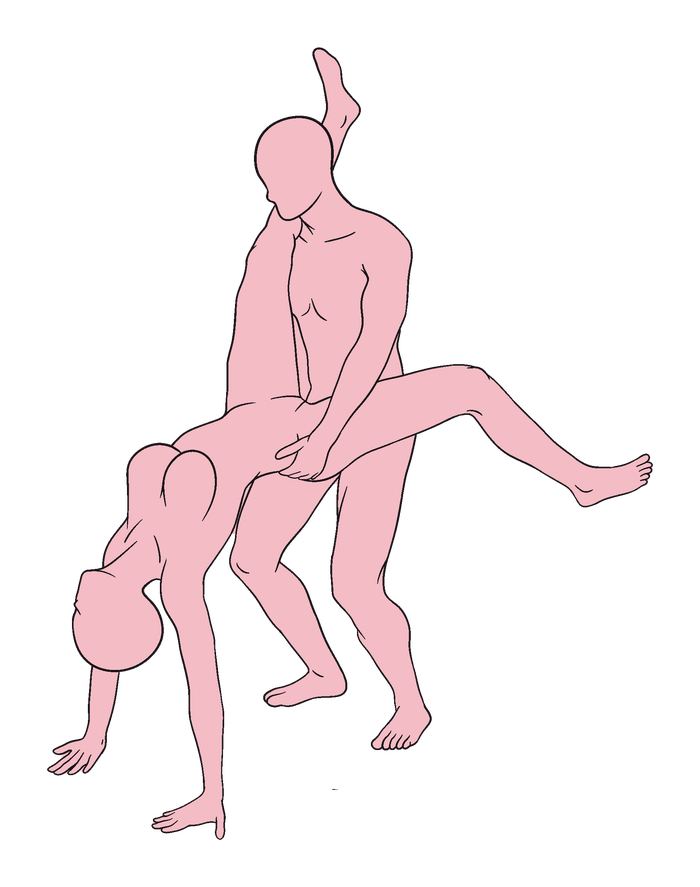
An inverted split: hands on the floor, hips at the standing partner's pelvis, one leg up and one held out level.
Squatted Reverse Pile Driver
The receiving partner lies with head, shoulders and upper back on the floor, hips rolled up high and legs extended up past their head, feet in the air, while the other partner squats over the upturned pelvis facing away from the receiving partner's face, feet planted flat on either side.
Both hands grip the raised buttocks as the squatting partner thrusts downward — the reversed facing is what separates this from the forward-facing squatting version. The fold carries significant neck and inversion load for the receiving partner, so build up to it gradually and stop at any sign of neck strain.
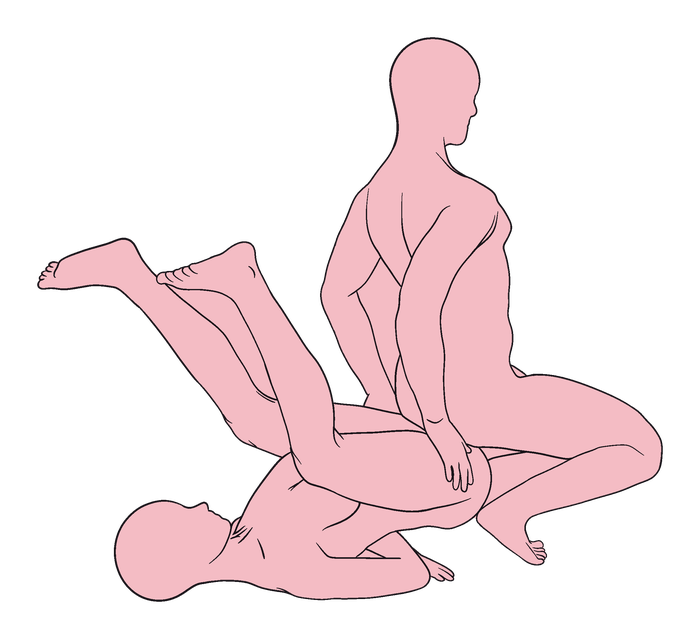
An inverted fold with the other partner squatting above, facing away, gripping the raised hips for downward entry.
Squatting Pile Driver
The receiving partner rests on their upper back and shoulders with hips raised vertically and legs lifted and spread in the air, while the other partner squats above the raised pelvis facing them, feet flat on the floor on either side and hands braced on hip and thigh.
This is a true inversion: weight sits on the receiving partner's neck and shoulders while the squatting partner holds a deep squat, so it demands strength and balance on one side and tolerance for neck load on the other. Ease in, keep the weight on the shoulders rather than the neck, and come out slowly.
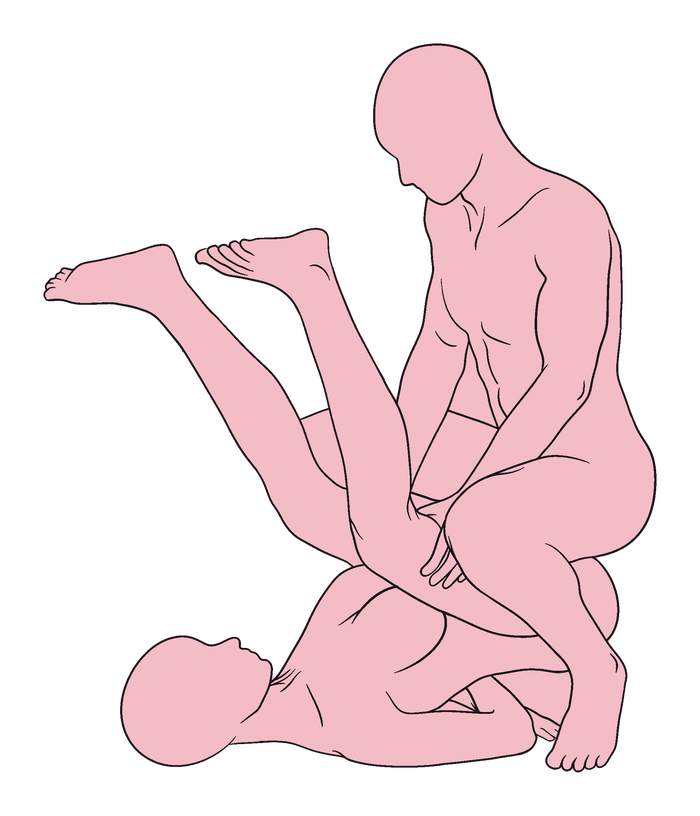
The receiving partner inverts onto their shoulders, hips vertical, while the other partner squats above facing them.
Squatting Reverse Pile Driver
The receiving partner is folded sharply forward, face down with arms hanging toward the floor, while their hips lift high against the pelvis of the other partner, who squats behind and above them gripping the hips with both hands; the legs rise into the air on either side of the squatting partner, one extended high.
Entry is from behind and above. Between the head-down fold and the deep squat, this carries real neck and inversion load and asks for balance from both partners — ease in and come down at the first sign of strain.
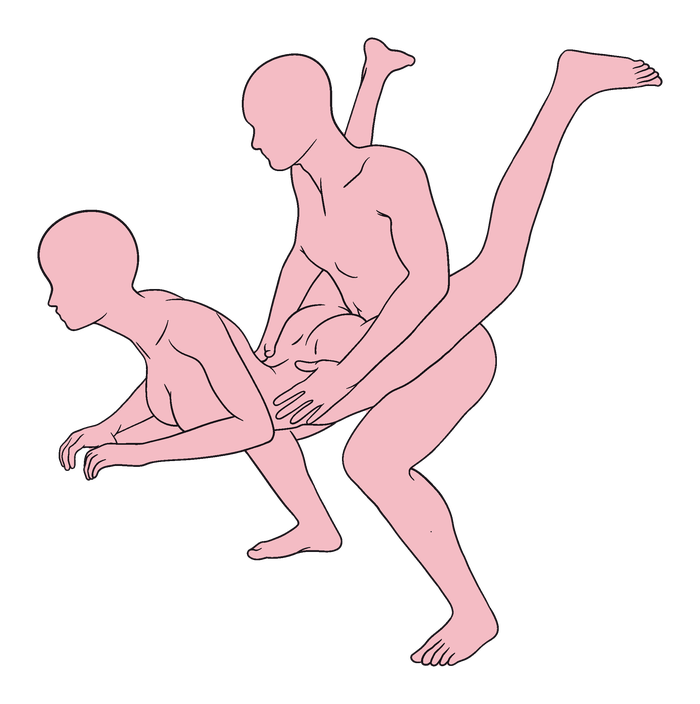
Folded face-down with hips lifted high, the receiving partner is entered from behind and above by a squatting partner.
Standing Doggy Raised
The receiving partner leans far forward with both palms flat on the floor and arms straight, hips lifted off the ground and held at the pelvis of the other partner, who stands behind with knees bent.
The receiving partner's legs raise and hook around or alongside the standing partner's thighs, one foot extending behind them — essentially a wheelbarrow take on standing doggy. It loads the receiving partner's arms and shoulders and the standing partner's grip, so ease in and set down before wrists or hold start to tire.
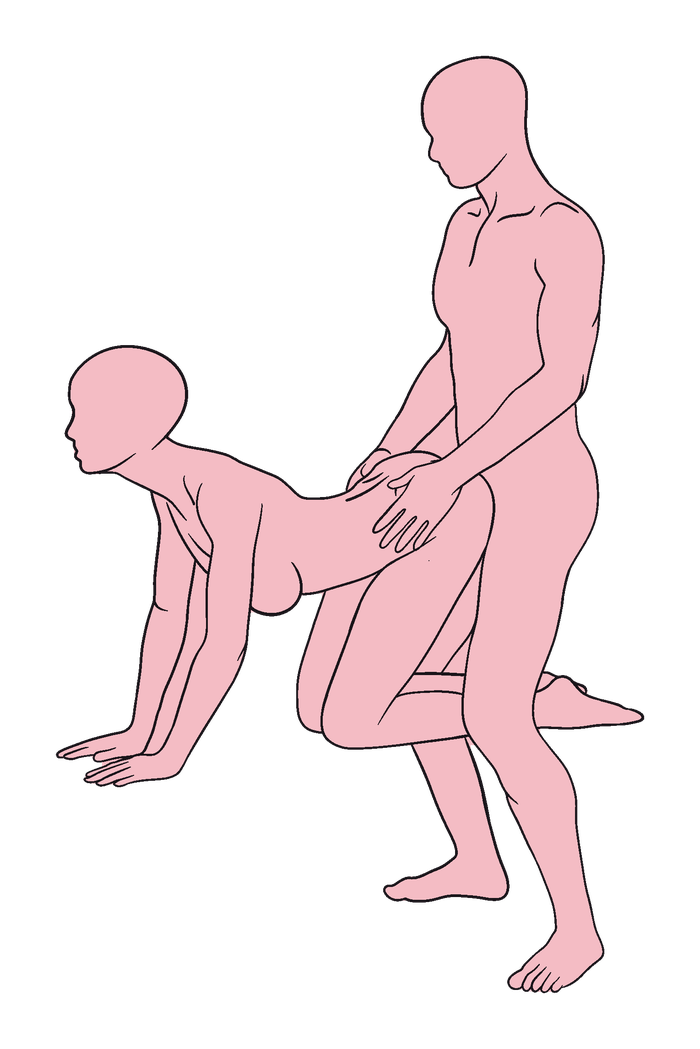
A wheelbarrow-style raised doggy: palms flat on the floor, hips held at the standing partner's pelvis, legs hooked around their thighs.
Standing Pile Driver
The receiving partner holds a shoulder stand with head and shoulders on the floor and torso vertical, legs extended out horizontally in front of the standing partner in a scissored split.
The standing partner bends slightly forward, gripping the receiving partner's hips against their pelvis and entering from above. The inversion loads the neck and shoulders heavily, so keep the weight on the shoulders, build up gradually, and come down at the first sign of strain.
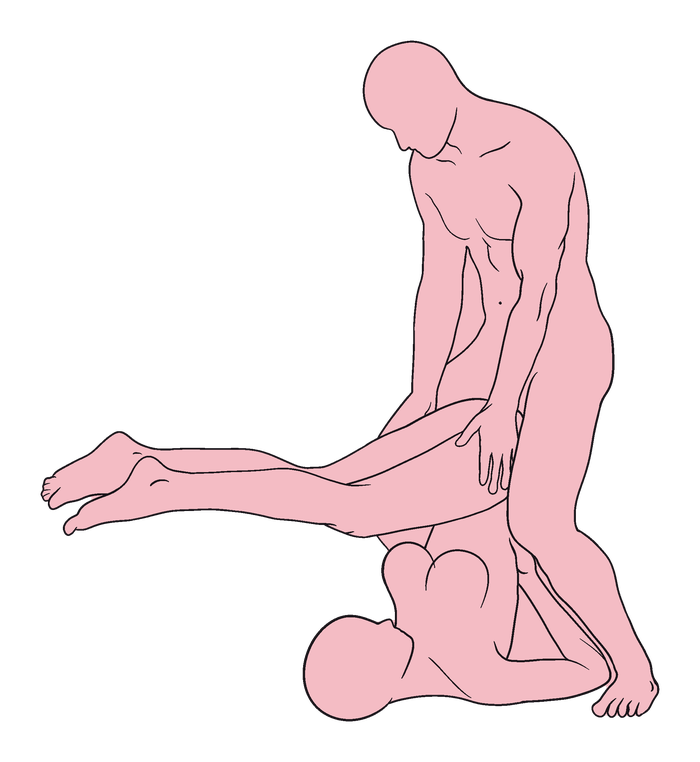
A shoulder-stand inversion with legs extended out level in front — entry from above. Mind the neck.
Standing Reverse Pile Driver
The receiving partner jackknifes onto their shoulders with head on the floor, hips raised, and both legs held straight and extended horizontally forward. The standing partner stands over the raised hips facing the same direction as the legs, knees bent and body hunched forward to enter from above.
As with any inverted position, the neck takes real load, so ease in slowly and keep the weight on the shoulders rather than the head.
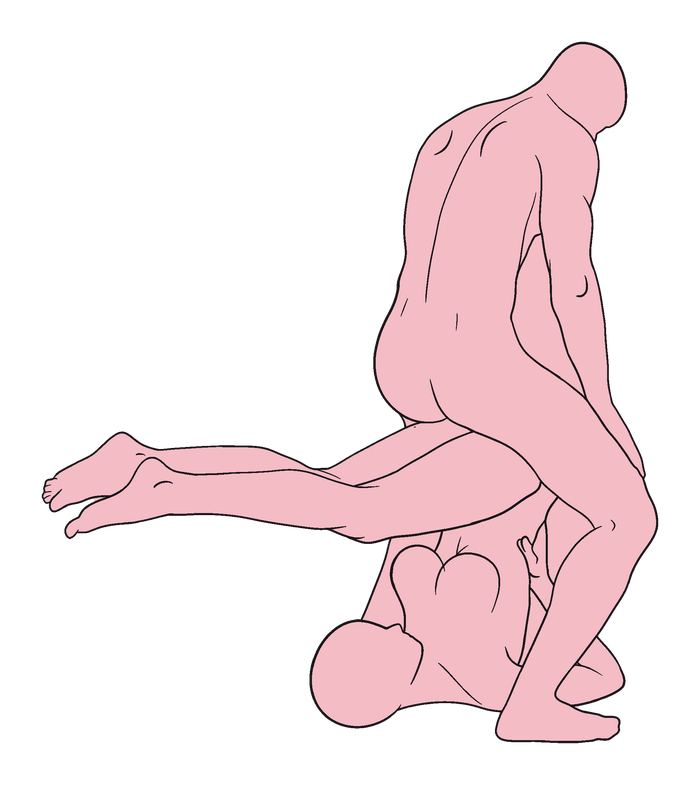
Jackknifed on the shoulders with legs straight out forward while the standing partner enters from above, facing the same way.
Wheelbarrow
The receiving partner takes a near-handstand facing away from the standing partner, both hands flat on the floor with the body steeply inclined and hips raised to the standing partner's pelvis.
The legs extend upward in a wide split — one foot high in the air, the other rising past the standing partner's shoulder — while the standing partner grips the hips and buttocks for support. Between the inversion, the arm strength, and the split, this is an advanced hold; ease in, keep it brief, and mind the neck coming out.
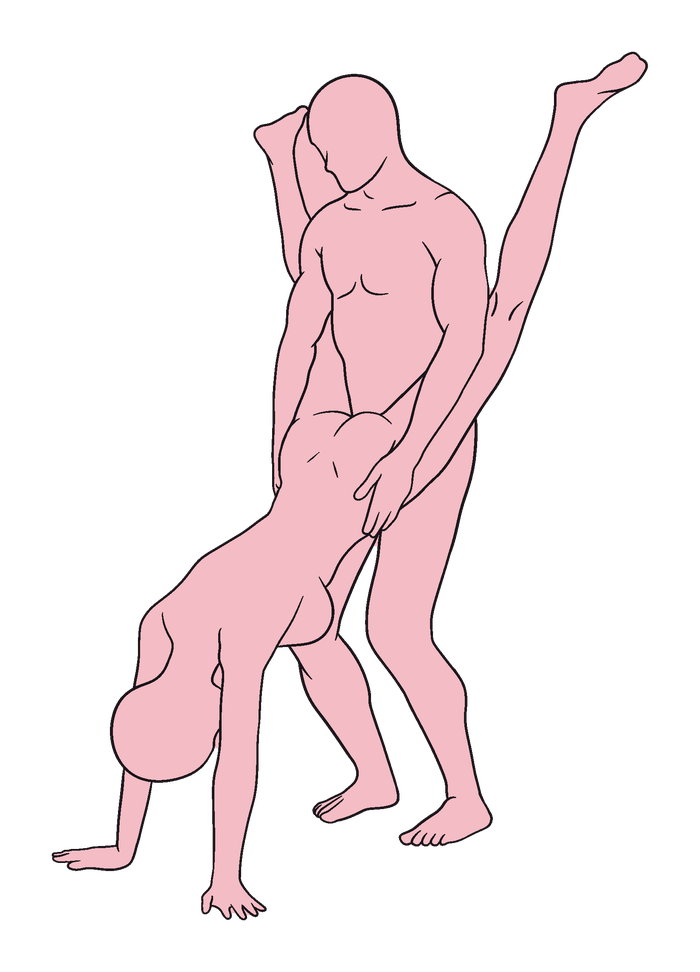
Near-handstand facing away from the partner, legs in a wide upward split, hips gripped and supported from behind.
Downward V
The receiving partner holds a handstand, hands flat on the floor and head down, with their back pressed against the standing partner's front while the standing partner holds their hips at pelvis height.
The receiving partner's bent legs hang forward against the standing partner, a foot hooking near their knee. This is a full inversion with real load on the arms and shoulders, so keep it brief and come upright slowly.
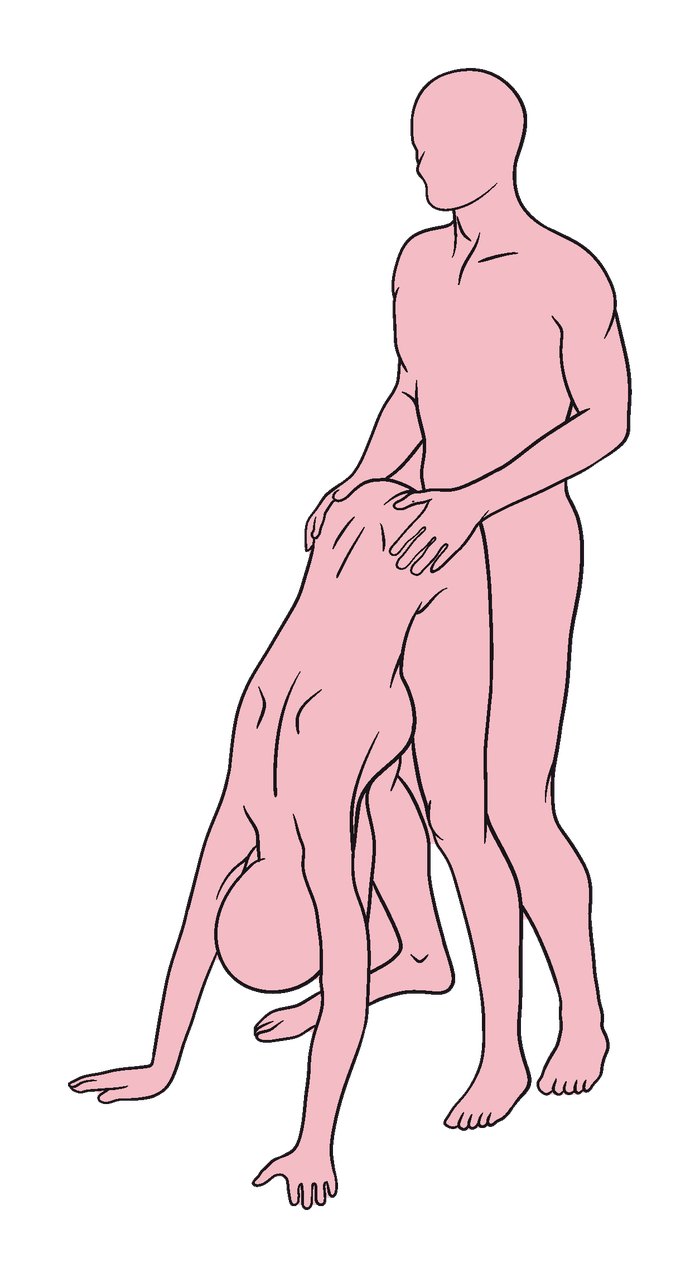
A supported handstand against the standing partner's front, bent legs hanging forward against them.
Quick reference: more named positions
Shorter entries for names that come up often but don't need a full walkthrough or diagram to describe clearly.
- Monkey: the receiving partner squats over the other partner, who's seated or lying down — squatting gives the partner on top control over depth and pace.
- Frog: a lower, closer-to-the-ground squatting variant than monkey, with both partners nearer the floor or bed rather than one elevated above the other.
- Face-off: both partners seated, facing each other, one in the other's lap — close, low-effort, doesn't need much space or any equipment.
- Anvil: legs pushed back further than mating press, deeper into the fold — the most flexibility-dependent position in the "legs pushed back" family after seashell.
- Seashell: the deepest fold of the group, legs pressed back furthest — genuinely advanced, and only worth attempting once mating press and anvil both feel comfortable.
- Triceratops: a leapfrog-adjacent rear-entry variant with the head and chest lowered close to the ground — a novelty name, but describable enough to include.
- Clothespin: commonly refers to keeping the legs pressed together during penetration rather than spread apart, for a tighter feel — not to be confused with clothespins the object, which show up in bondage and sensation play as a clamp-style tool, a completely different meaning of the same word.
- Superman: a viral name for an inversion position where the receiving partner is held largely horizontal in the air, supported only by the other partner's arms and strength. Realistically, it demands serious strength and carries real injury risk for most people — worth knowing the name exists, not necessarily worth attempting without real caution, a spotter, and a much lower bar for "let's stop."
- Bridge: the receiving partner arches their hips up off the surface, weight on shoulders and feet — similar to a yoga bridge pose — while the other partner kneels at hip height. A real core and hamstring workout in addition to everything else; worth trying briefly before committing to a full session in it.
- Snow angel: the receiving partner lies flat on their back with arms and legs spread out to the sides, like making a snow angel, rather than wrapped around the other partner. A simple, low-effort variation on missionary that changes the visual and the amount of body contact rather than the mechanics.
- Spider: both partners seated facing each other with legs crossed or interlaced rather than wrapped around — a tangled-limbs variant of face-off, close contact without much room needed.
- Bulldog: a rear-entry variant that sits between standard all-fours and leapfrog — chest and head lower than a straight-armed doggy-style position, but not as flat as leapfrog.
- Lazy dog: functionally very close to leapfrog — a lower-effort, chest-down rear-entry variant. Different name, same basic idea; if you've already read the leapfrog entry above, you've effectively read this one too.
- Bear hug: standing or seated, wrapped in a full-body embrace with minimal space between torsos — a closer, tighter variant of face-off or standing, defined more by the embrace than any specific angle.
- Pretzel dip: the receiving partner lies on their side while the other partner kneels or lies perpendicular, one leg crossing over the receiving partner's — a side-entry variant, angled between a spooning-style side-lie and a fully perpendicular position.
- Scorpion: the receiving partner lies face down, propped on their forearms with hips raised and legs bent back toward their own head, while the other partner kneels behind — a flexibility-dependent rear-entry variant in the same family as anvil and seashell, worth easing into rather than forcing.
- Eiffel Tower: unlike everything else on this list, this one describes a three-person configuration, not a two-person position — two partners penetrating a third from either end simultaneously, arms raised to meet in the middle. It's a real, commonly referenced term, but it's a group-sex position specifically, which is outside the two-partner scope this glossary otherwise covers — included here only so the name itself doesn't go unexplained.
Positions for deeper penetration
If this is what you're actually looking for, it's less about one specific name and more about a family: mating press, anvil, and seashell all push the legs back progressively further for a deeper, more face-to-face angle, while piledriver achieves depth through elevation and control instead.
All of them ask more of the receiving partner's flexibility (or the other partner's strength) than the easier entries in each family, so it's worth being comfortable with mating press before working toward anvil or seashell, rather than starting there.
Shower sex: practical adaptations, not one fixed position
"Shower sex positions" gets searched a lot, but it's less about a specific named position and more about adapting simple, low-balance positions to a slippery, upright environment. A few things matter more here than which position you pick:
- A non-slip mat or textured surface reduces the single biggest real risk, which is falling.
- Standing positions with a wall or grab bar to hold onto are far more stable than anything requiring balance without support.
- Soap and most body washes strip natural lubrication and can disrupt vaginal pH, so a water-safe lubricant (see our lube guide) is worth having in the shower rather than assuming water is enough.
Simpler beats ambitious here — standing, facing each other or from behind, covers most of what people are actually looking for with this search.
Couch, chair, and other furniture sex
Like shower sex, this is really about adapting positions to furniture rather than one specific named position. A couch or chair changes what's actually available:
- Sitting height puts a seated partner at a convenient angle for a standing or kneeling partner.
- The armrest or back cushion can substitute for a wall when a standing position needs something to lean on.
- A firm chair, rather than a soft, sinking couch cushion, generally gives more stable footing than people expect.
The main practical adjustment versus a bed is that furniture edges and arms are harder and less forgiving — a folded blanket or cushion under knees or hips solves most of the discomfort furniture sex actually causes.
On names without a real definition behind them
A few position names get searched often enough that leaving them out entirely would mean pretending the search doesn't exist — but some genuinely don't have one consistent, real technique behind them.
- "67" or "statue of liberty": internet jokes riffing on other terms or images rather than references to an actual established position — different sources online describe them completely differently or not at all.
- "Dragon": falls in the same bucket. It shows up across a few sites with a few different, inconsistent definitions, which is a sign no single one is actually standard.
- "Starfish": isn't a position at all; it's slang for a partner who lies still and passive during sex, spread out like the animal, usually used critically rather than as an instruction.
- "Jackhammer": describes a pace and intensity — fast, hard, minimal variation — that gets applied to missionary, doggy-style, or piledriver-family positions, rather than naming a distinct configuration of its own.
Rather than inventing a confident-sounding definition to fill space, we're saying so directly: if you searched for one of these expecting a real how-to, that's the honest answer.
A note on the Kama Sutra
The Kama Sutra is a real, centuries-old Sanskrit text that includes named positions of its own, predating internet-era slang naming by a very long time.
It's a genuinely different tradition from the modern colloquial names covered above, and worth knowing about separately rather than folded into this list — this glossary sticks to the names people actually search for today rather than attempting a full historical catalog.
Which one to actually try first
If none of these are familiar territory, missionary and cradle are the easiest entry points in the whole glossary — or use the Easy filter above to see every position that asks for no particular flexibility or strength.
The rear-entry and on-top families are the most forgiving places to explore next, standing positions ask more of your balance, and the inversions family deserves real caution rather than casual experimentation.
For something lower-effort to start with instead, our Elevated Spoon guide is a gentler place to begin, and our decision guide by goal can help you figure out which direction to explore next.
What makes these positions easier
Clove's guides to the props and toys that pair well with the positions on this page.
The 14 products we actually own
Bought with our own money, used, and reviewed from real use. Everything else on the site is labelled "researched" instead.
- We-Vibe Chorus review
- We-Vibe Melt review
- OG Rose review
- plusOne Rose Arouser review
- plusOne Air Pulsing Arouser review
- Secret Kisses Rosegasm Twosome review
- Satisfyer Penguin review
- Xsara Violet 2-in-1 review
- NS Novelties Sugar Pop Aurora review
- CalExotics Clit Flicker Ring review
- Trojan Vibrations lineup review
- Liberator Wedge & Ramp review
- The Adventure Challenge ...In Bed review
- K-Y Liquid review
Frequently asked questions
What are some sex position names?
Well-established named positions include missionary, doggy style, cowgirl and reverse cowgirl, standing, mating press, piledriver, and 69, among many others. This glossary covers 113 real, physically describable named positions rather than novelty filler.
What is the easiest sex position to start with?
Missionary needs the least flexibility, strength, or setup of any position in this glossary. Standing is a reasonable next step, and doggy style is another low-effort, widely used default.
What is considered the deepest sex position?
Mating press pushes the legs back furthest for depth through angle alone, while piledriver reaches similar depth through elevation and control instead. Both require real flexibility and shouldn't be a first attempt at a deep position.
How many sex positions are there?
There's no fixed number — position names are largely informal and overlapping, with new ones coined regularly. This glossary sticks to 113 names that have a real, consistent, physically describable technique behind them, rather than attempting to catalog every variant.
Get the free Clove starter guide
The easiest positions to try first, lube basics and our tested picks, sent to your inbox. Then one practical guide a week. No spam, unsubscribe anytime.