
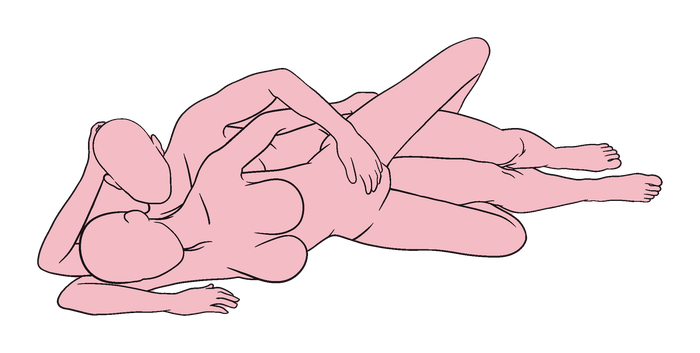
Side-lying, stacked and facing the same direction — propping the front partner's top leg on a pillow opens the hips further.
Why this variation
Standard spooning is already one of the lowest-energy positions there is, which makes it a good default when someone is tired, unwell, pregnant, or just not in the mood for anything that requires much movement. The one common complaint is angle: lying flat on your sides can make things harder to align comfortably. Elevated Spoon fixes that with one small change.
Setup
- Lie on your sides, front to back, in the standard spooning position.
- The partner in front bends their top leg forward and rests it on a pillow, opening the hips slightly rather than keeping both legs stacked flat.
- The partner in back can prop their own upper body slightly on an elbow or a wedge pillow, which gives a little more control over depth and angle without much extra effort.
- A pillow under the front partner's head and another between or under the knees takes pressure off the lower back and hips, especially useful in later pregnancy.
What it's good for
- Low energy days, illness, or recovery, where movement should stay minimal.
- Later pregnancy, since neither partner needs to put weight on the other or on the belly.
- Slower, more intimate pacing — this position doesn't lend itself to speed, which some couples find is exactly the point.
- Mismatched height or size, since side-lying is more forgiving than positions that require close alignment of hip height.
Adjustments
For more sensation: the front partner can reach back or down for manual or toy stimulation, since both hands stay free in this position.
For a different angle: the back partner shifting their hip height up or down slightly (using a pillow underneath themselves) changes the angle more than moving legs does.
For mobility limitations: this is already one of the more accessible positions, but a wedge pillow under the front partner's whole upper body can reduce the need for either partner to hold themselves up.
Communication note
Because this position is slower and less visually driven than face-to-face options, it's an easy one to talk during — worth using if pace or pressure needs adjusting, since neither partner has to stop moving to make eye contact first.
What makes these positions easier
Clove's guides to the props and toys that pair well with the positions on this page.
Get the free Clove starter guide
The easiest positions to try first, lube basics and our tested picks, sent to your inbox. Then one practical guide a week. No spam, unsubscribe anytime.