

Every position in this family shares two mechanical facts: nobody carries a partner's weight, and the legs do the work that stacked torsos do elsewhere. Whether they're interleaved, draped over a hip, or crossed at the pelvis in the scissor arrangement, the legs set the entry angle and supply most of the pressure — which is why the native motion here is a rock or a grind rather than a full stroke, and why most of these hold comfortably for far longer than anything that involves supporting another person.
That profile is exactly what makes side-lying the family for tired nights, for pregnancy — weight stays off the belly, and the positions work lying down rather than braced up — and for partners with a meaningful size difference, since the leg arrangement does the aligning that matched torso lengths would otherwise have to. It's a small family: one true spoon, one flat X, and six takes on the scissor interlace. The raised-hip spoon variant, Elevated Spoon, has a dedicated guide of its own and isn't repeated here.
The list runs easiest to hardest. The front half asks nothing beyond lying or sitting down; from Leg Up Scissors onward, the receiving partner's raised leg becomes the difficulty dial, going higher with each entry and losing its support in the last. When one of the later positions strains, lower the leg or move back an entry — the interlace mechanic is the same all the way down, so you lose the stretch, not the position.
The positions
Facing Spooning
The family's starting point: both partners on their sides, the floor holding everything, the draped upper leg doing the aligning. Because the leg — not torso length — sets the fit, it absorbs a height difference gracefully, and it's the obvious first pick for late pregnancy or a night when nobody has energy to spend. Pay attention to how moving that draped leg changes the angle, because every scissor entry below is the same idea taken further. Full entry in the glossary.
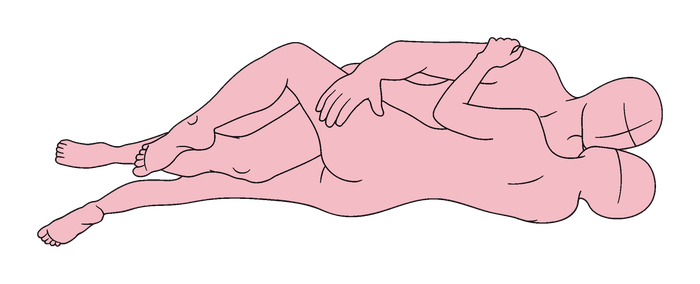
Side-lying and face-to-face, legs interleaved with the upper leg draped over the partner's hip.
X Position
Contact narrows to the joined pelvises and the clasped hands — both partners lie flat on their backs with nothing lifted or stretched. That makes it the pick for hot nights or low energy, when even facing spooning is more body heat than you want. The trade is motion: neither partner can thrust from flat, so everything comes from rocking and the pull of the hands, and it should be treated as a slow position by design. Full entry in the glossary.
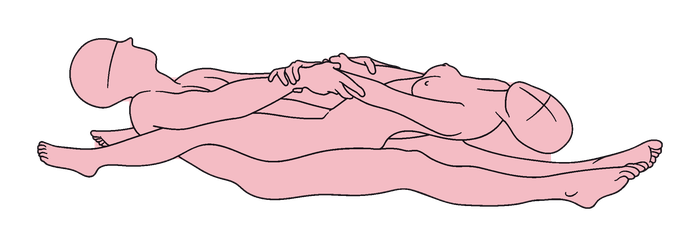
Both partners lie flat in opposite directions, pelvises joined and legs interleaved, hands clasped over the receiving partner's stomach.
Facing Scissors
The seated doorway into the scissoring half of the list: chest to chest, legs interlaced, one knee up, movement small and grinding. It asks nothing beyond sitting comfortably with legs woven together, so use it to find out whether the grinding mechanic suits you before working further down. If a full stroke is what you're after, this branch of the family will frustrate you — that's a mismatch, not a technique failure. Full entry in the glossary.
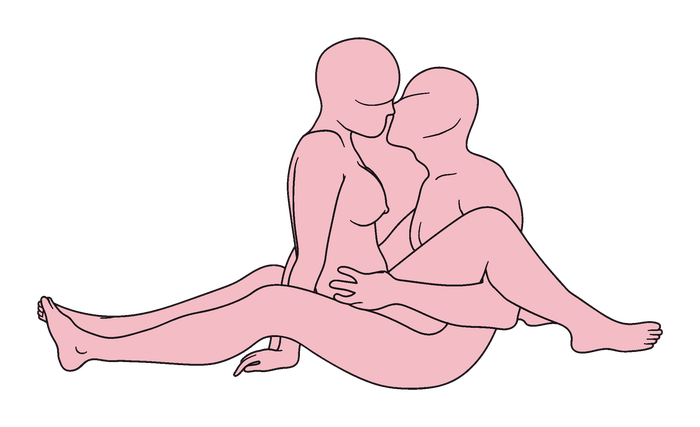
Seated chest to chest, legs interlaced with one knee up — small, grinding movement.
Sitting Penetration Scissoring
Bodies at a right angle, the other partner seated and steering while the receiving partner just lies back — a fair split when one partner has energy and the other doesn't. The seated partner can adjust the interlace by hand instead of repositioning whole bodies, which makes this a good place to learn what the crossed-legs angle actually changes. The mildly raised leg previews the flexibility ask that the last three entries turn into a real gate. Full entry in the glossary.
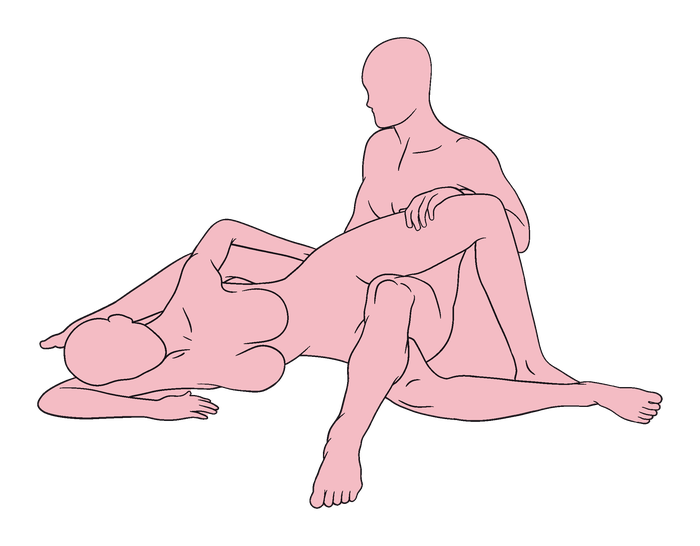
A seated, penetrative scissoring shape — bodies at right angles, legs interleaved at the pelvis.
Leg Up Scissors
The first entry where flexibility starts to matter: one of the receiving partner's legs goes up against the seated partner's chest, and the hamstring decides how far it gets. A soft bend at the knee keeps the angle without the strain, and staying bent indefinitely is a fine outcome. How this one feels is diagnostic — comfortable here means the last two entries are within reach; strained here means this is the rung to stop at. Full entry in the glossary.
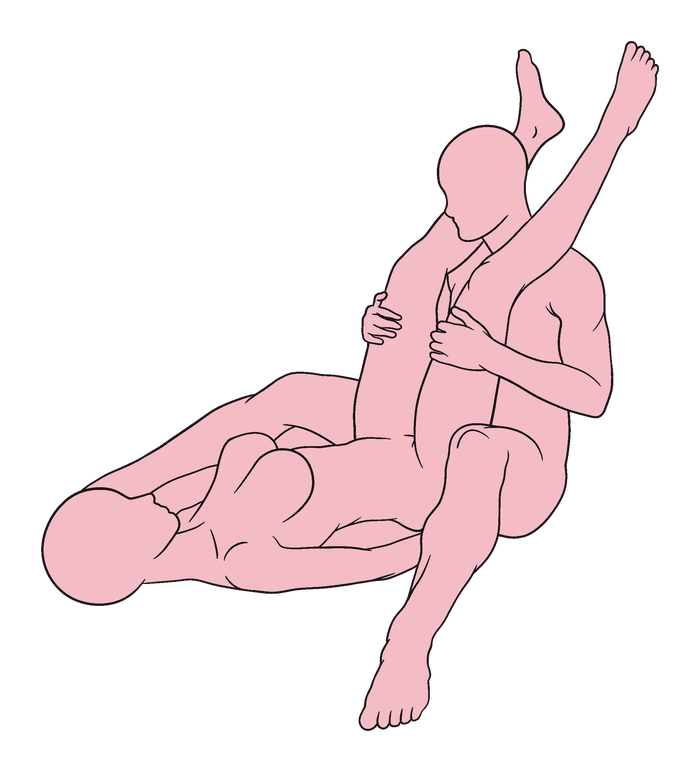
Legs interlocked scissor-style, the sitting partner holds the receiving partner's raised leg against their chest and shoulder.
Upright Penetration Scissoring
The same interlock as Leg Up Scissors with the other partner kneeling tall instead of sitting, which shifts control of pace and angle to them. The vertical leg is a longer hamstring reach than the seated version, so treat this as the step up rather than a sideways variation. Warm up before it, and drop back to the seated version whenever the raised leg starts fighting you. Full entry in the glossary.
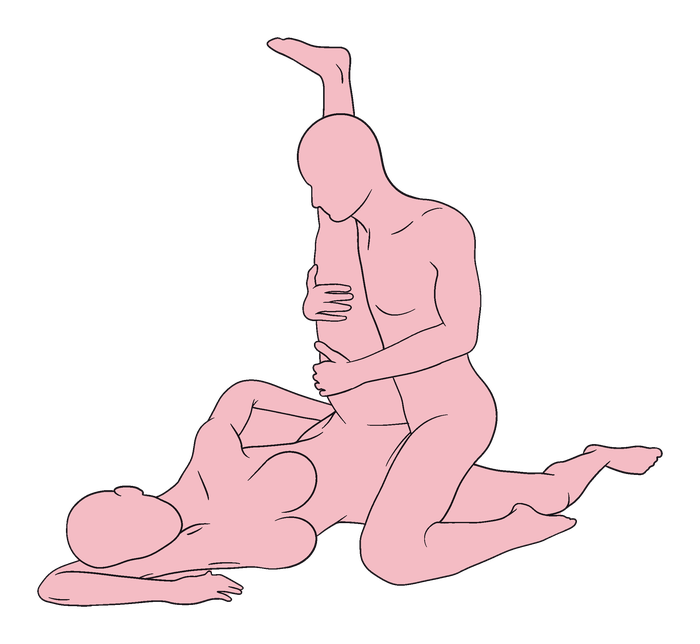
Scissoring with one leg flat and one held straight up the kneeling partner's chest, bodies at right angles.
Lying Penetration Scissoring
The same split as the previous entry — one leg straight up, one flat along the floor — but the other partner lies curled crosswise at the hips, so no seated torso supports the raised leg. Holding the leg up unassisted is where the extra difficulty lives; the stretch itself still gates on hamstring and inner-thigh range. Open toward the full spread in stages over a session, and step back one entry the moment the stretch turns from deep to sharp. Full entry in the glossary.
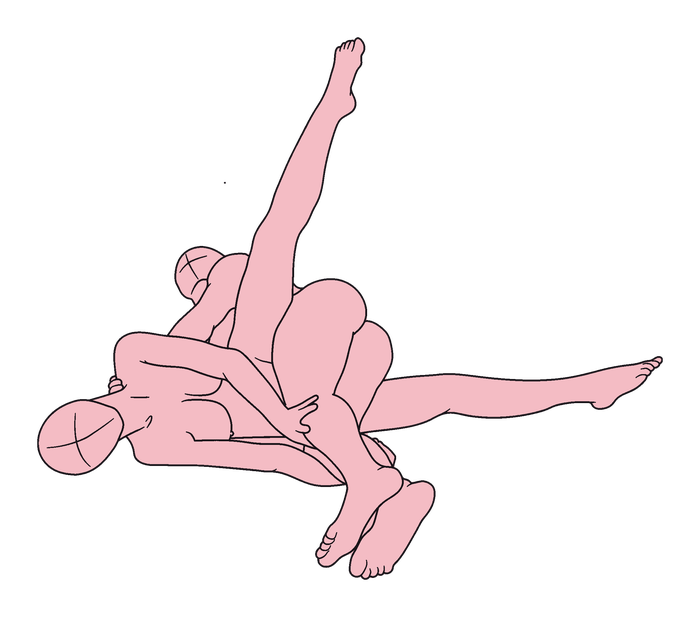
One leg straight up, one along the floor — the other partner lies curled crosswise at the receiving partner's hips.
Before you try these
- A pillow between the knees is the cheapest fix — hips misaligned in a side-lying position usually need height, not effort. A firm pillow under the top knee or between the thighs sets the angle without anyone holding a shape.
- Sort out the bottom arm before you start — it goes numb quietly in any side-lying position. Extend it overhead or slide it under the pillow first, rather than excavating it mid-session.
- Rock, don't stroke — the leg interlace trades thrusting range for pressure, and that's the deal across most of the family. If you're fighting for depth, you're fighting the design; move together from the hips instead.
- The raised leg is the difficulty dial — the back half of this list is the same scissor idea with the leg taken higher, then wider. Bend the knee or lower the leg before abandoning a position that almost works.
- Pregnancy narrows the list, it doesn't rule it out — side-lying keeps weight off the belly, which is why this family gets recommended for it. Skip the face-down entry, and limit long stretches flat on the back in later trimesters.
What makes these positions easier
Clove's guides to the props and toys that pair well with the positions on this page.
Get the free Clove starter guide
The easiest positions to try first, lube basics and our tested picks, sent to your inbox. Then one practical guide a week. No spam, unsubscribe anytime.