


Face to face, close contact — small adjustments to angle and hip height change depth and pressure.
What the missionary position is
Missionary is a face-to-face position: the receiving partner lies on their back, and the other partner is on top, facing them, supporting their own weight rather than settling fully down. It's the default most people learn first, largely because it needs no flexibility, no equipment, and no discussion to fall into.
Why missionary works
Missionary gets treated as the "basic" position, but that reputation undersells it. Face-to-face contact makes it one of the easiest positions to read a partner's expression and reactions in real time, it doesn't require unusual flexibility or strength from either person, and it's genuinely adjustable — small changes to hip height, leg position, or hand placement shift the angle and sensation more than people expect from something that looks so simple.
Setup
- The receiving partner lies on their back, knees bent, feet flat on the bed.
- The other partner positions themselves on top, facing them, supporting their own weight on their arms or forearms rather than settling fully onto the other person.
- The receiving partner's hips can stay flat, tilt up slightly with a pillow underneath, or lift with knees drawn toward the chest — each changes the angle.
- The top partner adjusts hip height and distance to find an angle that works for both people, using short, controlled movement rather than large motion.
Five real variations
1. Wrapped Missionary
The receiving partner wraps their legs up and around the top partner's waist and lower back, one foot hooked high near the buttocks, hands gripping the top partner's upper back. It's the closest-contact version of missionary — no gap between torsos, and the legs do the work of pulling the two bodies together rather than staying flat on the bed. Full entry in the glossary.
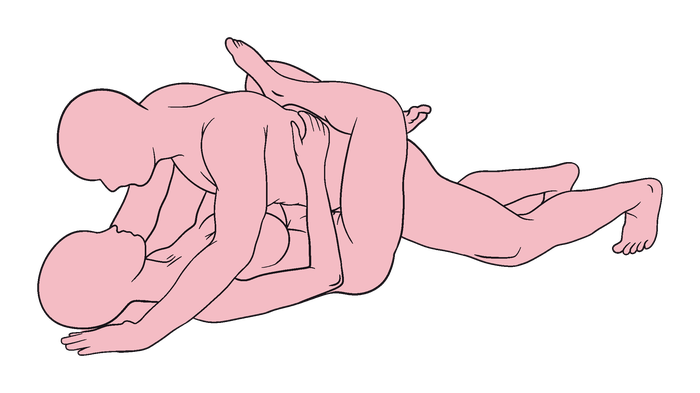
Missionary with the receiving partner's legs wrapped high around the top partner's waist and lower back.
2. Twisted Missionary
The receiving partner draws their knees up with both feet in the air, and the top partner settles in rotated roughly diagonal rather than square, chest low, torso and head extending off to one side so the two bodies cross in an X at the hips. The twist changes the friction angle without changing depth much, and a hand on the top partner's lower back helps keep the rotation steady. Full entry in the glossary.
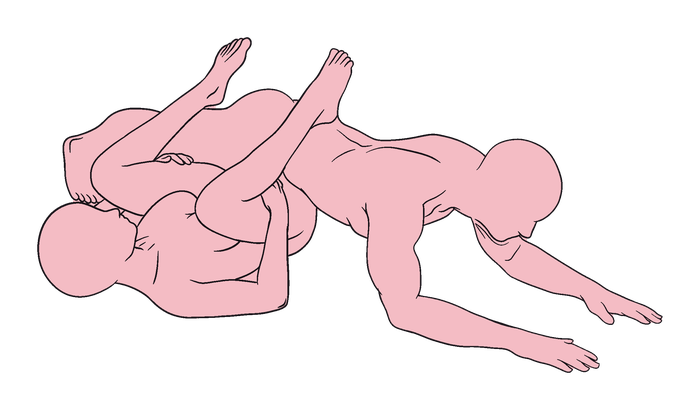
Missionary rotated onto the diagonal so the two bodies cross in an X at the hips.
3. Folded Missionary
The receiving partner raises both legs straight up together, ankles resting over one of the top partner's shoulders, while the top partner stays low over their chest, holding a thigh. It's a considerably deeper angle than flat missionary, and keeping the legs straight and stacked takes real hamstring flexibility — a soft bend at the knees is a fine place to start. Full entry in the glossary.
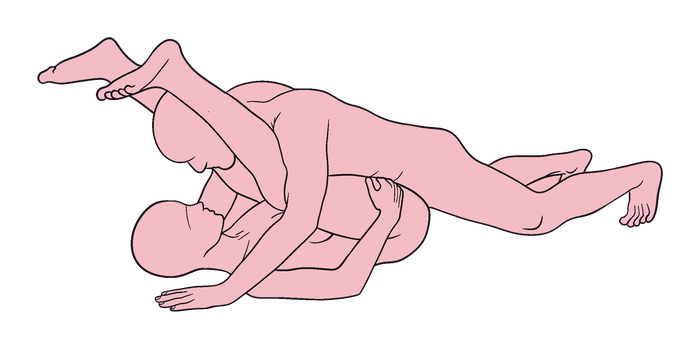
Both legs raised straight up together, ankles over one shoulder, the other partner lying extended on top.
4. Squatting Twisted Missionary
The receiving partner lies back with one leg extended out to the side and the torso twisted slightly toward the other partner, who squats low over them rather than lying flat, knees bent, weight carried forward on their own legs instead of settling down. One hand braces on the floor for balance, the other rests near the receiving partner's hip to keep the twist steady. It's the most active of the four, and asks real quad endurance from the squatting partner — drop back to a kneel when the legs tire rather than pushing through it. Full entry in the glossary.
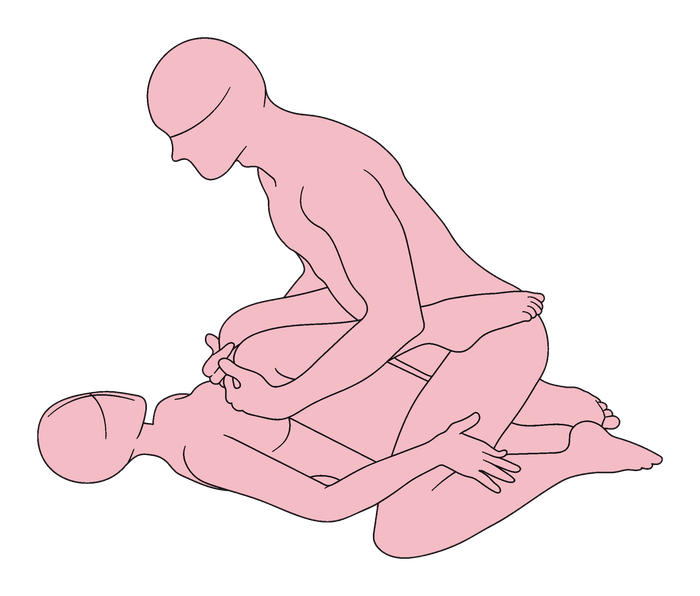
A low squat over a twisted, one-leg-out missionary base — more active than the lying version, with the top partner's legs doing the work.
5. Flat Missionary
The receiving partner keeps both legs straight and flat on the bed, together or just slightly apart, and the top partner's legs go outside them. Penetration is shallower than in standard missionary, but the closed thighs add pressure and friction where it counts, and a small pelvic tilt from the receiving partner (hips rolled up toward the ceiling, lower back pressed into the bed) brings the clitoris into much more contact. It's the lowest-effort version of the position and the easiest one on a sore back, because nobody holds a leg up. Skip it if depth is the goal; that's what Folded is for.
What it's good for
- Eye contact, kissing, and reading a partner's face — this is one of the most communicative positions by default.
- Couples who want a position that's easy to fall into without discussion, then adjust from there.
- Anyone recovering from something on their back, since the receiving partner does almost no physical work.
Adjustments
For different body sizes: a pillow under the receiving partner's hips is the single most useful fix for height or size mismatch, since it changes the angle without requiring either partner to hold an awkward position.
For low energy: the receiving partner can keep hips flat and legs relaxed, letting the top partner do the work with smaller, closer movements rather than large thrusts.
For extra support, the same pillow-under-hips principle shows up across a lot of positions, not just this one — see how sex pillows and props change angle and comfort for options beyond a standard bed pillow.
Communication note
Because missionary keeps both partners facing each other, it's an easy position to talk through in the moment — a quiet "a little higher" or "slower" lands naturally without breaking the mood. If missionary has started to feel routine rather than adaptable, that's usually a pacing or variation issue rather than a positional one; general tips for better sex cover more on keeping familiar positions from going stale.
What makes these positions easier
Clove's guides to the props and toys that pair well with the positions on this page.
The 14 products we actually own
Bought with our own money, used, and reviewed from real use. Everything else on the site is labelled "researched" instead.
- We-Vibe Chorus review
- We-Vibe Melt review
- OG Rose review
- plusOne Rose Arouser review
- plusOne Air Pulsing Arouser review
- Secret Kisses Rosegasm Twosome review
- Satisfyer Penguin review
- Xsara Violet 2-in-1 review
- NS Novelties Sugar Pop Aurora review
- CalExotics Clit Flicker Ring review
- Trojan Vibrations lineup review
- Liberator Wedge & Ramp review
- The Adventure Challenge ...In Bed review
- K-Y Liquid review
Frequently asked questions
What is flat missionary?
Flat missionary is the version where the receiving partner keeps their legs straight and flat rather than bent or raised, with the top partner's legs outside. It trades depth for tighter contact and friction, and a slight pelvic tilt from the receiving partner adds clitoral pressure.
What is the missionary position?
Missionary is a face-to-face position where the receiving partner lies on their back and the other partner is on top, supporting their own weight on their arms or forearms. It's the most common default position because it doesn't require flexibility or strength from either partner and keeps both people able to see each other's faces.
How do you do the missionary position?
The receiving partner lies on their back with knees bent and feet flat on the bed. The other partner positions themselves on top, facing them, weight on their arms or forearms rather than settled fully down. From there, hip height, leg position, and distance can all be adjusted to change the angle.
Can you do missionary standing up?
Yes — standing or wall missionary keeps the same face-to-face, front-entry structure but with both partners upright instead of on a bed, usually with the receiving partner's back against a wall for support. It trades some of the flat position's stability for spontaneity and a different angle.
How do you make missionary more intense?
Folded Missionary raises the legs straight up for a deeper angle, Wrapped Missionary pulls the two bodies closer together for tighter contact, and Twisted Missionary rotates the hips onto a diagonal for a different friction angle — each is a real named variation, not just a technique tweak.
Get the free Clove starter guide
The easiest positions to try first, lube basics and our tested picks, sent to your inbox. Then one practical guide a week. No spam, unsubscribe anytime.